

India’s top executives in NEOM to identify partnership opportunities

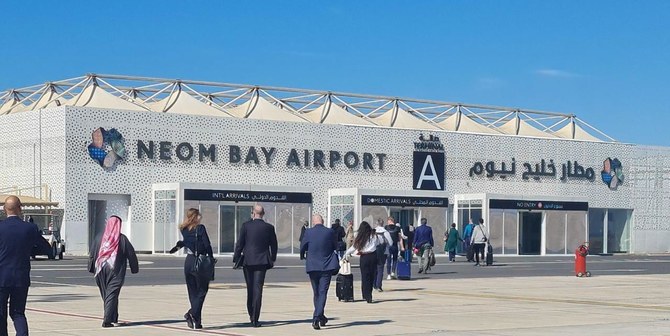
The Federation of Indian Chambers of Commerce and Industry arrives in Saudi Arabia's NEOM on Feb. 20, 2024. (FICCI)
Short Url
Updated 21 February 2024
Follow

India’s top executives in NEOM to identify partnership opportunities

  • FICCI-led delegation is visiting Saudi Arabia from Feb. 18 to 21
  • In NEOM, they met executives responsible for all ongoing projects

NEW DELHI: A delegation of chief executives from India’s top business body has visited NEOM to identify opportunities for cooperation under Saudi Arabia’s Vision 2030.

The Federation of Indian Chambers of Commerce and Industry is leading the delegation of CEOs and government officials to the Kingdom this week as businesses want to tap into the possibilities posed by Saudi megaprojects, including the flagship multibillion-dollar NEOM smart city.

“As the first Indian delegation to NEOM, comprising both private and government representatives, led by FICCI President Dr. Anish Shah, our members were looking for business opportunities for Indian companies,” FICCI Secretary General S.K. Pathak told Arab News.

“Many business deals would be the specific outcomes from this delegation visit to NEOM.”

Saudi-Indian ties gained new momentum last year throughout India’s presidency of the G20 and after the state visit of Saudi Crown Prince Mohammed bin Salman in September, during which officials signed an accord to boost mutual investment.

The delegation is visiting Saudi Arabia from Feb. 18 to 21 and has already held talks with Saudi Arabia’s Investment Minister Khalid Al-Falih, Energy Minister Prince Abdulaziz bin Salman and members of the Saudi-India Business Forum.

“The FICCI CEOs delegation met with the senior most ministers and large businesses in Riyadh on Feb. 19. The Saudi-India Business Forum with large businesses was very productive for CEOs on both sides. Now we shall leverage the warm ties between our countries and get into specific projects and investment and trade partnerships,” Pathak said.

“At least five specific areas in infrastructure, construction, energy, tourism and mobility are going to attain closure soon.”

In NEOM, he added, there were “trillion-dollar opportunities” at its numerous ongoing projects.

The delegation has met NEOM leaders and executives responsible for projects such as The Line linear smart city, the floating Oxagon city, the Torjena futuristic ski resort, TONOMUS — the world’s first ecosystem of cognitive technologies — and ENOWA, which leads the development of NEOM’s sustainable energy and water systems.

“We met NEOM leaders of all the above. FICCI and NEOM would be in regular touch for specific projects,” Pathak said.

“With top-level ties between PM Narendra Modi and the crown prince paving the way for people-to-people and business-to-business contact, we at FICCI foresee a very bright future for the next decade.”


Australia hits Afghan Taliban officials with sanctions, travel bans

Updated 06 December 2025
Follow

Australia hits Afghan Taliban officials with sanctions, travel bans

  • The Taliban has said it respects women’s rights, in line with its interpretation of Islamic law and local custom
  • The measures were part of a new Australian government framework that enabled it to “directly impose its own sanctions and travel bans to increase pressure on the Taliban, targeting the oppression of the Afghan people,” Wong said

SYDNEY: Australia on Saturday imposed financial sanctions and travel bans on four officials in Afghanistan’s Taliban government over what it said was a deteriorating human rights situation in the country, especially for women and girls.
Australia’s Foreign Minister Penny Wong said the officials were involved “in the oppression of women and girls and in undermining good governance or the rule of law” in the Taliban-run country.
Australia was one of several nations which in August 2021 pulled troops out of Afghanistan, after being part of a NATO-led international force that trained Afghan security forces and fought the Taliban for two decades after Western-backed forces ousted the Islamist militants from power.
The Taliban, since regaining power in Afghanistan, has been criticized for deeply restricting the rights and freedoms of women and girls through bans on education and work.
The Taliban has said it respects women’s rights, in line with its interpretation of Islamic law and local custom.
Wong said in a statement the sanctions targeted three Taliban ministers and the group’s chief justice, accusing them of restricting access for girls and women “to education, employment, freedom of movement and the ability to participate in public life.”
The measures were part of a new Australian government framework that enabled it to “directly impose its own sanctions and travel bans to increase pressure on the Taliban, targeting the oppression of the Afghan people,” Wong said.
Australia took in thousands of evacuees, mostly women and children, from Afghanistan after the Taliban retook power in the war-shattered South Asian country, where much of the population now relies on humanitarian aid to survive.