

Gaza death toll rises to 29,313, Rafah residents killed in strike

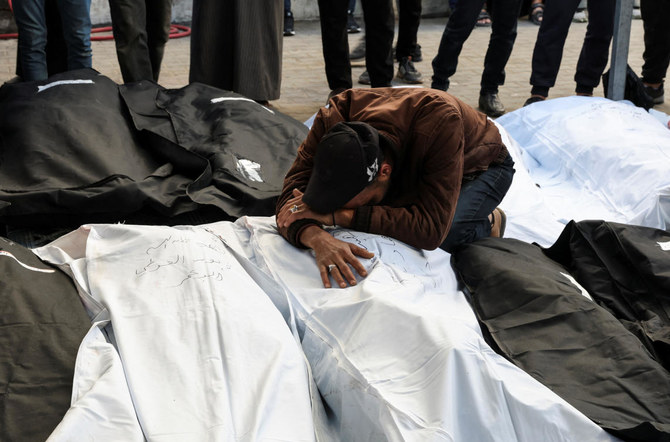
A mourner reacts near the bodies of Palestinians, most of whom were killed in Israeli strikes, at Abu Yousef Al-Najjar hospital in Rafah on Feb. 21, 2024. (Reuters)
Short Url
Updated 21 February 2024
Follow

Gaza death toll rises to 29,313, Rafah residents killed in strike

  • Ministry statement: A total of 118 people died in the past 24 hours

RAFAH, Gaza Strip/CAIRO: Israel stepped up its bombardment of the southern city of Rafah, residents said on Wednesday, as the death toll in the war across the devastated Palestinian strip rose to 29,313, according to the Gaza health ministry.

In its daily summary of events in Gaza, the Israeli army said it had intensified its operations in Khan Younis, a city just north of Rafah. It did not mention any attacks on Rafah itself, and did not immediately respond to a request for comment.

About 1.5 million people are estimated to be crammed into Rafah, on the southernmost fringe of the enclave close to the boundary with Egypt, most of them having fled their homes further north to escape Israel’s military onslaught.

Israel has said it was preparing for a ground assault on Rafah, despite mounting opposition from foreign countries, including its staunch ally the United States, over concern for civilian lives.

Residents said Israeli tanks had advanced west from Khan Younis into Al-Mawasi, previously an area of relative safety where the army had told Palestinians to seek shelter.

The tanks reached the coastal road, effectively cutting off Khan Younis and Rafah from the rest of the strip, though they retreated after a few hours, according to local residents.

Rafah residents reached by text message reported several air strikes and large explosions in the city, as well as naval boats opening fire on beachfront areas.

Reuters video journalists filmed the aftermath of a strike on the home of the Al-Noor family in Rafah, which was reduced to rubble, showing more than a dozen bodies wrapped in white or black shrouds and bereaved relatives at a Rafah hospital.

Abdulrahman Juma said his wife Noor, who was from the Al-Noor family, as well as his one-year-old daughter Kinza, had both been killed in the strike, along with Noor’s parents, brother and other relatives.

Juma was holding Kinza’s body, wrapped in a bloodstained white shroud.

“This one, who is on my lap, took my soul away ... She is one-and-a-half years old,” he said.

ANGER AT UNITED STATES

At the site of the bombed house, neighbors and relatives vented their anger at the United States, which on Tuesday vetoed a draft United Nations Security Council resolution calling for an immediate humanitarian ceasefire in Gaza.

“Since October 7 and until this moment, the US has been supporting Israel with rockets, aircrafts and tanks. All of these massacres are because of America,” said Youssef Sheikh Al-Eid, whose brother had been living in the bombed house.

Residents of Deir Al-Balah in central Gaza and Khan Younis also reported overnight strikes and deaths, and multiple funerals were taking place on Wednesday morning.

The Israel Defense Forces’ daily summary mentioned a targeted raid in the Zaytun area in northern Gaza, and operations in Khan Younis.

“Troops of the Givati Brigade conducted activities in eastern Khan Younis and killed approximately 20 terrorists in encounters over the past day,” it said.

“IDF Paratroopers expanded activities in western Khan Younis, targeting and killing terrorists with precise sniper fire and striking terror infrastructure. Additionally, two armed terrorists on bicycles approached IDF troops, who responded and killed them.”

Gaza’s health ministry said a total of 69,333 people had been injured in Gaza since the start of the war on Oct. 7, in addition to the 29,313 deaths, with 118 killed in the past 24 hours.

The war was triggered by Hamas militants who attacked southern Israel on Oct. 7, killing 1,200 people and taking 253 hostages, according to Israel.

Vowing to destroy Hamas, Israel has responded with an air and ground assault on Gaza that has displaced most of the population of 2.3 million, caused widespread hunger and laid waste to much of the territory.


Lebanon PM publishes long-awaited banking law draft

Updated 19 December 2025
Follow

Lebanon PM publishes long-awaited banking law draft

  • The law stipulates that each of the state, the central bank, commercial banks and depositors will share the losses accrued as a result of the financial crisis.
  • Depositors with a limit of $100,000, over the course of four years

BEIRUT: Lebanese Prime Minister Nawaf Salam published on Friday a long-awaited banking draft bill, which distributes losses from the 2019 economic crisis between banks and the state.
The draft law is a key demand from the international community, which has conditioned economic aid to Lebanon on financial reforms.
In a televised speech, Salam said “this draft law constitutes a roadmap to getting out of the crisis” that still grips Lebanon.
The draft will be discussed by the Lebanese cabinet on Monday before being sent to parliament, where it could be blocked.
The law stipulates that each of the state, the central bank, commercial banks and depositors will share the losses accrued as a result of the financial crisis.
Depositors, who lost access to their funds after the crisis, will be able to retrieve their money, with a limit of $100,000, over the course of four years.
Salam said that 85 percent of depositors had less than $100,000 in their accounts.
The wealthiest depositors will see the remainder of their money compensated by asset-backed securities.
“I know that many of you are listening today with hearts full of anger, anger at a state that abandoned you,” Salam said.
“This bill may not be perfect... but it is a realistic and fair step toward restoring rights, halting the collapse.”

- ‘Banks are angry’ -

The International Monetary Fund, which closely monitored the drafting of the bill, had previously insisted on the need to “restore the viability of the banking sector consistent with international standards” and protect small depositors.
The Associations of Banks in Lebanon criticized the draft law on Monday, saying in a statement that it contains “serious shortcomings” and harms commercial banks.
“Banks are angry because the law opens the door to them sharing any part of the losses,” said Sami Zougheib, researcher at The Policy Initiative, a Beirut-based think tank.
He told AFP that banks would have preferred that the state bear full responsibility.
The text provides for the recapitalization of failing banks, while the government’s debt to the Central Bank will be converted into bonds.
Salam said that the bill aims to “revive the banking sector” which had collapsed, giving free rein to a parallel economy based on cash transactions, which facilitate money laundering and illicit trade.
According to government estimates, the losses resulting from the financial crisis amounted to about $70 billion, a figure that is expected to have increased over the six years that the crisis was left unaddressed.
Since assuming power, Salam and President Joseph Aoun have pledged to implement the necessary reforms and legislation.
In April, Lebanon’s parliament adopted a bank restructuring law, as the previous legislation was believed to have allowed a flight of capital at the outbreak of the 2019 crisis.
The new bill stipulates that politically exposed persons and major shareholders who transferred significant capital outside the country from 2019 onwards — while ordinary depositors were deprived of their savings — must return them within three months or face fines.
The draft law could still be blocked by parliament even if the cabinet approves it.
“Many lawmakers are directly exposed as large depositors or bank shareholders, politically allied with bank owners, and unwilling to pass a law that either angers banks or angers depositors,” Zougheib said.
Politicians and banking officials have repeatedly obstructed the reforms required by the international community for Lebanon to receive financial support.