GAZA STRIP: The Hamas-run Gaza Strip’s health ministry said Wednesday the death toll from the war with Israel now tops 21,000, with a spokesman reporting 195 deaths over 24 hours.
Israel again pounded Gaza with air strikes and shelling after its military chief warned the war raging with Hamas since the Palestinian group’s October 7 attacks will last “many more months.”
Explosions lit up the sky over the southern Gaza city of Khan Yunis — a focus of heavy urban combat since the Israeli army said it had largely gained control over Gaza’s north.
A strike hit a house near Al-Amal hospital in Khan Yunis, killing 22 people and wounding 34, the Gaza health ministry said.
Heavy firefights also raged again around Gaza City in the north, while an air strike wounded 11 people near Rafah, a far-southern city crowded with internally displaced people, witnesses said.
Gaza’s spiralling humanitarian crisis has amplified calls for an end to the hostilities.
Israeli Prime Minister Benjamin Netanyahu has repeatedly vowed to keep up the campaign to destroy Hamas, a group blacklisted as a “terrorist” organization by the United States and the European Union.
“This war’s objectives are essential and not simple to achieve,” armed forces chief Herzi Halevi said Tuesday. “Therefore, the war will continue for many more months.”
The conflict erupted when Hamas gunmen attacked southern Israel, resulting in the deaths of about 1,140 people, mostly civilians, according to an AFP tally based on Israeli figures.
Palestinian militants also took around 250 hostages, 129 of whom remain in captivity, Israel says.
Israel retaliated with a relentless bombardment and a siege of Gaza followed by a ground invasion from October 27.
The campaign has killed at least 21,110 people, according to the latest toll issued by Gaza’s health ministry, about two thirds of them women and children.
Israel’s army blames Hamas and its allied armed groups for the high civilian death toll, charging that fighters hide in schools, hospitals and other civilian infrastructure, or in tunnels below them.
The army said the number of Israeli soldiers killed inside Gaza had risen to 164.
Israel on Tuesday returned the bodies of 80 Palestinians killed in Gaza, after checking there were no hostages among them, via the Red Cross, sources in the health ministry said.
An AFP photographer witnessed a digger lowering the human remains in blue body bags into a mass grave in Rafah.
Gaza’s 2.4 million people have suffered severe shortages of water, food, fuel and medicines, with only limited aid entering the territory.
An estimated 1.9 million Gazans have been displaced, the UN says.
AFPTV footage showed Palestinians who had been sheltering in a UN-run school in central Gaza’s Nuseirat refugee camp fleeing south, seeking safety from the bombardment.
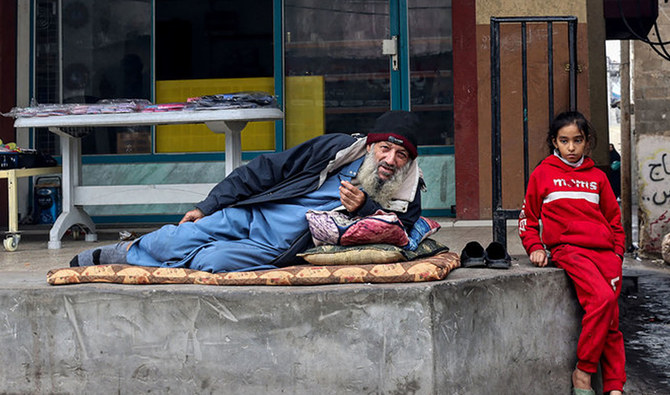
Displaced Gazans “don’t know where to go,” said one of them, declining to be named. “First, we’re displaced to Nuseirat, then to Rafah.”
Even schools “are no longer safe” in Gaza, said the man.
“A solution must be reached... Implement a ceasefire instead of bringing in aid.”
Palestinian president Mahmud Abbas, in an interview on Egyptian television, charged that the Gaza war “goes beyond a catastrophe and a genocide.”
“Netanyahu’s plan is to get rid of the Palestinians and the Palestinian Authority,” said Abbas, who is based in the occupied West Bank.
The UN Security Council, in a resolution last week, called for the “safe and unhindered delivery of humanitarian assistance at scale.”
The resolution, which did not call for an immediate end to the fighting, effectively leaves Israel with operational oversight of aid deliveries.
In Rafah, hundreds turned up at the Abdul Salam Yassin water company carrying baskets, pulling handcarts and even pushing a wheelchair stacked with bottles to queue for clean water.
“This was my father’s cart,” said Rafah resident Amir Al-Zahhar. “He was martyred during the war. He used it to transport and sell fish, and now we are using it to transport fresh water.”
Elsewhere in Rafah, people split logs and stacked kindling as the lack of fuel forced them to burn wood for cooking and to keep warm.
Internet and telephone services that were cut on Tuesday were gradually being restored in central and southern areas of Gaza, the Palestinian telecommunications company Paltel said on X, formerly Twitter.
Violence has also flared across the West Bank, with more than 310 Palestinians killed by Israeli troops or settlers since October 7, the health ministry there said.
An Israeli operation in a refugee camp in the northern West Bank killed six people early Wednesday, it said, with the army saying it had struck the Nur Shams camp from the air.
The war has reverberated across the Middle East, drawing in armed groups backed by Israel’s arch foe Iran in Lebanon, Iraq, Syria and Yemen.
An Israeli air strike on a Lebanon border town killed a Hezbollah fighter, the group said Wednesday, with state media reporting two of his relatives were also killed.
Hezbollah later Wednesday said it launched a barrage of 30 rockets toward northern Israel “in response to the enemy’s repeated crimes.”
In Syria, an Israeli strike Monday killed Iranian general Razi Moussavi, a senior commander in the Quds Force, the foreign operations arm of the Islamic Revolutionary Guard Corps.
Iran has vowed to avenge the death of Moussavi, whose body was due to be repatriated for burial after memorial prayers at the Shiite holy sites in Iraq on Wednesday.
Yemen’s Houthis have repeatedly fired at Israel and at passing cargo ships in the Red Sea in attacks in solidarity with Hamas.
US military forces shot down more than a dozen Houthi attack drones and several missiles, the Pentagon said, reporting no casualties or damage.
Israel’s military said Tuesday a fighter jet over the Red Sea had intercepted “a hostile aerial target that was on its way to Israeli territory.”

Gaza deaths soar as Israel says war to last ‘many more months’
https://arab.news/9c6rk
Gaza deaths soar as Israel says war to last ‘many more months’
- A strike hit a house near Al-Amal hospital in Khan Yunis, killing 22 people and wounding 34, the Gaza health ministry said
- Heavy firefights also raged again around Gaza City in the north, while an air strike wounded 11 people near Rafah
Israel attacks southern Lebanon, Bekaa Valley
- Lebanon insists on return of residents to border villages as a prerequisite for discussing any economic zone
BEIRUT: Two people, including a Hezbollah member, were killed, and more than five others injured on Sunday in Israeli airstrikes carried out without warning on towns in southern Lebanon and the northern Bekaa Valley.
The attacks came while the Mechanism Committee, monitoring the implementation of the ceasefire agreement between Lebanon and Israel, is experiencing “temporary paralysis.”
The date of its next meeting has yet to be confirmed, following the postponement of a session scheduled for Jan. 14 without a clear explanation.
Israeli airstrikes targeted the towns of Bir Al-Salasel, Khirbet Selm, Kfar Dunin, Barish, and Bazouriye, as well as the vicinity of the Nabi Sheet and Janta towns in the northern Bekaa.
The Lebanese Ministry of Health confirmed the fatality and injuries, while an Israeli military spokesperson said that the army attacked Hezbollah members working at a site used for producing weapons.
The strikes targeted a building where Hezbollah members were operating in the Bir Al-Salasel area in southern Lebanon. The building was being used to produce weapons, the spokesman said.
The Israeli army claimed that its airstrikes on the northern Bekaa targeted “Hezbollah military infrastructure,” adding that the “Hezbollah members’ activity at the targeted sites constitutes a violation of the agreements between Israel and Lebanon and poses a threat to Israel.”
The Mechanism Committee, headed by US Gen. Joseph Clearfield and tasked with monitoring the implementation of the cessation-of-hostilities agreement between Israel and Lebanon, is expected to resume its meetings on Feb. 25.
The committee leadership has not officially confirmed the date, which remains under discussion among its members.
An official Lebanese source told Arab News: “The failure of the Mechanism Committee to convene on Jan. 14, following two meetings that were held on Dec. 3 and 19 in Ras Al-Naqoura, indicates the existence of a crisis.”
The source said that “during the two previous meetings, Lebanon insisted on its two demands for the return of residents to border villages from which they were displaced and where their homes were destroyed, as well as the reconstruction of these villages. These two clauses constitute the foundation upon which negotiations must be built.”
The same source, who is involved in the Mechanism Committee’s meetings, said that “Lebanon’s only gateway for addressing the Israeli envoy’s proposition regarding the establishment of a border economic zone similar to a buffer zone is that the border villages must be inhabited by their residents from the Lebanese perspective. This condition cannot be overlooked under any circumstances.”
The source said that “this was discussed with the US side, in particular, and the statement issued by the US on Dec. 19 regarding the negotiations and the progress made by the Lebanese army south of the Litani River presented acceptable evidence that Lebanon is now at the heart of the negotiations.”
The source added: “Lebanon called on the Mechanism Committee to issue a statement endorsing the Lebanese army’s success in extending its control south of the Litani River, including acknowledgment from the Israeli side.
“However, through the office of Prime Minister Benjamin Netanyahu, Israel only issued a statement referring to positives and negatives."
Last week, Lebanese Finance Minister Yassine Jaber confirmed to Arab News, in a special interview from Davos on the sidelines of the World Economic Forum, that “the proposal to transform the Lebanese border area into an economic zone was immediately rejected.”
The official Lebanese source attributed the reasons for the postponement of the latest Mechanism meeting to “a structural flaw within the committee, and to a crisis affecting the American delegation related to regional and international developments, in addition to an American-Israeli desire to exclude the French representative.”
The official source spoke of two dilemmas: “There is an Israeli enemy persisting in its violations of the agreement and in its attacks on Lebanon.
“On the other hand, the Israeli side submits evidence to the Mechanism Committee, including documents, photos, and videos, regarding Hezbollah’s restoration of its capabilities, at a time when its Secretary-General, Sheikh Naim Qassem, threatens civil war if Hezbollah’s weapons north of the Litani River are touched.”
The source added: “For its part, the Lebanese Army presents evidence and documentation of what it has accomplished south of the Litani. This means that the Lebanese Army is achieving what it is capable of achieving with flesh and blood. It is aware of the existence of remaining Hezbollah weapons depots and is pursuing them.”
The official source fears “a lack of progress in negotiations in light of all these documents, high-pitched statements, and the American complaint about the slow pace of negotiations.”
He added: “The positions of Hezbollah officials do not help Lebanon’s stance within the Mechanism Committee, particularly with regard to capacity building.”
The source said that “the adherence of the Hezbollah–Amal Movement duo to the Mechanism Committee does not mean their approval of any progress in negotiations.
“When Lebanon proposes expanding the Lebanese delegation to include, for example, a former minister, this constitutes horizontal expansion rather than the vertical expansion that would serve the negotiation process, which should involve specialized experts and technicians. Consequently, any collapse of the ‘Mechanism’ meetings would mean that Lebanon would be facing a very difficult moment.
“It appears that the history of Lebanese–Israeli negotiations is passing through its most dangerous phase today. The world is no longer negotiating with Lebanon solely over its rights, but over its ability to prevent war.”
The official source also stressed that the “Mechanism” constituted a fundamental point of intersection among the participating states despite the difficulties affecting its work.
He said: “The suspension of the committee’s work could be reflected in the issue of the exclusivity of weapons north of the Litani, as its absence would mean leaving matters without controls, pushing Lebanon into an even worse phase.”
The official source said that “raising the level of representation of the Lebanese delegation is not currently on the table, but it is an inevitable end that Lebanon may reach according to the logic of events.”
Lebanon is counting on the anticipated visit of Army Commander Gen. Rodolphe Haykal to Washington early next month, and on the Paris conference scheduled for March 5, to secure further support for the plan to confine weapons north of the Litani River.


