


MILAN: This year’s Olympic and Paralympic Games are located in Italy, a historically Catholic nation. And they coincide with Ramadan, the Muslim holy month that’s a time for dawn-to-dusk fasting, religious reflection and communal celebration.
One of the two host cities, Milan, is multicultural and cosmopolitan, and there are Islamic centers and mosques spread around the city to gather and worship. At least one is welcoming people of other faiths wishing to partake in iftar dinners, when Muslims break their daily fast.
Up in the mountains, around the village of Cortina d’Ampezzo, prayer spaces are harder to come by. Still, Muslim residents in the area over recent years have been carving out their communities.
Here’s how some Muslims are observing Ramadan in Milan and Cortina:
A mosque welcoming members of all faiths
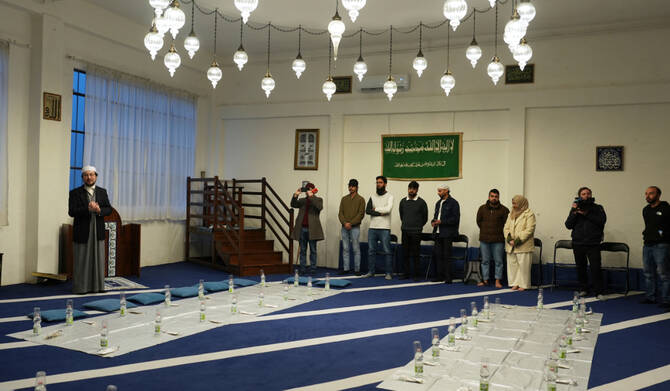
Milan’s Al-Wahid mosque is opening its doors during Ramadan, inviting guests to share the breaking of the fast and evening prayers. Near Milan’s Navigli district, it has been officially recognized as a place of worship by the city since 2000.
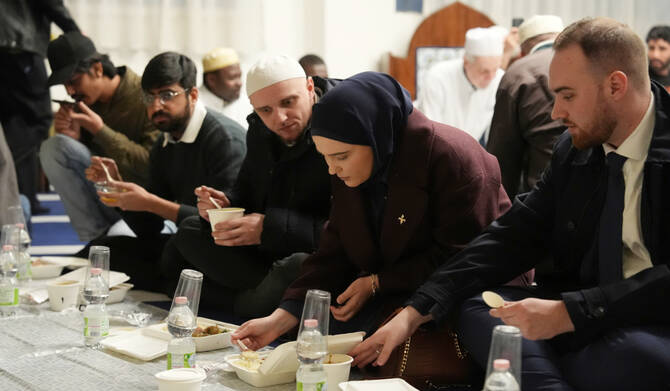
Fridays — the weekly day of congregational prayer in Islam — draw larger crowds to mosques. On those days during Ramadan for the last few years, Al-Wahid welcomes guests from the municipality, local institutions, the Catholic Church and other religious communities. Interfaith iftars have become common in many parts of the world, including Muslim-majority countries such as Indonesia and Pakistan, and in Australia and the United States, where Muslims are a relatively small minority.
Al-Wahid’s open gatherings aren’t specifically for Olympic visitors, though they are scheduled weekly through March 14 — the day before the Paralympics end.
“The Olympics are a symbolic moment,” Imam Yahya Pallavicini, vice president of a national Islamic religious association known by its acronym COREIS, told The Associated Press. “Sport, culture and art can help reduce prejudice and fear toward a particular culture or religious identity.”
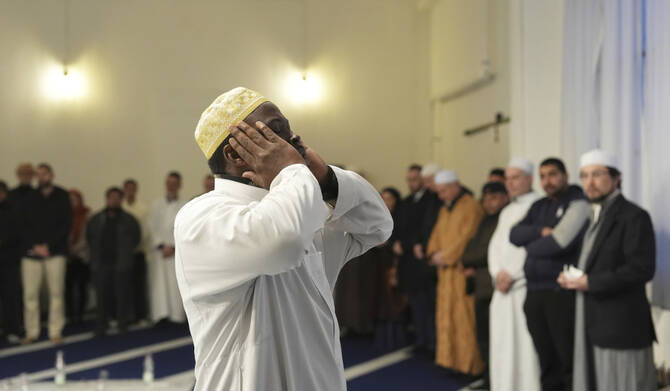
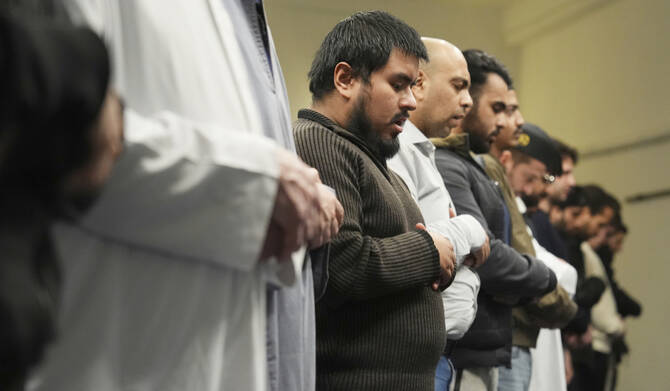
At sunset on Feb. 20, a few dozen Muslim worshippers stood shoulder to shoulder beneath a row of hanging lamps. They waited for the call to prayer before breaking their fast with dates offered on silver plates. Then they sat on the floor to share lentils, rice, meat and water before ending the evening with prayer.
A 2025 report by a Milan-based migration research institute, ISMU, estimates that almost 400,000 Muslims live in Lombardy, the Italian region with the biggest immigrant population and which includes Milan, Italy’s second-most populous city. The largest groups come from Morocco and Egypt, it said.
Pallavicini said the community also includes people from Bangladesh, Pakistan and Bosnia, among others.
Mountain towns, not many mosques
In the other Olympic host city, Cortina, at an elevation of about 1,220 meters (4,000 feet), eight Muslim people told the AP that finding a place to pray has proven challenging.
The upscale mountain town, known as the Queen of the Dolomites, is home to a little over 5,000 people. About half its population is part of Italy’s Ladin minority, which settled the mountain hamlet of Anpezo a millennium ago.
Rabah Boubegtiten, who traveled to work in the Olympics as a driver with Qatari security, said his drive to Brunico — the location of the nearest mosque he could find — took over an hour on a bad road. He found it using social media, having failed to locate one using Google, he added.
“There are many nationalities here, many Muslims from various countries: Algerians, Tunisians, other Africans, and many Qataris, because we are working with them during the Winter Olympic Games. They look everywhere to find a place to pray, but it’s almost impossible,” Boubegtiten, 52, who lives in Paris and is originally from Algeria, said. “For us, it’s really difficult. Sometimes, even if we want to come, we simply can’t.”
An interfaith prayer room is available at each residential village for athletes across the spread-out Games, but they are not accessible to the general public.
Elsewhere in the Dolomites, residents have been making their own spaces. They said there are sufficient places to worship around Brunico, which itself has about 17,000 people, as well as halal butchers and shops to accommodate the local Muslim population.
Around 120 people attended the Friday prayer in Brunico, sitting on the crowded floor in a room surrounded by curtains and listening to a sermon in Italian. Afterward, they were asked for donations to help cover the space’s rent and utility bills.
“In Italy, Ramadan is not an impossible thing. It is possible to practice Ramadan, it’s possible to pray,” said Kreem Wardi, whose father is Muslim from Morocco and mother is from Italy and Catholic. “It is not easy to find a mosque everywhere in Italy. But in this area, we are fine for now, inshallah.”
Wardi, a 20-year-old student, noted that in Brunico it’s uncommon to invite non-Muslims to iftar dinners or share Ramadan traditions.
“They maybe don’t want to talk about Islam. It’s not that they hate us Muslims, but it’s just that they are maybe not interested, so we don’t want to force it upon them,” he said.
A more diverse Italy
While the vast majority of Italy’s 59 million people are baptized Catholic, about three-quarters identify with the religion and far fewer regularly attend church. Muslims number 1.7 million, accounting for over 30 percent of the foreign resident population for the first time, ISMU, the migration research institute, said in July.
Migration over the past decade has stirred right-wing, anti-immigrant sentiment in some parts of Europe. Italian Premier Giorgia Meloni, who heads the far-right Brothers of Italy party, pledged a crackdown on migration after taking office in 2022, with the goal of deterring would-be refugees from paying smugglers to make the dangerous Mediterranean crossing.
A large portion of today’s Muslim population in Italy are migrants, but there is a growing number of second-generation Italian Muslims, converts and people born in Italy, Pallavicini said in Milan.
When the call to prayer finally echoed through the Al-Wahid mosque close to 7 p.m., men and women bowed in unison, their foreheads close to the floor.
Amina Croce, 28, was one of them. Born to Italian Catholic parents who converted to Islam and raised her as a Muslim, she said the mosque “has been a very significant part of who I am.”
Beyond religious observance, Croce added, she sees the faith as part of Europe’s history.
“We believe this diversity is part of Italy’s broader cultural heritage,” said Croce, who leads the youth division of COREIS. “It may still be underappreciated, but we hope it will be recognized more in the future.”


