

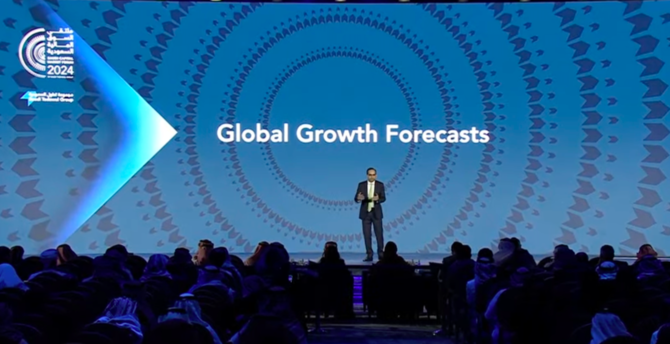

RIYADH: Financial experts are gathering at the third Saudi Capital Market Forum to delve into the complexities of the global economy and its implications for capital markets.
Held in Riyadh, the conference allows participants to explore financial concepts, encouraging discussion and cooperation to fortify international market resilience.
Head of Research at Al-Rajhi Capital, Mazen Al-Sudairi, shared his insights, including a look at the intricacy between bonds and equity in 2022, shedding light on the challenges stemming from the probability of rising interest rates.
He said: “The positive correlation between bonds and equity in year 22 is that they both fell together because of expecting higher interest rates, that’s going to continue for long.”
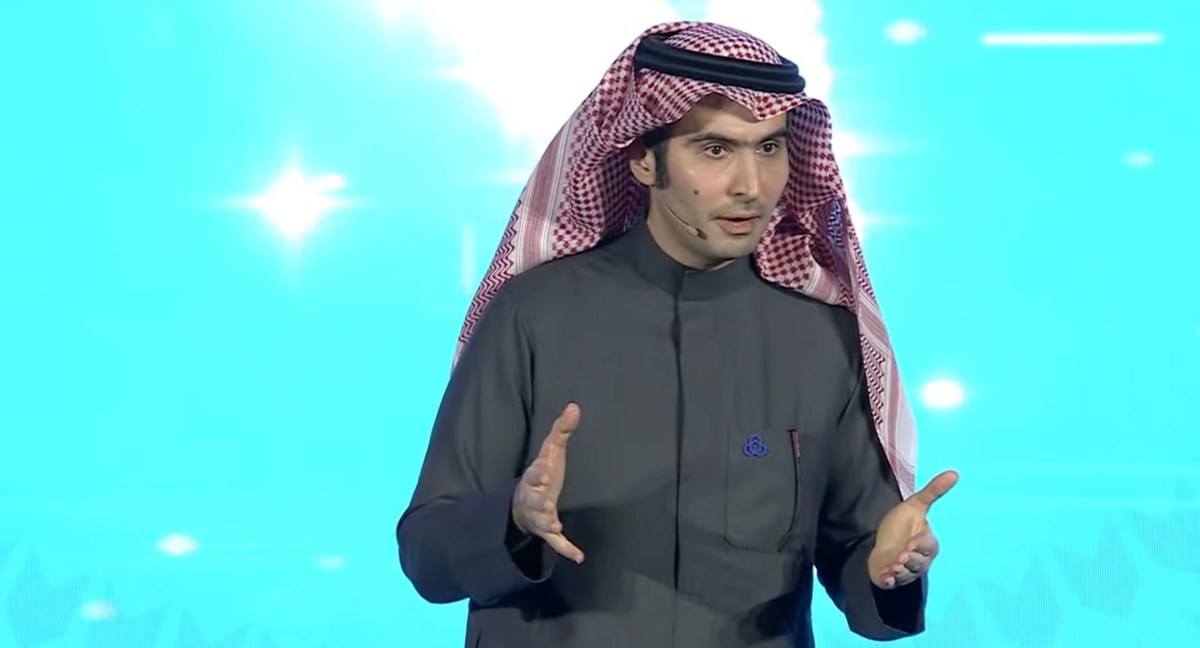
Head of Research at Al-Rajhi Capital, Mazen Al-Sudairi.
When discussing China’s concerted efforts to navigate economic headwinds while maintaining stability, Al-Sudairi stated: “I don’t think we should ask China to recover now. I think China is avoiding the crisis.”
The Al-Rajhi head also emphasized the resilience of oil consumption, citing Aramco’s figures as indicative of sustained demand.
Regarding the oil market dynamics, Al-Sudairi highlighted the significance of the demand for oil derivatives, projecting potential cost stability in the coming months.
Deputy Chief Global Economist at Morgan Stanley, Rajeev Sibal, directed attention to the US Federal Reserve’s pivotal role in shaping global economic trajectories.
“As I think about the conversations I’ve been having with clients over the past few months, every single one comes back to the Federal Reserve,” said Sibal.
He reiterated Morgan Stanley’s forecast of Fed rate cuts commencing in June, foreseeing a soft landing for the US economy.
In contrast to prevailing uncertainties, Managing Director and Head of CEEMEA Research at Goldman Sachs, Waleed Mohsin, injected a dose of optimism into the discourse.
“The good news that I would share with you is that our global forecast for global growth is set at 2.8 percent for 2024, which is well above consensus of 2.2 percent,” Mohsin exclaimed, highlighting the global economy’s resilience.
Mohsin elaborated on Goldman Sachs’ bullish outlook, pointing to anticipated recoveries in real disposable income and manufacturing activity.
He said: “Starting with equity capital markets, our analysis suggests that the Middle East can become as large as 10 percent of the MSCI Emerging Market Index in the medium to long-term with Saudi Arabia accounting for around 70 percent of this.”
He added: “Our calculation suggests that if investors were to move to a market weight position, and if the weight that we’re actually forecasting, which is 10 percent is correct, then this can unlock $50 billion of active and passive flows into the equity market.”
Mohsin underscored the transformative potential of Saudi Arabia’s Vision 2030, envisioning substantial growth in equity markets and emphasizing the crucial role of its development in financing the Kingdom’s projects.
Luis Oganes, managing director and head of Global Macro Research at J.P. Morgan, sounded a note of caution regarding lingering inflationary pressures.
Oganes underscored the Organization of the Petroleum Exporting Countries’s role in stabilizing oil markets amidst supply fluctuations, acknowledging Saudi Arabia’s contributions to the sector’s stability.
Ahmed Shams El-Din, managing director and head of Global Research at EFG Hermes, provided insights into Saudi Arabia’s evolving financial landscape, commenting on the evolution witnessed in the equity market.
He said: “I covered Saudi since 2006, and I can tell you this is a completely new country.”

Ahmed Shams El-Din, managing director and head of Global Research at EFG Hermes
El-Din emphasized the need for proportional development in the debt market to unlock untapped funding potential, advocating for strategic alignment between capital allocation and efficiency.
In the ever-evolving landscape of global finance, the insights shared at the Saudi Capital Market Forum serve as guiding principles, steering stakeholders toward sustainable growth and prosperity in the years to come.


