

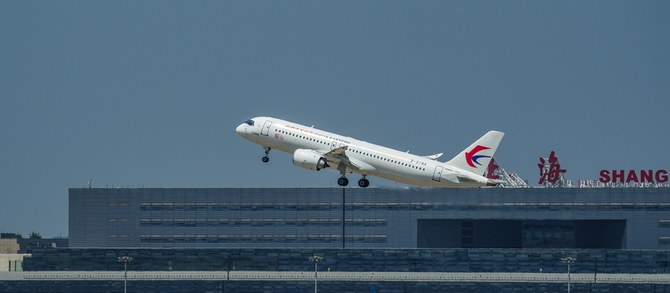

SINGAPORE: China’s challenger to Airbus and Boeing’s passenger jets, the narrow-body C919 manufactured by the Commercial Aircraft Corp. of China, or COMAC, has made its first trip outside Chinese territory, staging a fly-by at the Singapore Airshow on Sunday.
China has invested heavily in its attempt to break the hold of the dominant two Western planemakers on the global passenger market.
China has indicated a push this year to advance the C919 and COMAC’s footprint domestically and internationally. The plane is only certified within China and the first of now four C919s began flying with China Eastern Airlines last year.
With Airbus and Boeing struggling to ramp up production and meet demand for new planes, and Boeing struggling with a string of crises, the aviation industry is watching how COMAC positions itself as a viable alternative.
COMAC will invest tens of billions of yuan over the next 3-5 years to expand C919 production capacity, Chinese media reported a COMAC official saying in January.
China's aviation authority said last month it would this year pursue European Union Aviation Safety Agency validation for the C919, a process which began in 2018.
The C919 was one of two commercial planemakers flying their planes off Singapore’s coast alongside Airbus at a Sunday preview for Asia’s biggest air show. Boeing will not display a commercial aircraft this year.
COMAC has two passenger products: the ARJ21 regional jet and the larger C919 twin-engine narrow-body airliner with 158-192 seats, which competes with the established Airbus A320neo and Boeing 737 MAX 8 models.
The C919 made its first flight outside mainland China in December to Hong Kong. ARJ21s are in use by Indonesia’s TransNusa Air.
Many inside the industry caution that only four C919s are in service in China; the plane is only certified by Chinese regulators and the C919 relies international supply chains.
However, the aviation industry-wide supply crunch, which is testing an expected full return and then growth of civil capacity in Asia, is garnering COMAC more attention.
“We have also seen a growing trend where clients are including the C919 option in their fleet evaluation,” said Adam Cowburn of Alton Aviation Consultancy.
Two C919s were delivered in 2023. Aviation consultancy IBA forecasts 7-10 C919s could be delivered in 2024.
“With Airbus and Boeing narrowbodies in the A320neo and 737 MAX families sold out for most of this decade, the C919 has a strong opportunity to gain market share, particularly in its domestic market,” said Mike Yeomans of aviation consultancy IBA.
“The immediate challenges for COMAC are around production to meet local demand and certification to penetrate international markets,” Yeomans added.


