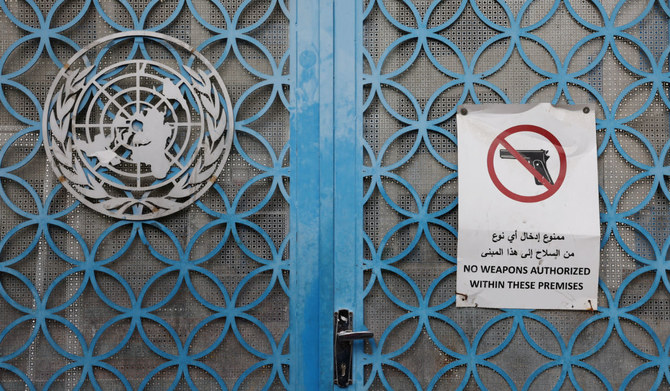

JERUSALEM: In refugee camps in the Israeli-occupied West Bank, Palestinians relying on the UN agency UNRWA for schooling and healthcare fear key services will stop as donors have paused funding over accusations staff members took part in Hamas’ Oct. 7 attack.
Most of the focus on the fate of the UN Relief and Works Agency for Palestinian refugees has been on its emergency operations in war-devastated Gaza where it is critical to an aid effort for the enclave’s 2.3 million inhabitants.
But the agency is also a lifeline for Palestinian refugees across the Middle East, including in the West Bank where it serves more than 870,000 people, running 96 schools and 43 primary health care facilities.
HIGHLIGHTS
• Donors paused UNRWA funding over Hamas allegations.
• UNRWA serves 870,000 in Israeli-occupied West Bank.
“If they cut off aid from UNRWA, there will be no help of any kind for residents, especially in refugee camps because they rely on UNRWA,” said Mohammad Al-Masri, a resident of Dheisheh refugee camp near Bethlehem.
UNRWA announced last month that it had dismissed staff after Israel presented it with allegations that 12 of its 13,000 employees in Gaza had taken part in the Oct. 7 assault by Hamas fighters who stormed border fences and attacked Israeli towns.
Accusations against UNRWA have reignited longstanding Israeli demands to dismantle an agency which both sides see as closely linked to a refugee problem dating to Israel’s creation in 1948 that lies at the heart of their decades-long conflict.
Some 700,000 Palestinians, half the Arab population of what 75 years ago was British-ruled Palestine, fled or were expelled, many spilling into neighboring Arab countries where they their descendants remain. The tent camps they lived in after 1948 evolved into built-up townships.
With no lasting settlement to the Israeli-Palestinian conflict on the horizon, they retain the status of refugees, including in the West Bank and Gaza, and assert a right to return to their homes within Israel’s borders.
Israel has always rejected that, saying they chose to leave and have no right to go back. Last month Israeli Prime Minister Benjamin Netanyahu renewed demands for UNRWA to be shut down, saying “it seeks to preserve the issue of Palestinian refugees.”
Daoud Faraj was 10 years old when his family became refugees. Now 85, he has lived most of his life in the West Bank’s Aida refugee camp near Jerusalem.
“Cutting off aid will hurt many people. Not only me,” he said, referring to the health services and schools that UNRWA manages in the camp.