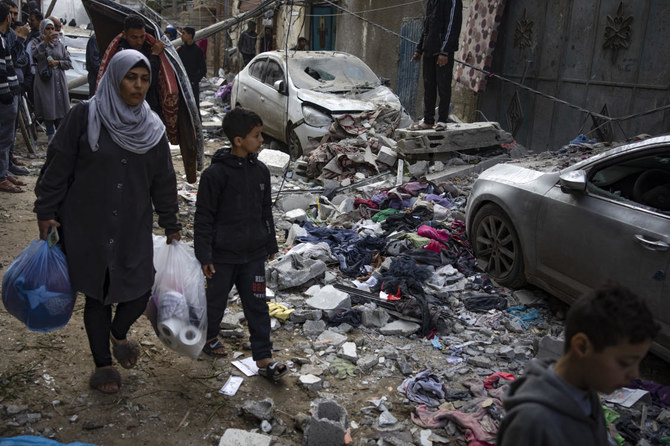
Israeli airstrikes killed at least 44 Palestinians — including more than a dozen children — in the southern Gaza city of Rafah on Saturday, hours after Israel’s prime minister said he had asked the military to plan for the evacuation of hundreds of thousands of people there ahead of a ground invasion.
Benjamin Netanyahu did not provide details or a timeline, but the announcement set off panic and warnings from diplomats. More than half of Gaza’s 2.3 million people are packed into Rafah, many after following Israeli evacuation orders that now cover two-thirds of the territory. It’s not clear where they could run next.
Israel says that Rafah, which borders Egypt, is the last remaining stronghold for the Hamas militant group in Gaza after more than four months of war sparked by the Oct. 7 Hamas attack.
Egyptian Foreign Minister Sameh Shoukry said any Israeli ground offensive on Rafah would have “disastrous consequences,” and asserted that Israel aims to eventually force the Palestinians out of their land.
Another mediator, Qatar, warned of disaster if Israel carries out a Rafah offensive, and Saudi Arabia warned of “very serious repercussions.” There is even increasing friction between Netanyahu and the United States, whose officials have said a Rafah invasion with no plan for the civilian population would lead to disaster.
Israel has carried out airstrikes in Rafah almost daily, even after telling civilians in recent weeks to seek shelter there from the current ground combat in Khan Younis just to the north.
Overnight into Saturday, three airstrikes on homes in the Rafah area killed 28 people, according to a health official and Associated Press journalists who saw the bodies arriving at hospitals. Each strike killed multiple members of three families, including a total of 10 children, the youngest 3 months old.
Fadel Al-Ghannam said one strike tore the bodies of his loved ones to shreds. He lost his son, daughter-in-law and four grandchildren. He fears even worse with a ground invasion of Rafah, and said the world’s silence has enabled Israel to proceed.
Later on Saturday, an Israeli airstrike on a home in Rafah killed at least 11 people, including three children, according to Ahmed Al-Soufi, head of Rafah municipality. The dead were taken to Abu Youssef Al-Najjar hospital, according to an AP journalist there.
“This is what Netanyahu targets — the civilians,” said a neighbor, Samir Abu Loulya.
Two other strikes killed two policemen and three senior officers in the civil police, according to city officials.
In Khan Younis, Israeli forces opened fire at Nasser Hospital, the area’s largest, killing at least two people and wounding five, according to the medical charity Doctors Without Borders. Israeli tanks reached the hospital gates Saturday morning, Ahmed Maghrabi, a physician at the hospital, said in a Facebook post.
Health Ministry spokesman Ashraf Al-Qidra said hospital staff are no longer able to move between buildings because of the intense fire. He said 300 medical personnel, 450 patients and 10,000 displaced people are sheltering there.
The Israeli military said troops were not currently operating inside the hospital and called the surrounding area “an active combat zone.”
Israel’s army chief, Lt. Gen. Herzl Halevi, said more than 2,000 Hamas fighters in Khan Younis had been killed in airstrikes and ground combat but the offensive in the city was far from over.
GAZA DEATH TOLL TOPS 28,000
The Gaza Health Ministry said Saturday that the bodies of 117 people killed in Israeli airstrikes were brought to hospitals over the past 24 hours, raising the overall death toll from the offensive to 28,064, mostly women and children. The ministry said more than 67,000 people have been wounded.
Israel declared war after several thousand Hamas militants burst across the border into southern Israel on Oct. 7, killing 1,300 people and taking 250 others hostage. Not all are still alive.
Israel holds Hamas responsible for civilian deaths because it fights from within civilian areas, but US officials have called for more surgical strikes. President Joe Biden said this week Israel’s response is “over the top.”
Netanyahu’s office says it is impossible to eliminate Hamas while leaving four Hamas battalions in Rafah.
Egypt has warned that any movement of Palestinians into Egypt would threaten the four-decade-old peace treaty between Israel and Egypt. The Rafah border crossing, which is mostly closed, serves as the main entry point for humanitarian aid.
Rafah had a prewar population of roughly 280,000. The United Nations says it is now home to some 1.4 million additional people who fled fighting elsewhere. Roughly 80 percent of Gaza’s people have been displaced, and the territory has plunged into a humanitarian crisis with shortages of food and medical services.
German Foreign Minister Annalena Baerbock warned that an Israeli offensive on Rafah would be a “humanitarian catastrophe in the making,” adding on X that “the people in Gaza cannot disappear into thin air.”
ELSEWHERE IN GAZA
On Saturday, Israel’s military said it had discovered tunnels underneath the main headquarters of the UN agency for Palestinian refugees in Gaza City, alleging that Hamas militants used the space.
An Israeli airstrike on the central town of Deir Al-Balah killed five people and wounded about 10 others, according to hospital officials and AP journalists.
In the Tel Al-Hawa neighborhood of Gaza City, two medics from the Palestinian Red Crescent were found dead in a destroyed ambulance after going missing 12 days ago. They had rushed to rescue 5-year-old Hind Rajab, who had been traveling with family to heed evacuation orders.
The PRC previously released a recording of a call from Hind’s cousin saying the car had come under fire and only she and Hind survived. The cousin went silent mid-call.
The PRC said the rescue mission was coordinated with Israel’s military, which had no comment.

Israeli strikes kill 44 Palestinians in Rafah after Netanyahu says ground invasion coming
https://arab.news/68hnd
Israeli strikes kill 44 Palestinians in Rafah after Netanyahu says ground invasion coming
- Israeli PM’s planned offensive on Rafah has drawn condemnation from rights groups and US
- Hamas warns Israeli Rafah op may cause casualties in ‘tens of thousands’
How Israeli land grabs are redrawing the map of Palestine’s Jordan Valley
- A major incursion in Tubas caused damage and displacement, but residents say a planned 22-km barrier poses bigger threat
- Israel calls the “Scarlet Thread” wall a security measure; activists say it’s a land grab severing the Jordan Valley
LONDON: Israeli raids are not new to Tubas, a Palestinian governorate in the northern West Bank’s western Jordan Valley. But fears of de-facto annexation have intensified since November, after land confiscation orders were issued for a planned barrier dubbed the “Scarlet Thread.”
On Nov. 26, Israeli security forces, backed by a helicopter that reportedly opened fire, sealed off the governorate and raided Tubas City and nearby towns, including Tammun, Aqqaba, Tayasir and Wadi Al-Fara — home to more than 58,000 people.
The operation involved drones, aircraft, bulldozers and curfews, according to the UN Office for the Coordination of Humanitarian Affairs, OCHA.
At least 160 Palestinians were injured, OCHA said, while homes and infrastructure sustained extensive damage. The raids also displaced residents and disrupted essential services, including water supplies.
In Al-Fara refugee camp, OCHA noted, Israeli forces seized at least 10 residential buildings, forcing at least 20 families to flee, and detained and interrogated dozens of Palestinians before withdrawing.
The Palestinian Detainees’ Affairs Society said 29 young men were detained in the camp and later released, with the exception of one.
Israeli military and internal security officials described the operation as part of a broad “counterterrorism” campaign.
Locally, however, concerns have grown not only over the scale of the assault but also its timing, which coincided with new land confiscation orders in the Jordan Valley.
Ahmed Al-Asaad, the Tubas governor, said the Israeli military has issued nine land confiscation orders to carve out a 22-kilometer settlement road that would isolate large areas of the Jordan Valley and extend to within 12 kilometers of the Jordanian border.
Although the orders were signed in August, Al-Asaad told Arab News that Palestinian landowners were not notified until Nov. 21, nearly three months later, and were given insufficient time to appeal.
An Arabic-language notice obtained by Arab News via WhatsApp from Mutaz Bisharat, a Palestinian official overseeing Jordan Valley affairs in Tubas, stated that the Israeli military ordered the confiscation of Palestinian land “for military purposes.”
Signed by Avi Bluth, head of the Israeli military in the West Bank, on Aug. 28, the order took effect “on the date of its signing” and remains in force until Dec. 31, 2027.
It instructed those “in possession of the lands” to remove all equipment and vegetation within seven days. It also said objections could be filed within seven days of the notice’s publication date through Israeli liaison offices.
Al-Asaad said landowners were given “only one week” to file objections, noting that two days fell on a weekend, while four days coincided with curfews during the first raid and two more during a second large-scale incursion.
“As a result, residents were unable to prepare land ownership documents,” he said.
Opinion
This section contains relevant reference points, placed in (Opinion field)
Palestinian landowners were invited on Dec. 3 to tour the land earmarked for confiscation. The seven-day appeal window, Al-Asaad said, was counted from the day of that tour.
But on Dec. 1, Israeli forces launched another large-scale operation, a day after withdrawing from the nearby Tammun. The three-day raid imposed an open-ended curfew on Tubas City and surrounding towns, according to OCHA.
During the operation, forces blocked five main roads with earth mounds, three in Tubas City and two in Aqqaba, as well as several secondary roads, severely restricting movement for about 30,000 Palestinians.
At least eight residential buildings were converted into military posts, forcibly displacing at least 11 families, OCHA said in a Dec. 4 situation update.
The land earmarked for confiscation under the “Scarlet Thread” project covers about 1,160 dunams, 85 percent of which is privately owned by residents of Tubas and Tammun, The Times of Israel reported, citing an X post by Israeli civil rights activist Dror Etkes.
Dunam is a unit of land area equal to 1,000 square meters or 0.1 hectares.
The Israeli military told the newspaper that the project was introduced based on a “clear military need” to prevent arms smuggling and “terror attacks.”
Etkes rejected that justification, saying the real aim was to “ethnically cleanse” the land between the proposed barrier and what Israel calls the Allon Road to the east, an area of about 45,000 dunams, with residents ultimately forced out.
On Dec. 1, the Israeli newspaper Haaretz reported that the army was preparing to build a new separation wall deep inside the occupied West Bank, in the heart of the Jordan Valley. The wall would stretch 22 kilometers and span 50 meters in width, cutting Palestinians off from tens of thousands of dunams of land.
According to the report, the project would require demolishing homes, agricultural buildings, wells, water lines and trees along the route.
It would also encircle the herding community of Khirbet Yarza, isolating about 70 residents who depend on several thousand sheep for their livelihood, and separate agricultural and pastoral communities from their lands, similar to what the separation barrier in the western West Bank has done.
Palestinians say the plan, if implemented, amounts to annexation of the northern West Bank.
“New notices have been issued, pursuant to the military orders, for the seizure of citizens’ lands in the areas of Tubas and Tammun, for the purpose of removing homes and agricultural projects, including greenhouses, sheds, and sheep pens,” Bisharat told Arab News.
He said authorities also ordered the removal of a 5-kilometer water pipeline.
“This decision will effectively end the Palestinian presence and agriculture on more than 22,000 dunams of cultivated land and lead to the displacement of more than 60 families,” he added.
While the Israeli military says the land is being seized for a road and barrier, Bisharat argues the true objective is annexation.
“These notices are issued under the pretext of opening a road and constructing the separation wall in Buqeia and the Jordan Valley,” he said. “But through these notices, the (Israeli) occupation is waging a war against the Palestinian presence in all residential communities, and against all farmers and agricultural projects.”
He added that Israel’s plan involves a “50-meter-wide corridor, along with a wall, gates and an earthen trench,” measures he described as “a new border demarcation” that would separate the Jordan Valley from the rest of the governorate.
“This is an annexation process,” he said. “As a result, we will be left without borders, without water, and without Palestine’s food basket, and will lose approximately 190,000 dunams of land.”
Al-Asaad echoed those warnings, saying Israel’s plans amount to de-facto annexation.
“The new settlement plan, under which the occupation forces intend to establish an apartheid separation wall, will separate the Jordan Valley from Tubas governorate and confiscate areas estimated at hundreds of thousands of dunams,” he said. “This constitutes a plan to annex the Jordan Valley.”
He warned the project would inflict severe political, economic and agricultural losses, undermine prospects for a Palestinian state and isolate Tubas from its eastern border with Jordan under 12 km of Israeli control.
By Dec. 12, around 1,000 dunams of Palestinian land have been reportedly confiscated. The UN Human Rights Office described Israel’s military road project as “another step towards the progressive fragmentation of the West Bank.”
“This is the most fertile land in the West Bank and the road is likely going to separate Palestinian communities from each other and the Palestinian farmers in Tubas from … land they own on the other side of the planned barrier,” said Ajith Sunghay, head of the OHCHR’s office in the Occupied Palestinian Territory.
Immediately after the seizure orders were issued, Al-Asaad said, local authorities submitted an initial objection through the Northern Jordan Valley file and the Colonization and Wall Resistance Commission, collected powers of attorney and land deeds, and coordinated with land departments to document ownership.
“We continue to work on submitting objections through attorney Tawfiq Jabarin,” he added, reiterating that curfews and military operations severely limited their ability to complete the legal file.
Etkes, however, dismissed the objection process as meaningless, saying Israel’s judiciary would reject the appeals.
Still, Tubas residents say they will continue to resist. Al-Asaad said officials plan to internationalize the issue, urging the Palestinian Foreign Ministry to organize tours for diplomats and raise the case in international forums.
“We will mobilize local and international media to expose the danger of a plan that would seize half the governorate’s land and destroy the two-state solution,” he said.
IN NUMBERS:
• 188 Palestinians killed in occupation-related violence in the West Bank since January 2025.
• 45 Children accounted for nearly a quarter of the above-mentioned victims.
(Source: UNRWA)
Jabarin, a Palestinian lawyer and human rights activist representing landowners, submitted an initial objection in late November, according to the Al-Quds Al-Arabi newspaper.
He argued that Jordan already shares a secure border with the Jordan Valley and that an internal wall would not prevent arms smuggling.
He said Palestinian communities are the ones who need protection from repeated settler attacks.
The developments in Tubas come amid a broader West Bank escalation following the Hamas-led Oct. 7, 2023, attack on southern Israel from Gaza and the devastating Israeli military retaliation.
Israel has sharply restricted movement, erecting new checkpoints and sealing off communities.
Since January, Israeli forces have intensified operations, killing dozens and displacing tens of thousands. The campaign began in Jenin refugee camp on Jan. 21, dubbed “Operation Iron Wall,” and expanded to Tulkarem and Nur Shams, displacing at least 32,000 people in January and February alone, according to UN figures.
Human Rights Watch said on Nov. 20 that Israel’s forced expulsions in West Bank refugee camps amount to war crimes and crimes against humanity — allegations Israel denies.
The UN says large-scale operations in Jenin and Tubas governorates affected more than 95,000 Palestinians between Nov. 25 and Dec. 1.
All of this has unfolded alongside accelerated settlement expansion and rising settler violence.
So far this year, OCHA has documented 1,680 settler attacks across more than 270 communities — an average of five per day — with the olive harvest season marked by widespread assaults on farmers, trees, and agricultural infrastructure.
In a landmark decision in July 2024, the International Court of Justice ruled that Israel’s occupation of the Palestinian territories is unlawful.
The Court also ruled that Israel must “immediately and completely cease all new settlement activities, evacuate all settlers, stop the forcible transfer of the Palestinian population, and prevent and punish attacks by its security forces and settlers.”
UN experts in 2025 referred to this advisory opinion to criticize ongoing settlement expansions and military operations as violations of international law.