Displaced Gazans resort to living in chicken sheds

1 / 4
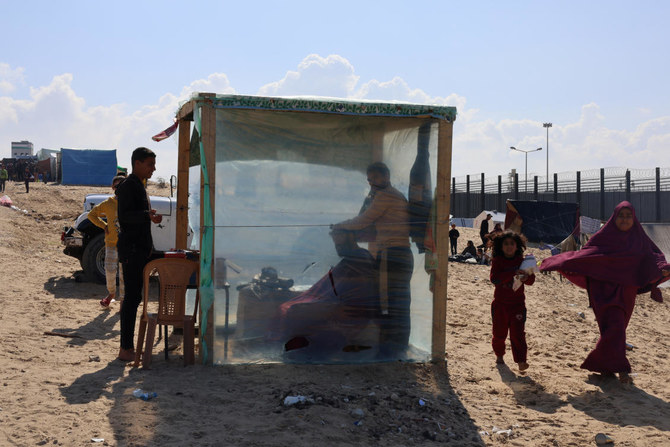
A Palestinians man gets a haircut, as displaced Palestinians, who fled their houses due to Israeli strikes, take shelter in a tent camp near the border with Egypt in Rafah on Feb. 6, 2024. (Reuters)
2 / 4
Children walk with a dog, as displaced Palestinians, who fled their houses due to Israeli strikes, take shelter in a tent camp, at the border with Egypt, in Rafah in the southern Gaza Strip, Feb. 8, 2024. (Reuters)
3 / 4
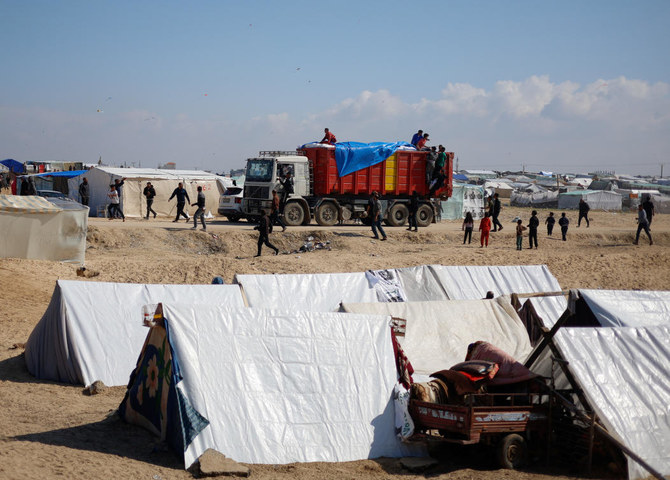
A truck carrying aid arrives at a tent camp, as Displaced Palestinians who fled their houses due to Israeli strikes, take shelter there near the border with Egypt in Rafah on Feb. 6, 2024. (Reuters)
4 / 4
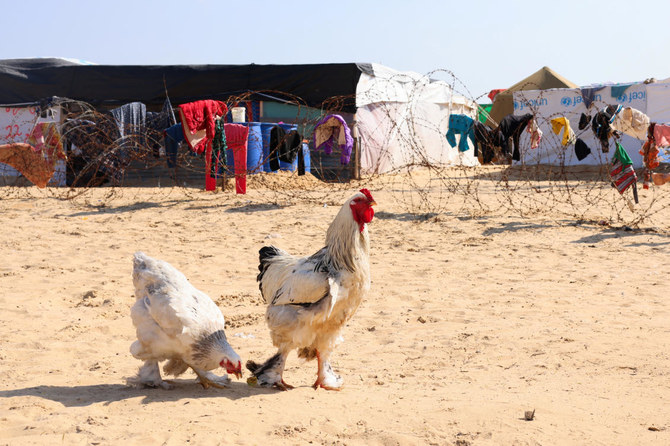
Chickens walk at a tent camp, amid the ongoing conflict between Israel and Hamas, at the border with Egypt, in Rafah in the southern Gaza Strip, on Feb. 7, 2024. (Reuters)
Short Url
Updated 08 February 2024
Follow

Displaced Gazans resort to living in chicken sheds

  • More than 85 percent of Gaza’s 2.3 million inhabitants have fled their homes, with about one million flocking into Rafah
  • For the Hanoon family, one of five in an extended clan that have moved in there, the chicken farm feels close to rock bottom

RAFAH, Gaza Strip: With one million Gazans displaced from their homes by Israeli bombardments seeking refuge in the border town of Rafah, five families have moved into a chicken farm, living in its long concrete sheds, the battery coops transformed into bunk beds.
The war that began on Oct. 7 with a Hamas attack on Israel that killed 1,200 people — drawing an Israeli military assault on Gaza that local health authorities say has killed more than 27,800 Palestinians — has devastated the enclave.
More than 85 percent of Gaza’s 2.3 million inhabitants have fled their homes, with about one million flocking into Rafah, hard against the Egyptian border. Many of them live in tents crammed into empty lots or patches of beach.
For the Hanoon family, one of five in an extended clan that have moved in there, the chicken farm feels close to rock bottom.
“We’re living in a place meant for animals,” said Umm Mahdi Hanoon, standing among the cages. “Imagine a child sleeping in a chicken crate.”
“The place is very bad. Water leaks down on us. The cold is really harsh for the children, for the old people, for those who are ill... sometimes we wish the morning won’t come,” she said.
Her son Mahdi said they had lived in the Sheikh Radwan neighborhood of Gaza City, an area that came under the path of Israel’s military offensive early in the war.
“We moved to Al-Zawayda. Due to the shelling we looked for another place but couldn’t find one because there are a lot of us. Then an acquaintance, a friend of my cousin’s, told me there’s a chicken farm in Rafah with cages,” he said.
“We struggled at first. There were insects. We have children,” he said, initially thinking they would only be there for a couple of days.
But as the time went by they had to accept that the chicken sheds would be their home for much longer. They used the metal frames of the cages as beds and cook bread, when they manage to find flour, on a metal stove on the floor.
“It is hard to live in a place like this, a place which was designed for chicken and birds. You find yourself in a cage,” Mahdi said.


In Sudan’s old port of Suakin, dreams of a tourism revival

Updated 6 sec ago
Follow

In Sudan’s old port of Suakin, dreams of a tourism revival

  • Inside the ruins of a mosque, a restoration crew is hard at work rebuilding this piece of Suakin, over a century after the city was abandoned
SUAKIN, Sudan: The mayor of Suakin dreams of a rebirth for his town, an ancient Red Sea port spared by the wars that have marked Sudan’s history but reduced to ruins by the ravages of time.
“It was called the ‘White City’,” for its unique buildings made of coral stone taken from the seabed, said mayor Abu Mohamed El-Amin Artega, who is also the leader of the Artega tribe, part of eastern Sudan’s Beja ethnic group.
Now the once-booming port and tourist draw languishes on the water, effectively forgotten for years as Sudan remains mired in a devastating war between the army and paramilitary forces.
But inside the ruins of a mosque, a restoration crew is hard at work rebuilding this piece of Suakin, over a century after the city was abandoned.
“Before the war, a lot of people came, a lot of tourists,” said Ahmed Bushra, an engineer with the association Safeguarding Sudan’s Living Heritage from Conflict and Climate Change (SSLH).
“We hope in the future, when peace comes to Sudan, they will come and enjoy our beautiful historic buildings here,” he told AFP.
Architecture student Doha Abdelaziz Mohamed is part of the crew bringing the mosque back to life with funding from the British Council and support from UNESCO.
“When I came here, I was stunned by the architecture,” the 23-year-old said.
The builders “used techniques that are no longer employed today,” she told AFP. “We are here to keep our people’s heritage.”

Abandoned

The ancient port — set on an oval island nestled within a lagoon — served for centuries as a transit point for merchant caravans, Muslim and Christian pilgrims traveling to Makkah and Jerusalem, and the regional slave trade, according to the Rome-based heritage institute ICCROM.
It became a vibrant crossroads under the Ottoman Empire, said Artega, 55, and its population grew to around 25,000 as a construction boom took off.
“The streets were so crowded that, as our forefathers said, you could hardly move.”
Everything changed in 1905, when the British built a deeper commercial port 60 kilometers (37 miles) north, to accommodate increased maritime traffic with the opening of the Suez Canal.
“Merchants and residents moved to Port Sudan,” the mayor said, lamenting the decline of what he calls “Sudan’s great treasure.”
But his Artega tribe, which has administered the city since the sixth century with powers “passed from father to son,” refused to leave.
His ancestor, he said, scolded the British: “You found a port as prosperous as a fine hen — you took its eggs, plucked its feathers and now you spit its bones back at us.”
As proof of the Artega’s influence, he keeps at home what he says are swords and uniforms gifted to his ancestors by Queen Victoria during the British colonial period.
The rise of Port Sudan spelled disaster for Suakin, whose grand public buildings and elegant coral townhouses were left to decay, slowly eaten away by the humid winds and summer heat.
But the 1990s brought new hope, with the opening of a new passenger port linking Suakin to Jeddah in Saudi Arabia.
Today, the Sudanese transport company Tarco operates daily crossings, carrying around 200 passengers per trip from the modern port of Suakin, within sight of the ancient city and its impoverished environs.

Lease to Turkiye

The city’s optimism grew in 2017 when then-president Omar Al-Bashir granted the old port to his Turkish counterpart, Recep Tayyip Erdogan, under a 99-year lease for touristic development.
A Turkish company restored the old governor’s palace, customs house and two mosques, but the project stalled in 2019 after Bashir fell from power in the face of mass protests.
Then, in April 2023, the cruise passengers and scuba divers who once stopped in Suakin completely vanished when fighting erupted between the army and the paramilitary Rapid Support Forces (RSF).
A rusting cargo ship now lies stranded on a sandbank in the blue lagoon, where only a handful of fishing boats float around.
But Bushra, from SSLH, remains optimistic. He hopes to see the mosque, which houses the tomb of a Sufi sheikh, host a traditional music festival when the renovation is complete, “in five months.”
“When we finish the restoration, the tourists can come here,” he said.