US lawmakers reject $17.6 billion Israel aid bill

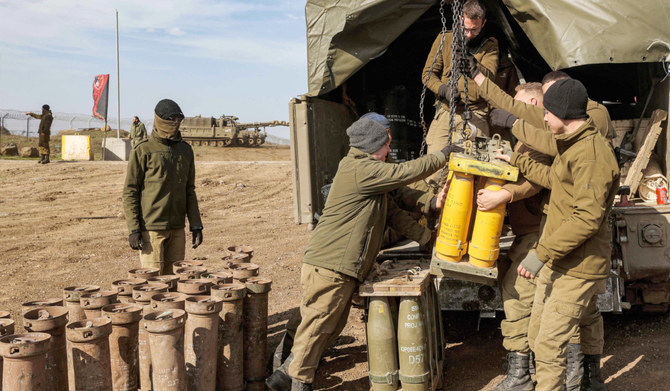
Israeli soldiers transport munitions off a vehicle at a position in the Israeli-annexed Golan Heights on January 2, 2023. (AFP)
Short Url
Updated 07 February 2024
Follow

US lawmakers reject $17.6 billion Israel aid bill

  • The standalone Israel bill would have provided $17.6 billion in military aid for the country, which is strongly supported by the vast majority of lawmakers in both parties as it responds to the deadly October 7 attacks by Hamas militants

WASHINGTON: US lawmakers voted Tuesday to reject a standalone Israel aid bill denounced by critics as a “cynical” bid to thwart a cross-party border security and foreign assistance package that would include cash for war-torn Ukraine.
Republicans in the House of Representatives scheduled the vote after the Democratic-led Senate released a bipartisan bill Sunday pairing billions of dollars for Israel and Ukraine with some of the strictest immigration curbs in decades.
But support for that $118 billion package has dwindled, with Donald Trump — who is running for a second White House term — pressuring Republicans to avoid handing President Joe Biden a legislative victory ahead of November’s election.
Republican House Speaker Mike Johnson said after the border and foreign aid bill was unveiled that it would be “dead on arrival” if it reached the lower chamber of Congress.
The standalone Israel bill would have provided $17.6 billion in military aid for the country, which is strongly supported by the vast majority of lawmakers in both parties as it responds to the deadly October 7 attacks by Hamas militants.
But 167 Democrats voted no after Biden had threatened to wield his veto, angered that the legislation appeared aimed at undermining the larger package, hammered out after months of negotiations with a bipartisan group of senators.
The standalone bill was also opposed by 13 Republicans as it did not contain budgetary offsets that conservatives have been pushing for with every proposal for new spending.
One of Johnson’s first actions when he took office in the fall was to shepherd a bill through the House that would have provided $14.3 billion to Israel.
But it included steep cuts to the Internal Revenue Service, which Biden opposed.
The ultra-conservative House Freedom Caucus blasted Johnson for “surrendering” to pressure for an even larger package which is not offset by cuts.
Biden’s Office of Management and Budget had said the Republican “ploy” would undermine efforts to secure the US border and support Ukraine against Russian aggression, while denying humanitarian assistance to Palestinian civilians caught in the crossfire of the Israel-Hamas conflict.
But Johnson countered at a news conference Tuesday that it was “outrageous and shameful” Biden would suggest vetoing support for Israel “in their hour of greatest need.”
House Democratic leaders called the bill a “nakedly obvious and cynical attempt” to undermine the larger package, which ties the Israel cash to $60 billion aid for Ukraine and $20 billion for US border security but is deadlocked in Congress.
“Unfortunately, the standalone legislation introduced by House Republicans over the weekend, at the 11th hour without notice or consultation, is not being offered in good faith,” House Democratic Minority Leader Hakeem Jeffries said in a letter to colleagues.


Baghdad traders protest new customs tariffs

Iraqi traders protest against the imposition of customs duties on imported goods in Baghdad, Iraq, Sunday, Feb. 8, 2026. (AP)
Updated 4 sec ago
Follow

Baghdad traders protest new customs tariffs

  • The demonstrators gathered outside the General Customs Directorate on Sunday, chanting slogans against corruption and rejecting the new fees

BAGHDAD: Hundreds of traders and owners of customs clearance companies protested in central Baghdad on Sunday, demanding that Iraq’s government reverse recently imposed customs tariffs they say have sharply increased their costs and disrupted trade.
The new tariffs that took effect on Jan. 1 were imposed to reduce the country’s debt and reliance on oil revenues, as oil prices have fallen.
Iraq faces a debt of more than 90 trillion Iraqi dinars ($69 billion) — and a state budget that remains reliant on oil for about 90 percent of revenues, despite attempts to diversify.
But traders say the new tariffs — in some cases as high as 30 percent — have placed an unfair burden on them. Opponents have filed a lawsuit aiming to reduce the decision, which Iraq’s Federal Supreme Court is set to rule on Wednesday.
The demonstrators gathered outside the General Customs Directorate on Sunday, chanting slogans against corruption and rejecting the new fees.
“We used to pay about 3 million dinars per container, but now in some cases they ask for up to 14 million,” said Haider Al-Safi, a transport and customs clearance company owner. 
“Even infant milk fees rose from about 495,000 dinars to nearly 3 million.”
He said that the new tariffs have caused a backlog of goods at the Umm Qasr port in southern Iraq and added that electric vehicles, previously exempt from customs duties, are now subject to a 15 percent fee.
“The main victim is the citizen with limited income, and government employee whose salary barely covers his daily living, those who have to pay rent, and have children with school expenses — they all will be affected by the market,” said Mohammed Samir, a wholesale trader from Baghdad.
Protesters also accused influential groups of facilitating the release of goods in exchange for lower unofficial payments, calling it widespread corruption. 
Many traders, they said, are now considering routing their imports through the Kurdistan region, where fees are lower.
The protests coincided with a nationwide strike by shop owners, who closed markets and stores in several parts of Baghdad to oppose the tariff increase. 
In major commercial districts, shops remained shut and hung up banners reading “Customs fees are killing citizens.”