Saudi Arabia: No diplomatic relations with Israel without Palestinian state

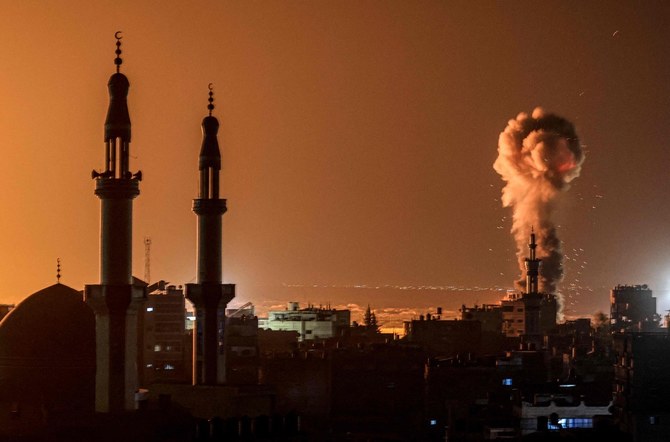
Smoke billows during Israeli bombardment in Rafah on the southern Gaza Strip amid ongoing battles between Israel and Hamas. (AFP)
Short Url
Updated 07 February 2024
Follow

Saudi Arabia: No diplomatic relations with Israel without Palestinian state

  • Kingdom’s foreign ministry calls for end to Israel’s aggression against Gaza, withdrawal of occupation forces

RIYADH: Saudi Arabia said there will be no diplomatic relations between the Kingdom and Israel unless Palestinians had an independent state, state news agency SPA reported early on Wednesday, citing a statement from the foreign ministry.
The statement by the foreign ministry said Riyadh was steadfast on Palestinians obtaining their legitimate rights.
“The Kingdom has communicated its firm position to the US administration that there will be no diplomatic relations with Israel unless an independent Palestinian state is recognized on the 1967 borders with East Jerusalem as its capital,” the statement said.
The official note addressed comments attributed to US National Security Council spokesperson John Kirby, without outlining his remarks.
Reuters reported on Tuesday that “Kirby said that the Biden administration has received positive feedback that Saudi Arabia and Israel are willing to continue to have normalization discussions.”
The Saudi statement also demanded “Israeli aggression on the Gaza Strip stops and all Israeli occupation forces withdraw from the Gaza Strip.”
The Kingdom called on permanent members of the UN Security Council to “expedite the recognition of the Palestinian state.”
US Secretary of State Antony Blinken met Saudi Crown Prince Mohammed bin Salman in Riyadh on Monday.
Blinken is on a regional tour to discuss the situation in Gaza with allies. He arrived in Israel after visiting Egypt and Qatar on Tuesday.


Economic growth and resilience at heart of 2nd AlUla Emerging Market Economies Conference

Updated 03 February 2026
Follow

Economic growth and resilience at heart of 2nd AlUla Emerging Market Economies Conference

  • Event on Feb. 8 and 9 will bring together ministers, governors of central banks, policymakers, economic experts and international financial institutions
  • Emerging-market economies a ‘pivotal element’ in global economic system due to effect they have on growth and stability, says Saudi Finance Minister Mohammed Al-Jadaan

RIYADH: The second annual AlUla Conference for Emerging Market Economies, which Saudi Arabia will host next week, offers a platform to exchange views on global developments and discuss policies and reforms that support inclusive growth and strengthen economic resilience, the Kingdom’s finance minister said.

The event on Feb. 8 and 9 will bring together finance ministers, governors of central banks and policymakers, alongside economic experts and representatives of international financial institutions.

Organized by the Saudi Ministry of Finance in partnership with the International Monetary Fund, it takes place as emerging-market economies face mounting challenges amid rapid global economic change.

Finance Minister Mohammed Al-Jadaan said the decision to host the conference reflects Saudi Arabia’s ongoing commitment to efforts that support global financial and economic stability, and highlights the growing influence of emerging economies on worldwide growth.

Emerging-market economies represent a “pivotal element” in the global economic system due to the direct impact they have on economic growth and stability, he added.

“The AlUla Conference for Emerging Market Economies provides a unique platform for exchanging views on global economic developments, and discussing policies and reforms that will support inclusive growth and enhance economic resilience, in light of broader international cooperation that contributes to confronting common challenges,” Al-Jadaan said.

Kristalina Georgieva, managing director of the IMF, said the event would help emerging economies deal with growing uncertainty driven by technological change, demographic shifts and geopolitical tensions.

“The AlUla conference provides a vital platform for emerging economies to discuss how they can navigate the risks and embrace the opportunities ahead,” she said.

“In these times of sweeping transformations in the global economy, policymakers face a more challenging and uncertain environment. Countries should work together to strengthen resilience through sound macroeconomic and financial policies.”