

Historic storm sends debris through LA’s Hollywood Hills, leaves 1.1 million without power

1 / 3
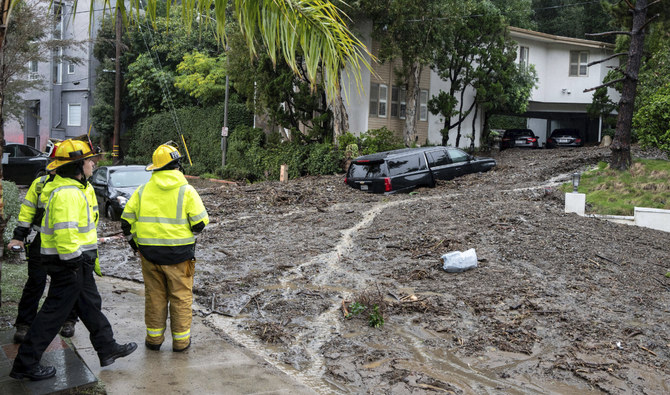
Firefighters look over damage from a large mudslide which occurred at the intersection of Beverly Drive and Beverly Place in the Beverly Crest area of Los Angeles on Monday, February 5, 2024. (AP)
2 / 3
Firefighters look over damage from a large mudslide which occurred at the intersection of Beverly Drive and Beverly Place in the Beverly Crest area of Los Angeles on Monday, February 5, 2024. (AP)
3 / 3
A fallen tree lies atop a car, as atmospheric river hitting California has caused damage across the state including downed trees, mudslides and swiftwater rescues in Los Angeles, California, U.S., February 5, 2024. (Reuters)
Short Url
Updated 06 February 2024
Follow

Historic storm sends debris through LA’s Hollywood Hills, leaves 1.1 million without power

LOS ANGELES: A storm of historic proportions dumped a record amount of rain over parts of Los Angeles on Monday, sending mud and boulders down hillsides dotted with multimillion-dollar homes while people living in homeless encampments in many parts of the city scrambled for safety.

More than one million people statewide were without power.

The storm was the second one fueled by an atmospheric river to hit the state over the span of days.

About 2.5 million people in the Los Angeles area, including the Hollywood Hills and Beverly Hills, were under a flash flood warning. Up to 9 inches (23 centimeters) of rain had already fallen in the area, with more expected, according to the National Weather Service, which called the flash flooding and threat of mudslides “a particularly dangerous situation.”

Already crews were rescuing people from swift-moving water in various parts of Southern California, including two homeless people who were evacuated Monday from a small island in the Santa Ana River in San Bernardino, about 55 miles (88.51 kilometers) east of Los Angeles, authorities said.

Gushing rivers carried mud, rocks and household objects downhill as floodwaters coursed through Studio City, an area on the backside of the Hollywood Hills.

Sixteen Studio City residents were evacuated and two homes were damaged, city officials said.

“It looks like a river that’s been here for years,” said Keki Mingus, whose neighbors’ homes were damaged. “I’ve never seen anything like it.”

The Los Angeles Fire Department said 1,000 firefighters were contending with 49 debris flows, 130 reports of flooding, half a dozen structure fires and several rescues of motorists stranded in vehicles.

Drake Livingston who lives in the Beverly Crest neighborhood, was watching a movie around midnight when a friend alerted him to flooding.

“We looked outside and there’s a foot-and-a-half of running water, and it starts seeping through the doors,” Livingston said.

Livingston scrambled to save some possessions but eventually had to retreat to a neighbor’s house. In the morning, Livingston’s car was submerged in several feet of mud.

Los Angeles Mayor Karen Bass urged residents to avoid driving, warning of fallen trees and electrical lines on flooded roadways.

Over 10 inches (25.4 centimeters) of rain has fallen in the Santa Monica Mountains. Los Angeles Fire Chief Kristin Crowley said hazards will continue to be a threat in areas around recent wildfire burn scars, noting that rain is forecast to continue into Tuesday.

A record 4.1 inches (10.41 centimeters) of rain fell Sunday in downtown Los Angeles, making it the 10th wettest day on record, the National Weather Service said. That’s more rain than the area typically gets for the entire month.

That didn’t stop the Grammy Awards on Sunday night from continuing as planned at downtown’s Crypto.com Arena.

The weather service forecast up to 8 inches (20 centimeters) of rainfall across Southern California’s coastal and valley areas, with 14 inches (35 centimeters) possible in the foothills and mountains over the next two days.

Commuters stepped through several inches of floodwater on Monday morning as they rushed to catch trains at Union Station in downtown Los Angeles.

The storm over the weekend inundated streets and brought down trees and electrical lines throughout the San Francisco Bay Area, while the weather service issued a rare “hurricane force wind warning” for the Central Coast. Several people had to be rescued from rising floodwaters, including those in cars and others living in a homeless encampments.

In Yuba City, about 100 miles (160 kilometers) northeast of San Francisco, police said they were investigating the death of a man found under a big redwood tree in his backyard Sunday evening. A neighbor heard the tree fall, and it was possible the man was using a ladder to try and clear the redwood when he was killed, police said on Facebook.

In Southern California, off the coast of Long Beach, 19 people were rescued Sunday after the 40-foot sailboat they were traveling in lost its mast, said Brian Fisk, a firefighter and paramedic for the Long Beach Fire Department.

Another vessel heard the distress call on the marine radio and helped rescue eight people while 11 were able to get onto the rocky breakwater by Alamitos Bay where they were rescued by lifeguards, he said. One person was treated for injuries.

“They went out sailing in gale-force winds and stormy weather,” Fisk said. “They’re very, very lucky.”

Gov. Gavin Newsom declared a state of emergency for most counties in coastal Southern California and said emergency resources were ready, while emergency shelters were opened.

Most public schools in Los Angeles were open, though other districts called off classes.

Heavy snow was falling throughout the Sierra Nevada and motorists were urged to avoid mountain roads.

Much of the state was still drying out from the initial atmospheric river-powered storm that blew in last week. Atmospheric rivers are relatively narrow plumes of moisture that form over an ocean and can produce torrential amounts of rain as they move over land.

Both atmospheric rivers were called a “Pineapple Express” because they originated near Hawaii.

Since last winter, 46 atmospheric rivers have made landfall on the US West Coast, pulling the state out of a yearslong drought, according to the Scripps Institution of Oceanography’s Center for Western Weather and Water Extremes. Nine were categorized as strong, two were extreme and one was exceptional.


War powers resolution fails in Senate as 2 Republicans bow to Trump pressure

Updated 15 January 2026
Follow

War powers resolution fails in Senate as 2 Republicans bow to Trump pressure

WASHINGTON: Senate Republicans voted to dismiss a war powers resolution Wednesday that would have limited President Donald Trump’s ability to conduct further attacks on Venezuela after two GOP senators reversed course on supporting the legislation.
Trump put intense pressure on five Republican senators who joined with Democrats to advance the resolution last week and ultimately prevailed in heading off passage of the legislation. Two of the Republicans — Sens. Josh Hawley of Missouri and Todd Young of Indiana — flipped under the pressure.
Vice President JD Vance had to break the 50-50 deadlock in the Senate on a Republican motion to dismiss the bill.
The outcome of the high-profile vote demonstrated how Trump still has command over much of the Republican conference, yet the razor-thin vote tally also showed the growing concern on Capitol Hill over the president’s aggressive foreign policy ambitions.
Democrats forced the debate after US troops captured Venezuelan leader Nicolás Maduro in a surprise nighttime raid earlier this month
“Here we have one of the most successful attacks ever and they find a way to be against it. It’s pretty amazing. And it’s a shame,” Trump said at a speech in Michigan Tuesday. He also hurled insults at several of the Republicans who advanced the legislation, calling Sen. Rand Paul of Kentucky a “stone cold loser” and Sens. Lisa Murkowski of Alaska and Susan Collins of Maine “disasters.” Those three Republicans stuck to their support for the legislation.
Trump’s latest comments followed earlier phone calls with the senators, which they described as terse. The president’s fury underscored how the war powers vote had taken on new political significance as Trump also threatens military action to accomplish his goal of possessing Greenland.
The legislation, even if it had cleared the Senate, had virtually no chance of becoming law because it would eventually need to be signed by Trump himself. But it represented both a test of GOP loyalty to the president and a marker for how much leeway the Republican-controlled Senate is willing to give Trump to use the military abroad. Republican angst over his recent foreign policy moves — especially threats of using military force to seize Greenland from a NATO ally — is still running high in Congress.
Two Republicans reconsider
Hawley, who helped advance the war powers resolution last week, said Trump’s message during a phone call was that the legislation “really ties my hands.” The senator said he had a follow-up phone call with Secretary of State Marco Rubio Monday and was told “point blank, we’re not going to do ground troops.”
The senator added that he also received assurances that the Trump administration will follow constitutional requirements if it becomes necessary to deploy troops again to the South American country.
“We’re getting along very well with Venezuela,” Trump told reporters at a ceremony for the signing of an unrelated bill Wednesday.
As senators went to the floor for the vote Wednesday evening, Young also told reporters he was no longer in support. He said that he had extensive conversations with Rubio and received assurances that the secretary of state will appear at a public hearing before the Senate Foreign Relations Committee.
Young also shared a letter from Rubio that stated the president will “seek congressional authorization in advance (circumstances permitting)” if he engaged in “major military operations” in Venezuela.
The senators also said his efforts were also instrumental in pushing the administration to release Wednesday a 22-page Justice Department memo laying out the legal justification for the snatch-and-grab operation against Maduro.
That memo, which was heavily redacted, indicates that the administration, for now, has no plans to ramp up military operations in Venezuela.
“We were assured that there is no contingency plan to engage in any substantial and sustained operation that would amount to a constitutional war,” according to the memo signed by Assistant Attorney General Elliot Gaiser.
Trump’s shifting rationale for military intervention
Trump has used a series of legal arguments for his campaign against Maduro.
As he built up a naval force in the Caribbean and destroyed vessels that were allegedly carrying drugs from Venezuela, the Trump administration tapped wartime powers under the global war on terror by designating drug cartels as terrorist organizations.
The administration has claimed the capture of Maduro himself was actually a law enforcement operation, essentially to extradite the Venezuelan president to stand trial for charges in the US that were filed in 2020.
Paul criticized the administration for first describing its military build-up in Caribbean as a counternarcotics operation but now floating Venezuela’s vast oil reserves as a reason for maintaining pressure.
“The bait and switch has already happened,” he said.
Trump’s foreign policy worries Congress
Lawmakers, including a significant number of Republicans, have been alarmed by Trump’s recent foreign policy talk. In recent weeks, he has pledged that the US will “run” Venezuela for years to come, threatened military action to take possession of Greenland and told Iranians protesting their government that ” help is on its way.”
Senior Republicans have tried to massage the relationship between Trump and Denmark, a NATO ally that holds Greenland as a semi-autonomous territory. But Danish officials emerged from a meeting with Vance and Rubio Wednesday saying a “fundamental disagreement” over Greenland remains.
“What happened tonight is a roadmap to another endless war,” Senate Democratic leader Chuck Schumer said at a news conference following the vote.
More than half of US adults believe President Donald Trump has “gone too far” in using the US military to intervene in other countries, according to a new AP-NORC poll.
House Democrats have also filed a similar war powers resolution and can force a vote on it as soon as next week.
How Republican leaders dismissed the bill

Last week’s procedural vote on the war powers resolution was supposed to set up hours of debate and a vote on final passage. But Republican leaders began searching for a way to defuse the conflict between their members and Trump as well as move on quickly to other business.
Once Hawley and Young changed their support for the bill, Republicans were able to successfully challenge whether it was appropriate when the Trump administration has said US troops are not currently deployed in Venezuela.
“We’re not currently conducting military operations there,” said Senate Majority Leader John Thune in a floor speech. “But Democrats are taking up this bill because their anti-Trump hysteria knows no bounds.”
Democratic Sen. Tim Kaine, who has brought a series of war powers resolutions this year, accused Republicans of burying a debate about the merits of an ongoing campaign of attacks and threats against Venezuela.
“If this cause and if this legal basis were so righteous, the administration and its supporters would not be afraid to have this debate before the public and the United States Senate,” he said in a floor speech.