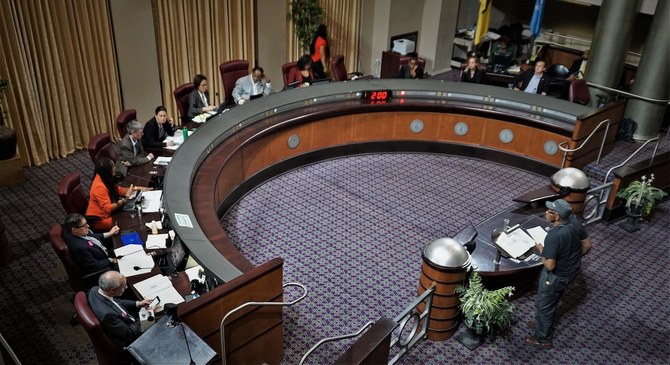
Californian council meeting goes viral online after residents defend Hamas

Speakers express support for militant group as Oakland council members vote for ‘immediate ceasefire’ in Israel-Hamas war. (City of Oakland/Website)
Short Url
Updated 01 December 2023
Follow

Californian council meeting goes viral online after residents defend Hamas

  • Speakers express support for militant group as Oakland council members vote for ‘immediate ceasefire’ in Israel-Hamas war

LONDON: A recent city council meeting in Oakland, California went viral online after speakers defended militant group Hamas.

And following debate, council members voted for an immediate ceasefire in the Israel-Hamas war.

In a clip shared online, one person attending the meeting said: “Calling Hamas a terrorist organization is ridiculous, racist, and plays into genocidal propaganda that is flooding our media and that we should be doing everything possible to combat.”


Another speaker referred to the group as a “resistance organization that is fighting for the liberation of Palestinian people in their land.”

Tye Gregory of the Jewish Community Relations Council Bay Area later told The Jewish News of Northern California that the meeting had been the “most antisemitic room I have ever been in.”

British journalist Piers Morgan shared the video on X and accused the commenters of being “brazen terrorist sympathizers.”

During the city council meeting, lawmakers unanimously approved a resolution calling for an “immediate ceasefire” in the conflict, the unrestricted entry of humanitarian assistance into Gaza, the restoration of food, water, electricity, and medical supplies to the Strip, and respect for international law.

They also called for a resolution that protected the security of all innocent civilians.


EU warns Meta it must open up WhatsApp to rival AI chatbots

Updated 09 February 2026
Follow

EU warns Meta it must open up WhatsApp to rival AI chatbots

  • The EU executive on Monday told Meta to give rival chatbots access to WhatsApp after an antitrust probe found the US giant to be in breach of the bloc’s competition rules

BRUSSELS: The EU executive on Monday told Meta to give rival chatbots access to WhatsApp after an antitrust probe found the US giant to be in breach of the bloc’s competition rules.
The European Commission said a change in Meta’s terms had “effectively” barred third-party artificial intelligence assistants from connecting to customers via the messaging platform since January.
Competition chief Teresa Ribera said the EU was “considering quickly imposing interim measures on Meta, to preserve access for competitors to WhatsApp while the investigation is ongoing, and avoid Meta’s new policy irreparably harming competition in Europe.”
The EU executive, which is in charge of competition policy, sent Meta a warning known as a “statement of objections,” a formal step in antitrust probes.
Meta now has a chance to reply and defend itself. Monday’s step does not prejudge the outcome of the probe, the commission said.
The tech giant rejected the commission’s preliminary findings.
“The facts are that there is no reason for the EU to intervene,” a Meta spokesperson said.
“There are many AI options and people can use them from app stores, operating systems, devices, websites, and industry partnerships. The commission’s logic incorrectly assumes the WhatsApp Business API is a key distribution channel for these chatbots,” the spokesperson said.
Opened in December, the EU probe marks the latest attempt by the 27-nation bloc to rein in Big Tech, many of whom are based in the United States, in the face of strong pushback by the government of US President Donald Trump.
- Meta in the firing line -
The investigation covers the European Economic Area (EEA), made up of the bloc’s 27 states, Iceland, Liechtenstein and Norway — with the exception of Italy, which opened a separate investigation into Meta in July.
The commission said that Meta is “likely to be dominant” in the EEA for consumer messaging apps, notably through WhatsApp, and accused Meta of “abusing this dominant position by refusing access” to competitors.
“We cannot allow dominant tech companies to illegally leverage their dominance to give themselves an unfair advantage,” Ribera said in a statement.
There is no legal deadline for concluding an antitrust probe.
Meta is already under investigation under different laws in the European Union.
EU regulators are also investigating its platforms Facebook and Instagram over fears they are not doing enough to tackle the risk of social media addiction for children.
The company also appealed a 200-million-euro fine imposed last year by the commission under the online competition law, the Digital Markets Act.
That case focused on its policy asking users to choose between an ad-free subscription and a free, ad-supported service, and Brussels and Meta remain in discussions over finding an alternative that would address the EU’s concerns.