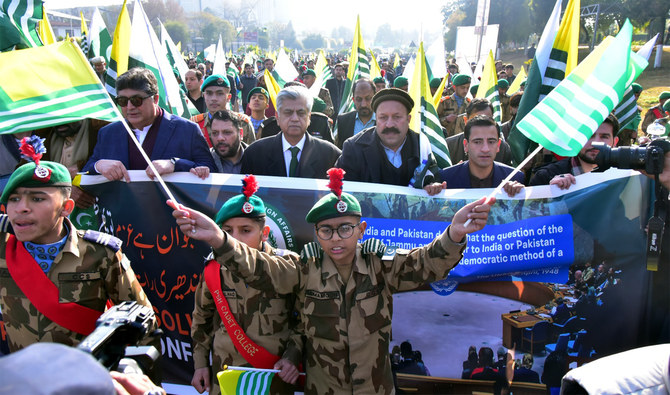
Pakistan observes Kashmir Solidarity Day today with rallies, speeches

Children wave Pakistan-administered Kashmir flags during a rally to mark Kashmir Solidarity Day in Islamabad, Pakistan, on February 5, 2024. (Government of Pakistan)
Short Url
Updated 05 February 2024
Follow

Pakistan observes Kashmir Solidarity Day today with rallies, speeches

  • Pakistan observes Kashmir Solidarity Day every year on Feb. 5 to express its support for people living in Indian-administered Kashmir 
  • Internationally disputed region has been a flashpoint between India and Pakistan since their independence from British rule in 1947

ISLAMABAD: Caretaker Prime Minister Anwaar-ul-Haq Kakar expressed his “unwavering support” for the people of Indian-administered Kashmir territory as Pakistan observes a public holiday today, Monday, to show solidarity with Kashmiris. 

The Muslim-majority Himalayan region of Kashmir has been a flashpoint between Pakistan and India since their independence from British rule in 1947. Both Pakistan and India rule parts of the Himalayan territory, but claim it in full and have fought two out of three wars over the disputed region. 

Pakistan has repeatedly called for the right of self-determination for the people of Indian-administered Kashmir and urged New Delhi to hold a plebiscite in line with the resolutions of the UN Security Council. 

“He [Kakar] said that the ‘Kashmir Solidarity Day’ was annually observed on the 5th February to express Pakistan’s unwavering support to the Kashmiri people’s just struggle for realization of their right to self-determination,” the state-run Associated Press of Pakistan (APP) said, quoting Kakar. 

Every year on Feb. 5, people from all walks of life hold demonstrations, form human chains and organize events in many parts of the country to express their support for the people of Indian-administered Kashmir. 

In connection with the Kashmir Solidarity Day, a walk is scheduled to be held in the Pakistani capital of Islamabad today, which would see participation from cabinet members, parliamentarians and people from different walks of life, according to the state-run Radio Pakistan.

In his message for Kashmir Solidarity Day, Pakistan’s President Dr. Arif Alvi said Kashmiris have been struggling for their rights for the past 76 years. 

“Today, IIOJK [Indian Illegally Occupied Jammu and Kashmir] is one of the most militarized zones in the world. Kashmiris are living in an environment of fear and intimidation,” Alvi said. 

In December last year, India’s Supreme Court upheld a 2019 decision by the government of Prime Minister Narendra Modi to revoke special autonomous status for Indian-administered Kashmir and set a deadline of Sept. 30 next year for state polls to be held.

The Modi government’s repealing of Article 370 of the constitution in 2019 allowed people from the rest of the country to have the right to acquire property in Indian-administered Kashmir and settle there permanently.

Kashmiris, rights groups and critics of the Indian government had termed the move an attempt to dilute the demographics of the only Muslim-majority Indian state.

It also heightened tensions between Pakistan and India, with Islamabad vowing not to normalize ties with New Delhi until it reverses its August 5 move. 


Pakistan top military commander urges ‘multi-domain preparedness’ amid evolving security threats

Updated 9 sec ago
Follow

Pakistan top military commander urges ‘multi-domain preparedness’ amid evolving security threats

  • Asim Munir says Pakistan faces layered challenges spanning conventional, cyber, economic and information domains
  • His comments come against the backdrop of tensions with India, ongoing militant violence in western border regions

ISLAMABAD: Pakistan’s top military commander Field Marshal Asim Munir on Tuesday stressed the need for “multi-domain preparedness” to counter a broad spectrum of security challenges facing the country, saying they ranged from conventional military threats to cyber, economic and information warfare.

Pakistan’s security environment has remained volatile following a brief but intense conflict with India earlier this year, when the two nuclear-armed neighbors exchanged missile and artillery fire while deploying drones and fighter jets over four days before a ceasefire was brokered by the United States.

Pakistan has also been battling militant violence in its western provinces of Khyber Pakhtunkhwa and Balochistan, where authorities say armed groups operate from across the border in Afghanistan and receive backing from India. Both Kabul and New Delhi have rejected claims.

The military has also warned that disinformation constitutes a new form of security threat, prompting tighter regulations that critics say risk suppressing dissent. Munir also pointed to a “complex and evolving” global, regional and internal security landscape while addressing participants in the National Security and War Course at the National Defense University (NDU).

“These challenges span conventional, sub-conventional, intelligence, cyber, information, military, economic and other domains, requiring comprehensive multi-domain preparedness, continuous adaptation and synergy among all elements of national power,” he said, according to a military statement.

“Hostile elements increasingly employ indirect and ambiguous approaches, including the use of proxies to exploit internal fault lines, rather than overt confrontation,” he continued, adding that future leaders must be trained and remain alert to recognize, anticipate and counter these multi-layered challenges.

Munir also lauded the NDU for producing strategic thinkers who he said were capable of translating rigorous training and academic insight into effective policy formulation and operational outcomes.