

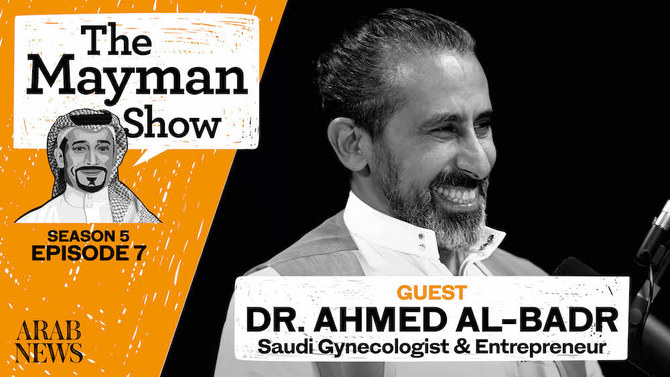

RIYADH: Herbs used for centuries by women in this part of the world are still effective, says renowned surgeon Dr. Ahmed Al-Badr, who has produced his own product based on these ancient remedies.
Speaking recently on the Arab News podcast The Mayman Show, Al-Badr said that his intimate wash, Byslan, improves overall health and wellbeing, and has been produced from lavender and myrrh.
Al-Badr said that myrrh, or murrah in Arabic, has a well-documented history of effectiveness spanning thousands of years, and is highly beneficial in treating women after surgery and childbirth, by assisting in healing and reducing pain.
The product is selling well, but the physician found he had to be careful about how to meet Saudi Arabia’s standards for such products, and could not make certain medical claims on the packaging.
“So what I do is I say murrah, in my social media accounts, I would say murrah is good for this and this and this. And then there is this wash which has murrah. So then that’s it.”
Al-Badr is the first Saudi Arabia doctor to specialize in gynecology, pelvic reconstructive surgery, and cosmetic gynecology. He started the first program for treating women with pelvic floor dysfunction at King Fahd Medical City in Riyadh, and developed fellowships for training obstetricians and gynecologists.
Al-Badr said that his work contributes to improving health and well-being as part of the Kingdom’s Quality of Life program, aligned with Vision 2030.
He praised the capabilities of doctors in Saudi Arabia. “When you go and see a Saudi doctor, you know that you’re in good hand. Because they’re well-trained and they’re very good,” he added.
Al-Badr has overcome significant obstacles in his career, but he believes in moving forward with positivity and creativity. His motto is: “Do not get sunk in thinking of the past … and just carry on.”
Initially, entering the field of gynecology as a male in Saudi Arabia was considered taboo, and he was rejected by a local hospital. But over time, this changed and he has treated citizens and expatriates seeking care.
“My father was like I encourage you to, if you think it’s a need, go ahead, do it. So that pushed me. And I guess I got something in the house that pushed me forward,” he said of how he first started out.
Despite being diagnosed with lung cancer in 2019, he continues to contribute to the advancement of his profession. His impact goes beyond the over 1,000 surgeries he has performed. He has written more than 50 academic articles and spoken at over 200 international and national conferences.
He is semi-retired now and planning, in his spare time, alongside the expansion of his product line, to produce educational videos for online distribution, on surgical procedures and healthcare interventions.


