

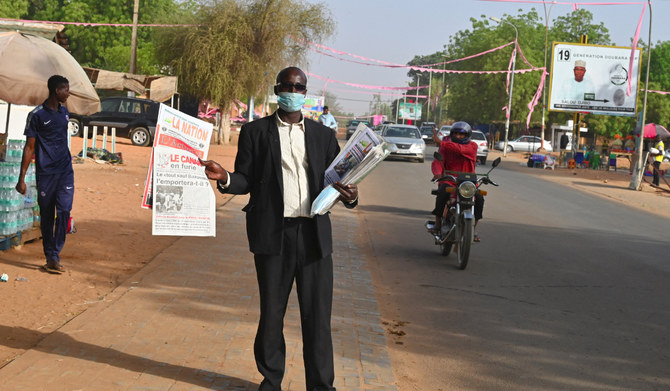

NIAMEY, Niger: Weak sales, deserting advertisers, falling revenues and unpaid wages: Niger’s newspaper industry has been buffeted by sanctions imposed on the country after military officers seized power in July.
Leaders of West African bloc ECOWAS slapped tough economic and financial measures on Niamey on July 30, four days after the coup.
As the latest of a series of putsches in the region, the Economic Community of West African States demanded the return to power of its democratically elected Niger president who remains in custody.
Niger was suspended from the bloc and, together with fellow post-coup Mali and Burkina Faso, announced on Sunday it was quitting the grouping.
The sanctions have hammered the economy of Niger, already one of the world’s poorest countries, provoking shortages of certain products and food price hikes.
Niger has a diverse mix of privately- and state-owned newspapers that include three dailies.
They are centered mainly in the capital Niamey and the northern town of Agadez, in a country where illiteracy remains at around 30 percent.
But the sector had only just got back on its feet after the Covid pandemic when the sanctions hit.
“As in other sectors, these sanctions have exacerbated the difficulties faced by the media,” Souleymane Brah, of the Maison de la Presse body that encompasses 30 media groups, told AFP.
Seminars, international conferences and workshops or other NGO activities, which are a staple source of funding for the media, have died off, he said.
Independent media have not escaped the trend either.
“Of the around 20 titles appearing regularly (before the sanctions), seven at most are currently being put out,” Souley Zaberou, president of the Nigerien Association of Independent Press Editors, said.
“The others have disappeared,” Zaberou, who is also director of the Le Temps weekly, added.
Printing costs have shot up.
To print 500 copies of a newspaper, the cost has risen from between 125,000 ($200) and 130,000 FCFA (around $217) before the coup to around 160,000 FCFA ($255) , Zaberou said.
Sales meanwhile have fallen.
Barely 100 copies out of every 500 on sale at the kiosks are sold, according to Zaberou, who said: “People don’t have money anymore.”
“If this situation goes on, no newspaper will be saved,” he warned.
It’s increasingly hard to cover costs, Ibrahim Manzo Diallo, director of the Air-Info weekly and Sahara FM radio based in Agadez, complained.
“Our revenues have fallen by 50 percent and we face more and more difficulties in paying the salaries and bills,” he said.
“All the NGOs from the European Union, the development projects have left with these sanctions,” Diallo said.
“They were our advertisers.”
At the bi-weekly La Roue de l’Histoire, things are similarly tight.
It has been forced to cut its print run from 2,500 copies before the sanctions, to just 500, chief editor Ibrahim Moussa said.
To keep its head above water, the publication has slashed 10 members from its editorial team.
“From the moment there’s no longer enough money, we can no longer keep everyone,” Moussa said.
In the immediate wake of the sanctions, the price of printing paper surged, Ali Soumana, director of Le Courrier weekly said.
“We juggle to print,” he lamented.
Prices for a roll of paper have doubled to between 35,000 and 40,000 FCFA, he said.
Broadcast media are also feeling the pinch.
Many TV staff are owed up to six months in salary arrears, Ismael Abdoulaye, general manager of the privately-owned Canal 3 television channel, said.
Most radio and TV stations have temporarily suspended daytime programming in a cost-cutting drive and now end broadcasting earlier than normal, according to their bosses.
“What to fear? It’s quite simply closure,” Abdoulaye warned.
Alarm about the media’s future in Niger is increasingly being voiced by those in the industry.
Urging authorities to keep a watchful eye on its members’ living conditions, the Union of Written Press and Audio-visual Professionals last week said those in privately-owned media face an “alarming and unprecedented precariousness.”


