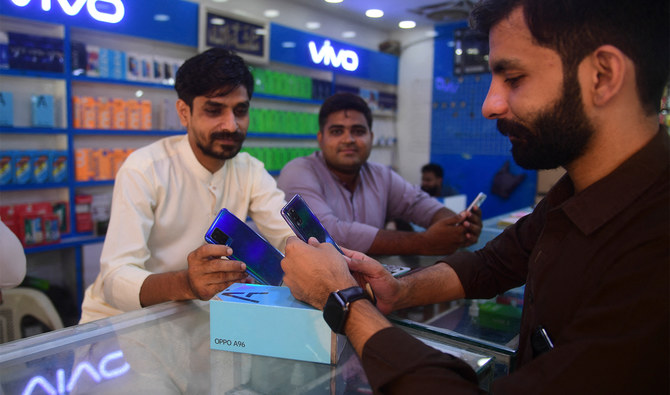

KARACHI: As local manufacturing of mobile phones continues to replace imports in Pakistan, the South Asian country is now targeting exporting $500 million worth of smartphones in the next two years and $5 billion in the next five, Pakistan’s caretaker IT minister has said.
Pakistan, a country of over 241 million people, is the 7th largest market of cellular users in the world, with 189 million people, or 78 percent of its population, owning mobile phones.
Pakistan used to be a net importer of mobile phones but gradually started replacing imports with local assembling of phones since 2016. In 2023, Pakistan made 21.28 million phones against imports of 1.58 million, according to data from the Pakistan Telecommunication Authority (PTA).
“We will also be announcing a plan to manufacture components in Pakistan (local deletion policy) and make the locally manufactured phones cheaper than imported phones using a tariff deferential policy,” Dr. Umar Saif, Pakistan’s IT minister, said in post on X after speaking at first Pakistan Mobile Summit in Islamabad on Monday.
“Our cell phones exports can grow to a billion dollar industry in the next few years.”
The minister highlighted the country’s recent achievements in mobile phone manufacturing, including assembling 9 million phones worth $1.5 billion and exporting 250,000 phones worth around $150 million.
“Pakistan has 33 handset manufacturers with a capacity to meet all of our local demand (25 million phones annually),” he added.
Pakistani mobile phone manufacturers said currently almost all mobile phone brands except iPhone were being assembled in Pakistan.
“All mobile brands except iPhone are being manufactured in Pakistan and mobile phone import has been largely replaced with local manufacturing,” Aamir Allawala, vice chairman of the Pakistan Mobile Phone Manufacturers Association (PMPMA), told Arab News on Tuesday.
Allawala said the industry was on a “strong footing” and had created 40,000 jobs so far. With localization of compounds, it would also increase revenue generation and more employment.
In the first phase, before 2020, Pakistan was mostly importing and distributing mobile phones but in the second phase it started local assembling of phones, Allawala added.
“We are now entering the next phase which is indigenization of components and the target parts, which are being focused on like charger, battery, hands-free, USB cable, and packaging,” the representative said.
“But there is a problem. For instance, if I import raw material for making charger’s casing the duty is too high and if I import charger the custom duty on it is zero. So obviously local manufacturing is not feasible.”
However, he hoped that the issue of duties would be resolved in the next budget. He also said Chinese mobile phone manufacturing companies had a combined export value of about $150 billion of their global sales which was an “emerging opportunity” for Pakistan, and a path to transition from a ‘Managed by China’ phase to a ‘Made by China’ one:
“For Chinese companies, Pakistan can become a base for export after the recent China-India dispute. Besides, in China the labor cost has jumped to $700 per month and labor for the factories is also not available.”