

RSG leads Saudi Arabia’s green transition with full fleet shift to low-carbon biofuel 

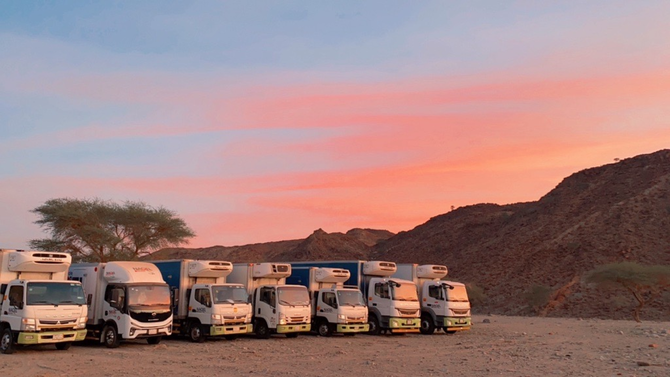
RSG’s entire fleet of land vehicles is now powered either by electricity or biofuel, making it the first company in the Kingdom to operate such an eco-conscious supply chain. Supplied
Short Url
Updated 28 January 2024
Follow

RSG leads Saudi Arabia’s green transition with full fleet shift to low-carbon biofuel 

RIYADH: Saudi Arabia’s sustainability drive gains momentum as multi-project developer Red Sea Global has become the first to use low-carbon biofuel in all delivery trucks. 

RSG’s entire fleet of land vehicles is now powered either by electricity or biofuel, making it the first company in the Kingdom to operate such an eco-conscious supply chain, according to a press statement.  

This shift from regular diesel usage to sustainable fuels is expected to reduce carbon emissions and extend vehicle engine life. 

The biofuel is produced from used cooking oil sourced within Saudi Arabia. The type of fuel RSG has adopted emits only 0.17 kilograms of carbon dioxide equivalent per liter, compared with 2.7kg CO2e per liter from regular diesel usage. 

RSG currently operates a fleet of six 8-tonne refrigerated trucks and three 3.5-tonne refrigerated trucks, all running on biofuel. 

The press statement added that each of these vehicles is equipped with a chip measuring the amount of biofuel used daily.  

This data will enable the fleet’s managers to analyze and optimize fuel consumption, thus enhancing the sustainability of RSG’s operations and strengthening its commitment to the environment. 

These trucks now transport goods to the five Red Sea hotels, including Turtle Bay, Six Senses, Southern Dunes, St. Regis Red Sea Resort, and Nujuma, a Ritz Carlton Reserve.  

This development also aligns with RSG’s long-term strategy to transition to green hydrogen throughout its mobility sector. By 2030, RSG aims to have between 700 and 800 vehicles in its sustainable fleet. 

RSG, wholly owned by Saudi Arabia’s Public Investment Fund, is developing The Red Sea and Amaala, two ambitious tourism destinations in the Kingdom.  

By 2030, the Red Sea megaproject will host a collection of 50 resorts comprising 8,000 hotel units and over 1,000 residential units spread across 22 islands and six mainland sites.  

Earlier this month, RSG introduced a state-of-the-art robot to clean its beaches sustainably. 

“With the capability to clean 3,000 sq. meters in just one hour, it efficiently sifts and collects plastic waste and debris, identifying items as small as one sq. centimeter,” said the company in a press statement.


Oman money supply rises 6.4% to $68.6bn in November 

Updated 4 sec ago
Follow

Oman money supply rises 6.4% to $68.6bn in November 

JEDDAH: Oman’s money supply climbed 6.4 percent to 26.4 billion Omani rials ($68.6 billion) in November, signaling solid liquidity conditions and continued growth in bank deposits, official data showed.  

The increase in broad money — a measure that includes cash in circulation and bank deposits — was driven by a 12.2 percent rise in cash and demand deposits, alongside a 4.1 percent increase in savings and time deposits, the Oman News Agency reported. 

The latest reading follows steady gains earlier in 2025, with money supply up 6.1 percent in the three months through August. This was supported by a 6.9 percent rise in narrow money and a 5.8 percent increase in quasi-money. The trend reflects sustained liquidity conditions and stronger deposit growth across the banking system. 

The expansion in monetary aggregates points to continued liquidity and policy support for private-sector lending, as Oman advances fiscal and economic reforms under its Vision 2040 strategy. 

“During the same period, currency in circulation increased 1.9  percent, while demand deposits rose 14.1 percent,” the ONA report stated. 

At conventional commercial banks, the weighted average deposit rate in Omani rials declined to 2.50 percent in November from 2.73 percent a year earlier, while the weighted average lending rate eased to 5.45 percent from 5.67 percent over the same period. 

The overnight interbank lending rate averaged 3.92 percent in November, down from 4.56 percent a year earlier, reflecting a decline in the weighted average repo rate to 4.5 percent from 5.30 percent, influenced by US Federal Reserve policy shifts. 

Meanwhile, total assets of Islamic banks and windows reached about 9.3 billion Omani rials by the end of November, accounting for 19.4 percent of the Gulf state’s total banking sector assets.  

“This marks a 12.3 percent increase compared with the same period in 2024,” ONA reported, citing data from the Central Bank of Oman. 

Total financing by Islamic banking units rose 10.3 percent to around 7.5 billion rials, while deposits increased 10.9 percent to approximately 7.3 billion rials by the end of November. 

The November data follows the International Monetary Fund’s 2025 Article IV consultation report, released earlier this month, which highlighted the continued resilience of Oman’s economy amid global uncertainty. 

The IMF cited steady growth in non-hydrocarbon sectors, low inflation, and broadly sound fiscal and external positions, underscoring the effectiveness of Oman’s coordinated economic and financial policies.