

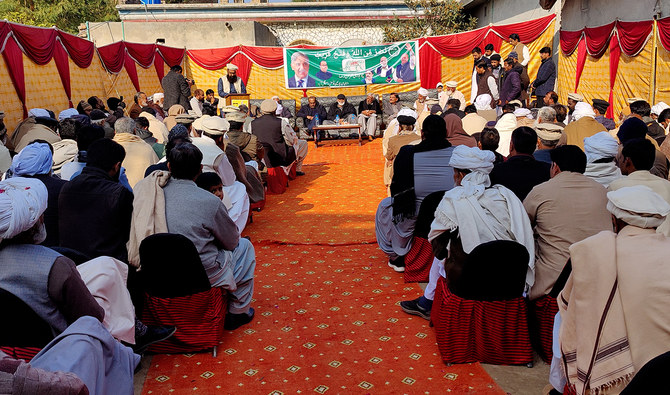

ISLAMABAD: As one enters the Chakwal city in Pakistan’s Punjab province, they are greeted by hundreds of banners and posters of rival candidates along the road who are contesting the upcoming national elections, scheduled for Feb. 8.
While electioneering in rural areas of the National Assembly’s NA-58 constituency remains dull, election activities in the city continue in full swing and show that it is going to be a clash of two traditional titans on election day.
The front-runners in NA-58 include Ayaz Amir, a noted journalist backed by former prime minister Imran Khan’s Pakistan Tehreek-e-Insaf (PTI) party, and Major (retired) Tahir Iqbal, the Pakistan Muslim League-Nawaz’s (PML-N) nominee, the party led by three-time former prime minister Nawaz Sharif.
Both candidates, who possess strong political legacies, are tirelessly campaigning in the constituency and holding back-to-back corner meetings to woo a majority of around 600,000 voters with their own set of promises and compelling slogans.
“We are telling people that this election is not about local issues,” Amir told Arab News this week, after addressing a charged meeting of supporters in Chakwal. “This is not about drains, or streets or street lights, it is about the future of Pakistan.”
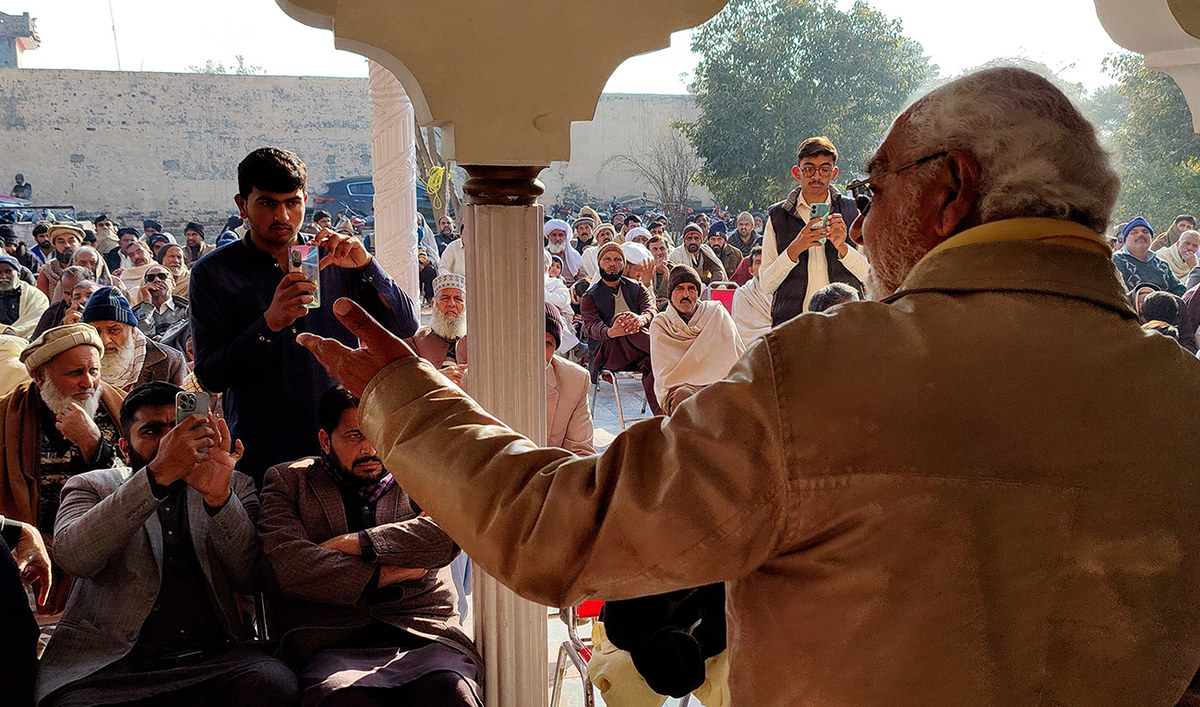
Ayaz Amir, electoral candidate from National Assembly’s NA-58 constituency speaks during an election campaign corner meeting in Chakwal, Pakistan on January 25, 2024. (AN Photo)
The PTI, which is backing Amir as its candidate, has been at the receiving end of a crackdown since May last year, when its supporters staged violent demonstrations across the country over Khan’s brief arrest in a graft case. The crackdown has seen several senior PTI figures defect, arrested or gone underground.
Khan, who remains in jail since August in a separate case, accuses the country’s powerful military and election authorities of trying to keep his party from winning the elections. The military and the election authorities deny the allegation.
Amir said the PTI was aiming for “real democracy” in the country, but they were not being granted a “level playing field” for the upcoming elections.
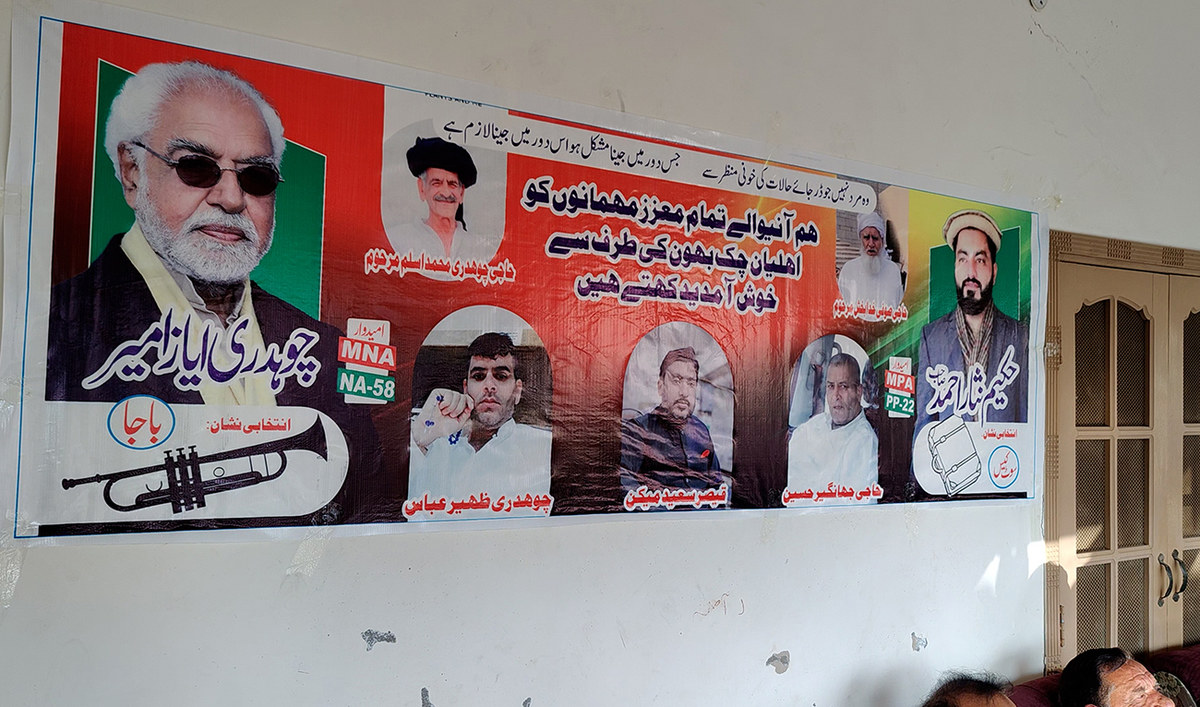
Banners of electoral candidates from National Assembly’s NA-58 constituency displayed in Chakwal, Pakistan on January 25, 2024. (AN Photo)
“The administration is trying its best to favor other candidates and make things difficult for the PTI, so it’s not level playing field at all,” he said. “Our first pitch will be for the return of real democracy in Pakistan, for the institution of the rule of law in Pakistan.”
Located around 130 kilometers from the federal capital of Islamabad, Chakwal is known as the land of ‘martial race’ as a vast majority of its residents have either served or are serving in the armed forces of Pakistan.
In 1951, Amir’s father Chaudhry Mohammad Amir Khan defeated an entrenched politician, Raja Mohammad Sarfraz Khan, who was the first legislator from the area to be elected to the Punjab Assembly in 1927. Amir’s father was elected again to the National Assembly in the country’s first general elections held in December 1970, but the seat fell vacant after his murder in August 1974.
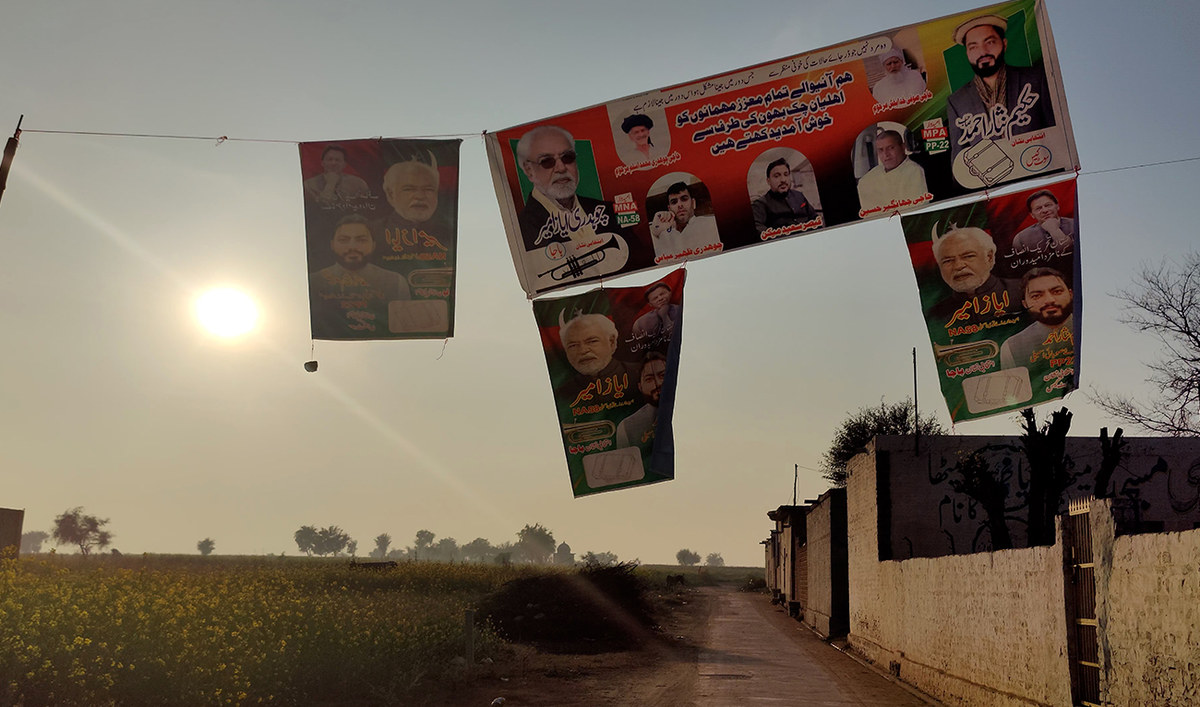
Banners of electoral candidates from National Assembly’s NA-58 constituency displayed in Chakwal, Pakistan on January 25, 2024. (AN Photo)
On the other hand, Iqbal is the nephew of late General (retired) Abdul Majeed Malik who won this National Assembly seat in five consecutive elections from 1985 till 1997.
In the 2002 elections, Amir lost this constituency to Iqbal by a margin of only 3,000 votes, but managed to reclaim it in the 2008 elections, with a record 125,437 votes, the highest among all winners in Punjab. Amir did not contest the 2013 general election, and Iqbal won this seat again. In 2018, Zulfiqar Ali Khan Dullah won the seat on PTI’s ticket.
Like Amir, Iqbal has also been rigorously campaigning in the constituency and addressing multiple corner meetings daily. He hopes to win the election based on his past performance and proximity with the constituents.
“The main reason is I have been performing even in opposition,” he told Arab News. “I have tried my best to stay here and be involved with my people and do something that is possible for me to get done.”
If elected to parliament again, Iqbal said, he would try to initiate four major projects in the district, including a cardiology center, a medical college, completion of a 400-bed general hospital and a campus of the Punjab University.
The PML-N candidate said he had been with his constituents through thick and thin and hence expected the people to vote for him.
Last month, Pakistan’s election regulator also deprived the PTI of its election symbol, a cricket bat, which is reflective of Khan’s past as a successful cricketer, who led Pakistan to their only 50-over World Cup win in 1992. In Pakistan, the adult literacy rate is just 58 percent that makes election symbols on ballot papers vital for people to rightly vote for a candidate of their choice.
Amir considers the loss of his party’s symbol a disadvantage and is contesting the polls as an independent candidate with a ‘saxophone’ symbol. He, however, says the response of the constituents has been “remarkable” due to Khan’s popularity.
“In the previous campaigns, someone like me would run after voters, this time the voter is coming to us because of the PTI’s mass appeal,” he said.
Asked about the possibility of PTI-backed independents deserting the party after winning the polls, Amir said it was not possible as they all were “diehard PTI followers.”
“We can’t even think of what you’re suggesting,” he said. “These are diehard PTI followers, so the question of them breaking the ranks doesn’t arise.”
Habib Akram, a political analyst, says the candidacy of Amir, a prominent journalist and columnist, in NA-58 had given the constituency much prominence, though it was just one out 141 constituencies in Punjab.
“In the 2018 elections, the PML-N could not win even a single National Assembly seat in north Punjab, including Chakwal, Jhelum and Attock, and this pattern seems to follow in this election as well,” Akram told Arab News.
“In Chakwal, majority of the votes are driven by the candidates’ personality and indeed, Ayaz Amir has got an edge over his rival and is believed to be a favorite candidate in this election.”


