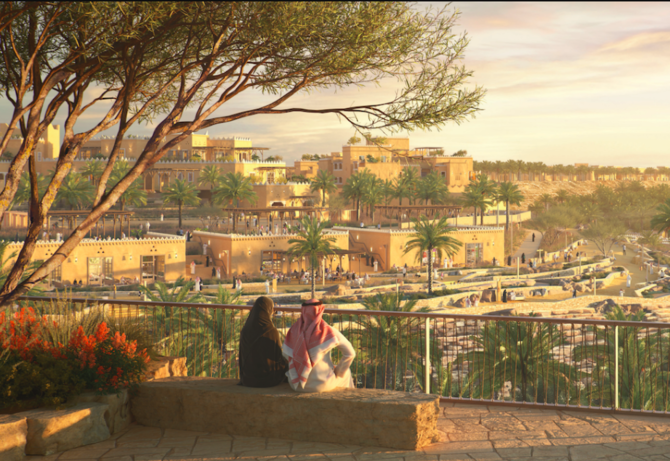
Private sector investments in Diriyah project now at $6bn: CEO

The historic seat of the nascent Saudi state, Diriyah’s At-Turaif district is a UNESCO World Heritage site attracting attention around the world and creating jobs at home. File.
Short Url
Updated 25 January 2024
Follow

Private sector investments in Diriyah project now at $6bn: CEO

RIYADH: Private sector investments in Saudi Arabia’s Diriyah project have reached SR22.50 billion ($6 billion), as the Kingdom continues its tourism push, said a top official.

Jerry Inzerillo, CEO of Diriyah Gate Development Authority, said that major investments in the heritage site are happening in the hotels, restaurants, retail, and residential sectors.

According to Inzerillo, this flurry of acquisitions coincides with the authorities’ spending of SR30 billion on infrastructure, new roads, water, and electricity.

“Hotels and investment are two highly intriguing matters, and what we are discovering now with hotels, restaurants, retail, and housing is that there is a considerable amount of investment in the private sector,” said the CEO, in an interview with CNBC Arabia,

He added: “So, this year, with the infrastructure and all the new roads, water, and electricity, we spent SR30 billion on all these matters. We find that we already have commitments totaling $6 billion from private sector investments in hotels, retail, and restaurants.”

Developing Diriyah is one of the most crucial agendas for Saudi Arabia, as the Kingdom aims to evolve as a global tourist hub, aligned with the goals outlined in Vision 2030.

The attraction is a $62.2 billion development project located 15 minutes northwest of Riyadh. The heritage site is home to the At-Turaif UNESCO World Heritage Site.

On Jan. 22, Diriyah Co. announced the completion of the tunnel highway for the Western Ring Road, a project connecting Diriyah to one of Riyadh’s main highways at exit 38.

According to the company, the new route is expected to ensure traffic safety and will enhance the quality of life for citizens, providing improved access to Diriyah and the rest of Riyadh.

Earlier in January, during the Saudi Tourism Forum, Inzerillo told Arab News that Riyadh will be undergoing consistent transformative change “every year” that will allow visitors and residents to feel a palpable difference.

In December, global hospitality giant Mariott International conducted a groundbreaking ceremony for its flagship project, The Ritz-Carlton, in Diriyah.

This hotel is expected to open in 2026, and will feature 195 guestrooms, including 34 suites, a specialty restaurant, and an all-day dining venue.


Multilateralism strained, but global cooperation adapting: WEF report

Updated 10 January 2026
Follow

Multilateralism strained, but global cooperation adapting: WEF report

DUBAI: Overall levels of international cooperation have held steady in recent years, with smaller and more innovative partnerships emerging, often at regional and cross-regional levels, according to a World Economic Forum report.

The third edition of the Global Cooperation Barometer was launched on Thursday, ahead of the WEF’s annual meeting in Davos from Jan. 19 to 23.

“The takeaway of the Global Cooperation Barometer is that while multilateralism is under real strain, cooperation is not ending, it is adapting,” Ariel Kastner, head of geopolitical agenda and communications at WEF, told Arab News.

Developed alongside McKinsey & Company, the report uses 41 metrics to track global cooperation in five areas: Trade and capital; innovation and technology; climate and natural capital; health and wellness; and peace and security.

The pace of cooperation differs across sectors, with peace and security seeing the largest decline. Cooperation weakened across every tracked metric as conflicts intensified, military spending rose and multilateral mechanisms struggled to contain crises.

By contrast, climate and nature, alongside innovation and technology, recorded the strongest increases.

Rising finance flows and global supply chains supported record deployment of clean technologies, even as progress remained insufficient to meet global targets.

Despite tighter controls, cross-border data flows, IT services and digital connectivity continued to expand, underscoring the resilience of technology cooperation amid increasing restrictions.

The report found that collaboration in critical technologies is increasingly being channeled through smaller, aligned groupings rather than broad multilateral frameworks.  

This reflects a broader shift, Kastner said, highlighting the trend toward “pragmatic forms of collaboration — at the regional level or among smaller groups of countries — that advance both shared priorities and national interests.”

“In the Gulf, for example, partnerships and investments with Asia, Europe and Africa in areas such as energy, technology and infrastructure, illustrate how focused collaboration can deliver results despite broader, global headwinds,” he said.

Meanwhile, health and wellness and trade and capital remained flat.

Health outcomes have so far held up following the pandemic, but sharp declines in development assistance are placing growing strain on lower- and middle-income countries.

In trade, cooperation remained above pre-pandemic levels, with goods volumes continuing to grow, albeit at a slower pace than the global economy, while services and selected capital flows showed stronger momentum.

The report also highlights the growing role of smaller, trade-dependent economies in sustaining global cooperation through initiatives such as the Future of Investment and Trade Partnership, launched in September 2025 by the UAE, New Zealand, Singapore and Switzerland.

Looking ahead, maintaining open channels of communication will be critical, Kastner said.

“Crucially, the building block of cooperation in today’s more uncertain era is dialogue — parties can only identify areas of common ground by speaking with one another.”