KYIV: A new report warns that the number of soldiers killed, injured or missing on both sides of Russia’s war on Ukraine could hit 2 million by the spring, with Russia suffering the largest number of troop deaths recorded for any major power in any conflict since World War II.
The report from the Center for Strategic and International Studies came less than a month before the fourth anniversary of Moscow’s full-scale invasion of Ukraine on Feb. 24.
The CSIS report, released Tuesday, said Russia suffered 1.2 million casualties, including up to 325,000 troop deaths, between February 2022 and December 2025.
“Despite claims of battlefield momentum in Ukraine, the data shows that Russia is paying an extraordinary price for minimal gains and is in decline as a major power,” the report said. “No major power has suffered anywhere near these numbers of casualties or fatalities in any war since World War II.”
It estimated that Ukraine, with its smaller army and population, had suffered between 500,000 to 600,000 military casualties, including up to 140,000 deaths.
Neither Moscow nor Kyiv gives timely data on military losses, and each side seeks to amplify the other side’s casualties.
Commenting on the report, Kremlin spokesperson Dmitry Peskov said Wednesday that the research could not be considered “reliable information” and that only Russia’s Ministry of Defense was authorized to provide information on military losses.
The ministry’s last statement on battlefield deaths was in September 2022, when it said that just under 6,000 Russian soldiers had been killed. It has not released any updated figures since then.
There was no immediate comment from the Ukrainian government.
In an interview with NBC in February 2025, Ukrainian President Volodymyr Zelensky said that more than 46,000 Ukrainian soldiers had been killed since the war began.
The report estimated that at current rates, combined Russian and Ukrainian casualties may be as high as 1.8 million and could reach 2 million by spring.
The figures from the CSIS were compiled using the Washington, D.C.-based think tank’s own analysis, data published by independent Russian news site Mediazona with the BBC, estimates by the British government and interviews with state officials.
A war of attrition
Reports about military losses have been repressed in Russian media, activists and independent journalists say.
Mediazona, together with the BBC and a team of volunteers, has so far collected the names of over 160,000 troops killed by scouring news reports, social media and government websites.
The report also said that Russian forces were advancing at a sluggish pace since it seized the initiative on the battlefield in 2024, despite its much larger size.
Russia’s advance in Ukraine has largely settled into a grinding war of attrition, and analysts say that Russian President Vladimir Putin is in no rush to find a settlement, despite his army’s difficulties on the roughly 1,000-kilometer (600-mile) front line.
The report said Russian forces have advanced at an average rate of between 15 and 70 meters (49 to 230 feet) per day in their most prominent offensives.
That is “slower than almost any major offensive campaign in any war in the last century,” the report said.
Putin told his annual news conference last month that 700,000 Russian troops are fighting in Ukraine. He gave the same number in 2024, and a slightly lower figure — 617,000 — in December 2023. It was not possible to verify those figures.
2 killed in attack in Kyiv region
Officials said Wednesday that two people were killed near the Ukrainian capital and at least nine others were injured in attacks across Ukraine.
A man and a woman died in an overnight attack in the Bilohorodka area on the outskirts of Kyiv, according to Mykola Kalashnyk, head of the regional military administration.
Officials in the Ukrainian cities of Odesa and Kryvyi Rih, as well as the Zaporizhzhia region, also reported Russian strikes overnight, wounding at least nine people and damaging infrastructure.
Ukraine’s air force said that Russia attacked overnight with one ballistic missile and 146 strike drones, 103 of which were shot down or destroyed using electronic warfare.
Meanwhile, Russia’s Ministry of Defense said its air defenses destroyed 75 Ukrainian drones overnight. Twenty-four were shot down over Russia’s southwestern Krasnodar region, with 23 more shot down over the Crimean Peninsula, which Russia illegally annexed in 2016.
Two drones were reportedly shot down over Russia’s Voronezh region, where Ukraine’s General Staff said Wednesday that it had struck the Khokholskaya oil depot. Regional Gov. Alexander Gusev wrote on Telegram that falling drone debris sparked a fire involving oil products, but did not give further details.

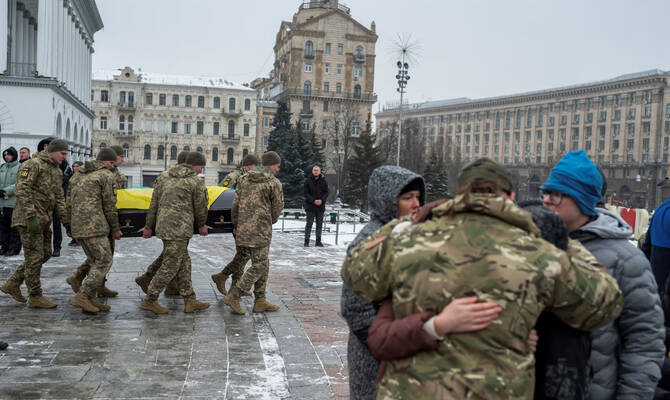
A new report warns that combined war casualties in Russia’s war on Ukraine could soon hit 2 million
Short Url
https://arab.news/583be
A new report warns that combined war casualties in Russia’s war on Ukraine could soon hit 2 million
- The CSIS report said Russia suffered 1.2 million casualties, including up to 325,000 troop deaths
- “Russia is paying an extraordinary price for minimal gains and is in decline as a major power”
Thailand PM Anutin consolidates power with dominating election win
- Bhumjaithai Party wins clear victory after a nationalist campaign amid Cambodia conflict
- Vote also included a referendum on a new constitution to replace a 2017 military-backed charter
BANGKOK: Thai Prime Minister Anutin Charnvirakul’s Bhumjaithai Party won a clear victory in Sunday’s general election, raising the prospect that a more stable coalition may now succeed in bringing an end to a period of prolonged political instability.
Anutin set the stage for the snap election in mid-December during a border conflict between Thailand and Cambodia, a move political analysts said appeared to be timed by the conservative leader to cash in on surging nationalism.
It is a gamble that paid off for a prime minister, who — having taken over after premier Paetongtarn Shinawatra of the populist Pheu Thai party was ousted over the Cambodian crisis — then dissolved parliament less than 100 days later.
“Bhumjaithai’s victory today is a victory for all Thais, whether you voted for Bhumjaithai Party or not,” Anutin told a press briefing. “We have to do the utmost to serve the Thai people to our full ability.”
With nearly 95 percent of polling stations reporting, preliminary results released by the election commission showed the Bhumjaithai Party winning about 192 seats, compared to 117 for the progressive People’s Party, and 74 for the once-dominant Pheu Thai party.
A handful of other parties won a combined 117 spots in the 500-seat parliament, according to a Reuters calculation of election commission data.
Power to govern
When Anutin dissolved parliament in December, he cited dysfunction and infighting between rival parties as making it impossible to lead a minority government.
While the Bhumjaithai Party was unlikely to win a majority outright, the results suggest it is in a strong position to push through campaign pledges, said Napon Jatusripitak, a political scientist at the Bangkok-based Thailand Future think-tank. Those include implementing a consumer subsidy program and ditching an agreement with Cambodia over maritime claims.
“For the first time in a long time, we will likely have a government that has sufficient effective power to govern,” he said. “We are seeing what I would describe as a marriage of convenience between technocrats, conservative elites, and traditional politicians.”
Critical to Anutin’s success were his embrace of nationalism and Bhumjaithai’s strategy of winning over politicians from rival parties in rural areas, analysts said.
“The scale of its victory was unanticipated, perhaps demonstrating that the more nationalist political environment and its ability to consolidate the conservative electorate all worked in its favor,” said Mathis Lohatepanont, an independent political analyst.
Coalition bid rejected
Speaking as results were coming in, People’s Party leader Natthaphong Rueangpanyawut conceded that, while some votes had yet to be counted, his party did not look likely to win.
Natthaphong said the party would not join a Bhumjaithai-led government but would also not form a competing coalition.
“If Bhumjaithai can form a government, then we have to be the opposition,” he told a press conference.
With a message of structural change and reforms to Southeast Asia’s second-largest economy, the People’s Party had led most opinion polls during the campaign season.
But in a survey conducted during the campaign’s final week and released on Sunday, the National Institute for Development Administration projected that Bhumjaithai would be the winner with between 140 and 150 seats in the 500-member House of Representatives, ahead of 125-135 for the People’s Party.
The progressive party’s earlier support for Anutin as prime minister was likely a severe miscalculation, undermining its own ideological purity and allowing Bhumjaithai to attain the benefits of incumbency, Mathis said.
Speaking to Reuters, Natthaphong said he did not see the election as the result of any mistakes by his party, but instead highlighted that its opponents had not been complacent.
“I’m not blaming any factors. Our responsibility now has to be to focus on the grassroots,” he said. “We’ve done a lot already but haven’t been able to crack what they have. It wasn’t good enough.”
Constitutional referendum
Thai voters were also asked during the vote to decide if a new constitution should replace a 2017 military-backed charter that critics say concentrated power in undemocratic institutions, including a powerful senate that is chosen through an indirect selection process with limited public participation.
The election commission’s early count showed voters backing the referendum by a margin of nearly two to one.
Thailand has had 20 constitutions since the end of its absolute monarchy in 1932, with most of the changes coming in the wake of military coups.
The new government and lawmakers can start the amendment process in parliament with two more referendums required to adopt a new constitution.
Anutin set the stage for the snap election in mid-December during a border conflict between Thailand and Cambodia, a move political analysts said appeared to be timed by the conservative leader to cash in on surging nationalism.
It is a gamble that paid off for a prime minister, who — having taken over after premier Paetongtarn Shinawatra of the populist Pheu Thai party was ousted over the Cambodian crisis — then dissolved parliament less than 100 days later.
“Bhumjaithai’s victory today is a victory for all Thais, whether you voted for Bhumjaithai Party or not,” Anutin told a press briefing. “We have to do the utmost to serve the Thai people to our full ability.”
With nearly 95 percent of polling stations reporting, preliminary results released by the election commission showed the Bhumjaithai Party winning about 192 seats, compared to 117 for the progressive People’s Party, and 74 for the once-dominant Pheu Thai party.
A handful of other parties won a combined 117 spots in the 500-seat parliament, according to a Reuters calculation of election commission data.
Power to govern
When Anutin dissolved parliament in December, he cited dysfunction and infighting between rival parties as making it impossible to lead a minority government.
While the Bhumjaithai Party was unlikely to win a majority outright, the results suggest it is in a strong position to push through campaign pledges, said Napon Jatusripitak, a political scientist at the Bangkok-based Thailand Future think-tank. Those include implementing a consumer subsidy program and ditching an agreement with Cambodia over maritime claims.
“For the first time in a long time, we will likely have a government that has sufficient effective power to govern,” he said. “We are seeing what I would describe as a marriage of convenience between technocrats, conservative elites, and traditional politicians.”
Critical to Anutin’s success were his embrace of nationalism and Bhumjaithai’s strategy of winning over politicians from rival parties in rural areas, analysts said.
“The scale of its victory was unanticipated, perhaps demonstrating that the more nationalist political environment and its ability to consolidate the conservative electorate all worked in its favor,” said Mathis Lohatepanont, an independent political analyst.
Coalition bid rejected
Speaking as results were coming in, People’s Party leader Natthaphong Rueangpanyawut conceded that, while some votes had yet to be counted, his party did not look likely to win.
Natthaphong said the party would not join a Bhumjaithai-led government but would also not form a competing coalition.
“If Bhumjaithai can form a government, then we have to be the opposition,” he told a press conference.
With a message of structural change and reforms to Southeast Asia’s second-largest economy, the People’s Party had led most opinion polls during the campaign season.
But in a survey conducted during the campaign’s final week and released on Sunday, the National Institute for Development Administration projected that Bhumjaithai would be the winner with between 140 and 150 seats in the 500-member House of Representatives, ahead of 125-135 for the People’s Party.
The progressive party’s earlier support for Anutin as prime minister was likely a severe miscalculation, undermining its own ideological purity and allowing Bhumjaithai to attain the benefits of incumbency, Mathis said.
Speaking to Reuters, Natthaphong said he did not see the election as the result of any mistakes by his party, but instead highlighted that its opponents had not been complacent.
“I’m not blaming any factors. Our responsibility now has to be to focus on the grassroots,” he said. “We’ve done a lot already but haven’t been able to crack what they have. It wasn’t good enough.”
Constitutional referendum
Thai voters were also asked during the vote to decide if a new constitution should replace a 2017 military-backed charter that critics say concentrated power in undemocratic institutions, including a powerful senate that is chosen through an indirect selection process with limited public participation.
The election commission’s early count showed voters backing the referendum by a margin of nearly two to one.
Thailand has had 20 constitutions since the end of its absolute monarchy in 1932, with most of the changes coming in the wake of military coups.
The new government and lawmakers can start the amendment process in parliament with two more referendums required to adopt a new constitution.
© 2026 SAUDI RESEARCH & PUBLISHING COMPANY, All Rights Reserved And subject to Terms of Use Agreement.