QAMISHLI, Syria: Russian forces have begun pulling out of positions in northeast Syria in an area still controlled by the Kurdish-led Syrian Democratic Forces after the group lost most of its territory in an offensive by government forces.
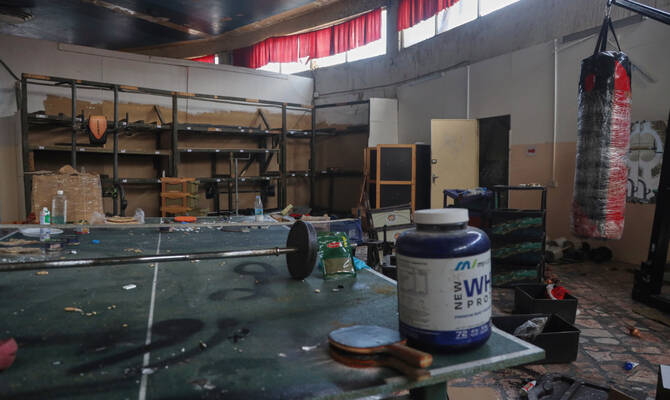
Associated Press journalists visited one base next to the Qamishli airport Tuesday and found it guarded by SDF fighters who said the Russians had begun moving their equipment out in recent days.
Inside what had been living quarters for the soldiers was largely empty, with scattered items left behind, including workout equipment, protein powder and some clothing.
Ahmed Ali, an SDF fighter deployed at the facility, said the Russian forces began evacuating their positions around the airport five or six days ago, withdrawing their equipment via a cargo plane.
“We don’t know if its destination was Russia or the Hmeimim air base,” he said, referring to the main Russian base on Syria’s coast. “They still have a presence in Qamishli and have been evacuating bit by bit.”
A UN humanitarian convoy from Damascus reached Qamishli on Tuesday, UN spokesman Stéphane Dujarric said.
“It delivered food, warm clothes and blankets, among other supplies,” he told UN reporters. “More convoys are planned in the coming days.”
Dujarric said the UN is also continuing to distribute food, bread and cash elsewhere including displacement sites.
There has been no official statement from Russia about the withdrawal of its forces from Qamishli.
Russia has built relations with the new central Syrian government in Damascus since former President Bashar Assad was ousted in December 2024 in a rebel offensive led by now-interim President Ahmad Al-Sharaa — despite the fact that Moscow was a close ally of Assad.
Moscow’s scorched-earth intervention in support of Assad a decade ago turned the tide of Syria’s civil war at the time, keeping Assad in his seat. Russia didn’t try to counter the rebel offensive in late 2024 but gave asylum to Assad after he fled the country.
Despite having been on opposite sides of the battle lines during the civil war, the new rulers in Damascus have taken a pragmatic approach to relations with Moscow. Russia has retained a presence at its air and naval bases on the Syrian coast.
Al-Sharaa is expected to visit Moscow on Wednesday and meet with Putin.
Fighting broke out early this month between the SDF and government forces after negotiations over a deal to merge their forces together broke down. A ceasefire is now in place and has been largely holding.
After the expiration of a four-day truce Saturday, the two sides announced the ceasefire had been extended by another 15 days.
Syria’s defense ministry said in a statement that the extension was in support of an operation by US forces to transfer accused Daesh militants who had been held in prisons in northeastern Syria to detention centers in Iraq.

Russian forces begin pulling out of bases in northeast Syria
https://arab.news/9ca4a
Russian forces begin pulling out of bases in northeast Syria
- Despite having been on opposite sides of the battle lines during the civil war, the new rulers in Damascus have taken a pragmatic approach to relations with Moscow
Sudan defense minister dismisses ‘intelligence document’ as fabrication after convoy strike
- Gen. Hassan Kabroun tells Arab News claims that army hid weapons in aid convoy are “completely false”
RIYADH: Sudan’s defense minister has firmly denied reports attributed to Sudanese intelligence alleging that a convoy targeted in North Kordofan was secretly transporting weapons under the cover of humanitarian aid.
Gen. Hassan Kabroun described the claims as “false” and an attempt to distract from what he called a militia crime.
The controversy erupted after news reports emerged that a document attributed to Sudan’s General Intelligence Service claimed the convoy struck in Al-Rahad on Friday was not a purely humanitarian mission, but was instead carrying “high-quality weapons and ammunition” destined for Sudanese Armed Forces units operating in the state.
The report further alleged that the convoy had been outwardly classified as humanitarian in order to secure safe passage through conflict zones, and that the Rapid Support Forces had destroyed it after gathering intelligence on its route and cargo.
Kabroun categorically rejected the narrative.
“First of all, we would like to stress the fact that this news is false,” he told Arab News. “Even the headline that talks about the security of the regions, such as Al-Dabbah, is not a headline the army would use.”
He described the document as fabricated and politically motivated, saying it was designed to “cover up the heinous crime they committed.”
The minister affirmed that the area targeted by drones is under full control of the Sudanese Armed Forces and does not require any covert military transport.
“Second, we confirm that the region that was targeted by drones is controlled by the army and very safe,” Kabroun said. “It does not require transporting any military equipment using aid convoys as decoys because it is a safe area controlled by the army, which has significant capabilities to transport humanitarian aid.”
According to the minister, the Sudanese military has both the logistical capacity and secure routes necessary to move equipment openly when needed.
“The army is professional and does not need to deliver anything to Kadugli or Dalang on board aid convoys,” he said. “The road between Dalang and Kadugli is open. The Sudanese forces used that road to enter and take control of the region. The road is open and whenever military trucks need to deliver anything, they can do so without resorting to any form of camouflage.”
Kabroun further rejected any suggestion that the military uses humanitarian operations as cover.
“Aid is transported by dedicated relief vehicles to the areas in need of this assistance,” he said. “Aid is not transported by the army. The army and security apparatus do not interfere with relief efforts at all, and do not even accompany the convoys.”
He stressed that the Sudanese Armed Forces maintains a clear institutional separation between military operations and humanitarian work, particularly amid the country’s crisis.
“These are false claims,” he said. “This fake news wanted to cover up the heinous crime they committed.”
Sudan has been gripped by conflict since April 2023, when fighting broke out between the Sudanese Armed Forces and the Rapid Support Forces, plunging the country into what the United Nations has described as one of the world’s worst humanitarian disasters.
The latest dispute over the convoy comes amid intensified fighting in South Kordofan, a strategically sensitive region linking central Sudan with the contested areas of Darfur and Blue Nile.
The false report suggested that intelligence monitoring had enabled the RSF to strike what it described as a military convoy disguised as humanitarian aid. But Kabroun dismissed that version outright.
“The intelligence agency is well aware of its duties,” he said. “The Sudanese Army has enough weapons and equipment to use in the areas of operations. These claims are completely false.”
He argued that the narrative being circulated seeks to shift blame for attacks on civilian infrastructure and humanitarian movements.
“This shows that they are trying to cover up the atrocities,” he added, referring to the militia.
Kabroun maintained that the army has regained momentum on multiple fronts and remains fully capable of sustaining its operations without resorting to deception.
“The region is secure, the roads are open, and the army does not need camouflage,” he said. “We are operating professionally and transparently.”
“These claims are completely false,” Kabroun said. “The Sudanese Army does not use humanitarian convoys for military purposes.”


