South Korea says North Korea has fired several cruise missiles into the sea

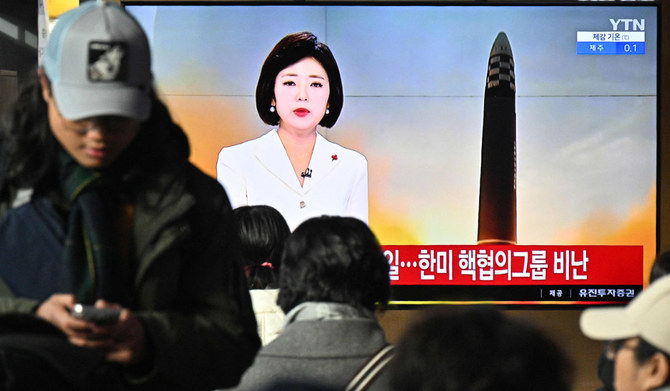
People sit near a television screen showing a news broadcast with file footage of a North Korean missile test, at a railway station in Seoul on December 18, 2023. (AFP)
Short Url
Updated 24 January 2024
Follow

South Korea says North Korea has fired several cruise missiles into the sea

  • Tensions on the Korean Peninsula have increased in recent months as North Korean leader Kim Jong Un continues to accelerate his weapons development and issue provocative threats of nuclear conflict with the United States and its Asian allies

SEOUL, South Korea: South Korea’s military says North Korea fired several cruise missiles into waters off its western coast, adding to a provocative run of weapons demonstrations in the face of deepening nuclear tensions with the United States, South Korea and Japan.
South Korea’s Joint Chiefs of Staff said Wednesday that the US and South Korean militaries were analyzing the launches. It did not immediately confirm the exact number of missiles fired or their specific flight details.
The launches marked North Korea’s second known launch event of the year, following a Jan. 14 flight test-firing of the country’s first solid-fuel intermediate range ballistic missile, which reflected its efforts to advance its lineup of weapons targeting US military bases in Japan and Guam.
Tensions on the Korean Peninsula have increased in recent months as North Korean leader Kim Jong Un continues to accelerate his weapons development and issue provocative threats of nuclear conflict with the United States and its Asian allies. The United States, South Korea and Japan in response have been expanding their combined military exercises, which Kim portrays as invasion rehearsals, and sharpening their deterrence strategies built around nuclear-capable US assets.
In the latest tit-for-tat, North Korea said last week conducted a test of a purported nuclear-capable underwater attack drone in response to a combined naval exercise by the United States, South Korea and Japan, as it continued to blame its rivals for tensions in the region.


Russia diverts its naphtha from Oman due to Middle Eastern crisis, data shows​

Updated 5 sec ago
Follow

Russia diverts its naphtha from Oman due to Middle Eastern crisis, data shows​

  • Strikes have disrupted energy production and shipping, including naphtha loadings and discharges
  • Since the European Union’s full embargo on Russian oil products took effect in February 2023, most Russian naphtha has been directed to the Middle East and Asia

MOSCOW: Russia has diverted its naphtha cargoes from Oman amid the Middle East crisis as it looks for new buyers, traders said and LSEG data showed, with at least one tanker now heading for Singapore.
Iran’s strikes on Gulf countries in retaliation for Israeli and US strikes against it have disrupted energy production and shipping, including naphtha loadings and discharges.
Since the European Union’s full embargo on Russian oil products took effect in February 2023, most Russian naphtha has been directed to the Middle East and Asia.
Middle Eastern countries are also the top ⁠supplier to Asia ⁠with the recent disruption forcing Asia’s naphtha margin to four-year highs, while at least one South Korean naphtha cracker operator was considering declaring force majeure and another has cut its operating rate by around a fifth.
The Liberia-flagged tanker, Amfitrion, which loaded in February in the Russian Black Sea ⁠port of Novorossiysk destined for Oman, last week halted navigation near the Gulf of Masira and on Tuesday turned for Singapore, according to LSEG data.
Five middle-sized tankers carrying a total 180,000 metric tons of naphtha in January departed Russian ports for an offshore STS (ship-to-ship) berth near Oman’s Shinas, shipping data showed. The final destination of these cargoes remains unknown.
According to data from LSEG and traders, Russia also sent two cargoes to Oman’s Sohar in November-December, ⁠carrying a total ⁠of 190,000 tons of naphtha as its other markets dried up.
India and Taiwan were among the main Asian buyers of Russian naphtha, but recent US sanctions have prompted both countries to pull back. Exports to Venezuela have also fallen to zero this year after US President Donald Trump in December ordered a blockade on all sanctioned oil tankers entering or leaving the Latin American country.
Though Asian buyers face naphtha shortages, Western sanctions could force traders to shun Russian cargoes. The long navigation from Russia’s Baltic ports to Asia also prevents prompt shipments, market sources said.