
JERUSALEM: A member of Israel’s War Cabinet cast doubt on the country’s strategy for releasing hostages held by Hamas, saying only a ceasefire can free them, as Prime Minister Benjamin Netanyahu rejected the United States’ calls to scale back its offensive.
The comments by Gadi Eisenkot, a former army chief, marked the latest sign of disagreement among top Israeli officials over the direction of the war against Hamas, now in its fourth month.
In his first public statements on the course of the war, Eisenkot said that claims the dozens of hostages could be freed by means other than a ceasefire amounted to spreading “illusions” — an implicit criticism of Prime Minister Benjamin Netanyahu, who heads the five-member War Cabinet and who insists that pursuing the war will win their release.
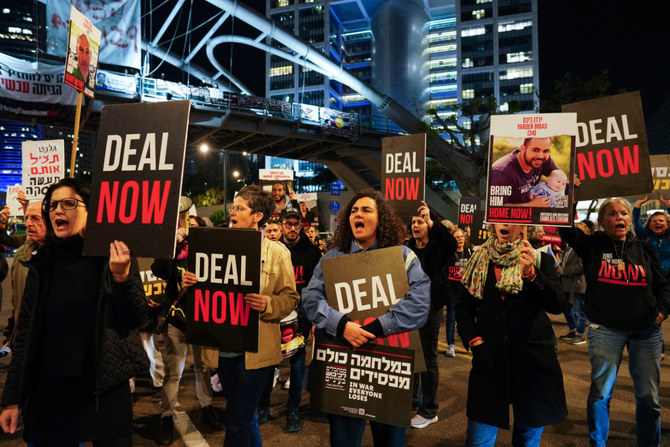
Eisenkot’s statements came as some relatives of hostages have intensified their protests, a sign of mounting frustration over the government’s seeming lack of progress toward a deal to release the remaining captives.
Eli Shtivi, whose 28-year-old son Idan has been held in Gaza since he was kidnapped by Hamas militants from the open-air Tribe of Nova music festival on Oct. 7., began a hunger strike Friday night outside Netanyahu’s private residence in the coastal town of Caesarea. Shtivi pledged to eat only a quarter of a pita a day — the reported daily meal of the hostages — until the prime minister agrees to meet with him. Dozens of people joined him for what organizers said was an overnight protest.
The day before, rifle-toting Israeli police scuffled with protesters who blocked a major highway in Tel Aviv to call for an immediate deal to release the hostages. Police detained seven protesters overnight, according to Israeli media.
Meanwhile, communications began to gradually return in Gaza after a nearly eight-day blackout, the longest such cutoff since the war began. The phone and Internet blackout made it nearly impossible for people in Gaza to communicate with the outside world or within the territory, hampering deliveries of humanitarian aid and rescue efforts amid continued Israeli bombardment.
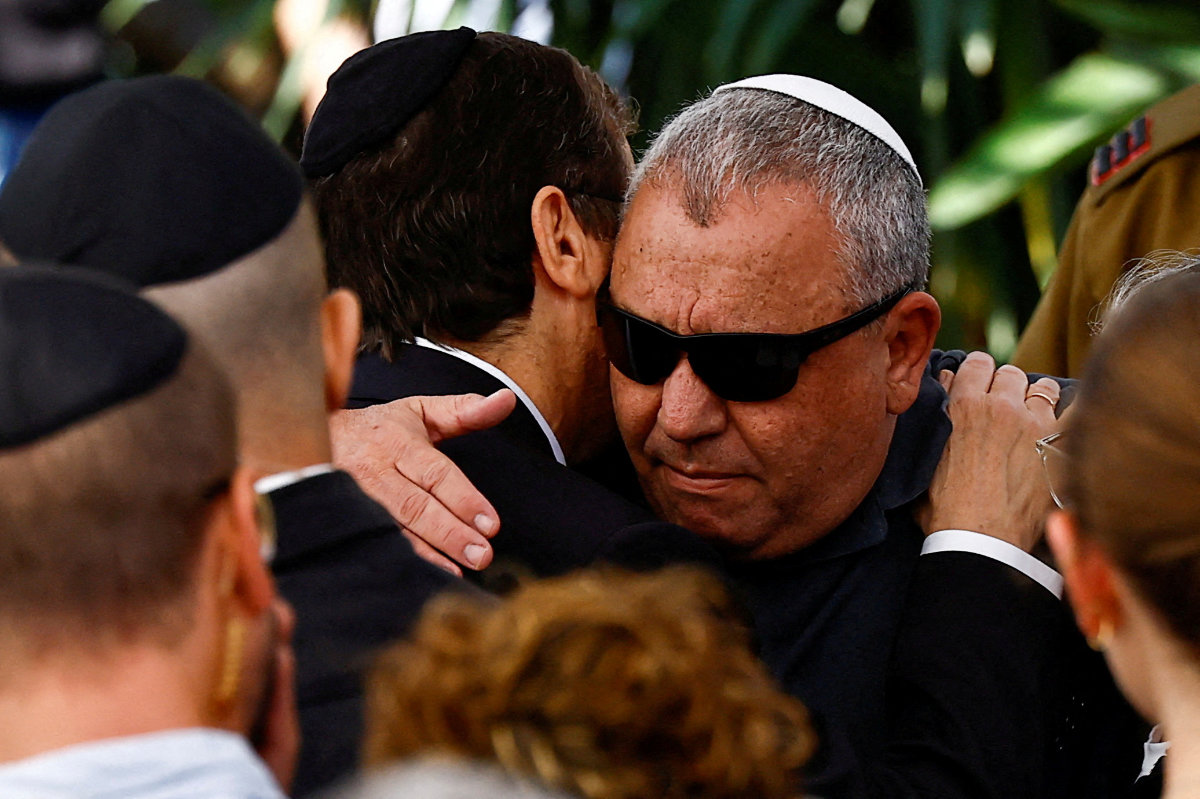
This photo taken in Herzliya, Israel, on December 8, 2023, shows Israeli cabinet minister and former military chief Gadi Eizenkot being consoled by Israeli President Isaac Herzog, as he attends the funeral of his son Gal Meir Eisenkot, 25, a soldier who was killed in northern Gaza during the ongoing ground operation by the IDF in the Gaza Strip. (REUTERS/File Photo)
For the past week, Gaza residents have struggled to get a signal on their phones. Many head to the beach, where some can pick up a non-Palestinian network. With families scattered across the tiny Mediterranean territory, networks are critical to make sure relatives are still alive as Israeli airstrikes crush homes.
“The people behind me came to check on their friends, family and loved ones,” said Karam Mezre, referring to others sitting with him on a rock at the beach in central Gaza, scanning their phones.
Even when communications return, “it is intermittent and not stable,” said Hamza Al-Barasi, who was displaced from Gaza City.
The blackout has also made it difficult for information to get out of Gaza on the daily death and destruction from Israel’s offensive. The assault has pulverized much of the Gaza Strip, home to some 2.3 million people, as Israel vows to crush Hamas after its unprecedented Oct. 7 raid into Israel. In the attack, about 1,200 people, mostly civilians, were killed and 250 others taken hostage. Israel has said more than 130 hostages remain in Gaza, but not all of them are believed to be alive.
Israel’s offensive, one of the deadliest and most destructive military campaigns in recent history, has killed nearly 25,000 Palestinians, according to Gaza health authorities, and uprooted more than 80 percent of the territory’s population.
Israel has also cut off all but a trickle of supplies into the besieged territory, including food, water and fuel, causing what UN officials say is a humanitarian disaster.
The United States, Israel’s closest ally, has provided strong military and political support for the campaign, but has increasingly called on Israel to scale back its assault and take steps toward establishing a Palestinian state after the war — a suggestion Netanyahu has soundly rejected.
Speaking during a nationally televised news conference Thursday, Netanyahu reiterated his longstanding opposition to a two-state solution, saying Israel “must have security control over the entire territory west of the Jordan River.”
On Friday, President Joe Biden and Netanyahu spoke by phone after a glaring, almost four-week gap in direct communication amid fundamental differences over their visions for Gaza once the war ends.
Biden, for his part, in Friday’s call reaffirmed his commitment to work toward helping the Palestinians move toward statehood.
Netanyahu and Defense Minister Yoav Gallant have also said the fighting will continue until Hamas is crushed, and argue that only military action can win the hostages’ release.
But commentators have begun to question whether Netanyahu’s objectives are realistic, given the slow pace of the offensive and growing international criticism, including genocide accusations at the United Nations world court, which Israel vehemently denies. Critics accuse Netanyahu of trying to avoid looming investigations of governmental failures, keep his coalition intact and put off elections. Polls show that the popularity of Netanyahu, who is on trial for corruption charges, has plummeted during the war.
Speaking to the investigative program “Uvda” on Israel’s Channel 12 television, Eisenkot said the Israeli hostages “will only return alive if there is a deal, linked to a significant pause in fighting.” He said dramatic rescue operations are unlikely because the hostages are apparently spread out, many of them in underground tunnels.
Claiming hostages can be freed by means other than a deal “is to spread illusions,” said Eisenkot, whose son was killed in December while fighting in Gaza.
Defense Minister Gallant has said troops disabled the Hamas command structure in northern Gaza, from which significant numbers of troops were withdrawn earlier in the week, and that the focus is now on the southern half of the territory.
But Eisenkot also dismissed suggestions that the military has delivered a decisive blow against Hamas.
“We haven’t yet reached a strategic achievement, or rather only partially,” Eisenkot said. “We did not bring down Hamas.”
The militant group has continued to fight back across Gaza, even in the most devastated areas, and launched rockets into Israel.
In his interview, Eisenkot also confirmed that a preemptive strike against Lebanon’s Hezbollah militia was called off at the last minute during the early days of the war. He said he was among those arguing against such a strike in an Oct. 11 Cabinet meeting that he said left him hoarse from shouting.
Such an attack would have been a “strategic mistake” and would likely have triggered a regional war, Eisenkot said.
In a thinly veiled criticism of Netanyahu, Eisenkot also said strategic decisions about the war’s direction must be made urgently and that a discussion about an endgame should have started immediately after the war began.
He said he examines every day whether he should remain in the War Cabinet, which also includes Netanyahu, Gallant, former Defense Minister Benny Gantz and Ron Dermer, strategic affairs minister in the Netanyahu government. Eisenkot is a parliament member from the opposition National Unity alliance headed by Gantz.
“I know what my red line is,” Eisenkot said when asked at what point he would quit. “It’s connected to the hostages, that is one of the objectives, but it’s also connected to the way in which we need to run this war.”
The war has rippled across the Middle East, with Iranian-backed groups attacking US and Israeli targets. Fighting between Israel and Hezbollah militants in Lebanon threatens to erupt into all-out war, and Iran-backed Houthi rebels in Yemen continue to target international shipping despite US-led airstrikes.
The United States conducted a sixth strike against Houthi rebels in Yemen on Friday, taking out anti-ship missile launchers that were prepared to fire, according to a US official who spoke on condition of anonymity to discuss ongoing military operations. President Joe Biden has acknowledged that bombing the militants has yet to stop their attacks on shipping in the crucial Red Sea corridor.