NUUK, Greenland: Troops from several European countries, including France, Germany, Norway and Sweden, are arriving in Greenland to help boost the Arctic island’s security after talks between representatives of Denmark, Greenland and the US on Wednesday highlighted “fundamental disagreement” between the Trump administration and European allies.
“The first French military elements are already en route” and “others will follow,” French President Emmanuel Macron announced Wednesday, as French authorities said about 15 French soldiers from the mountain infantry unit were already in Nuuk for a military exercise.
Germany will deploy a reconnaissance team of 13 personnel to Greenland on Thursday, its Defense Ministry said.
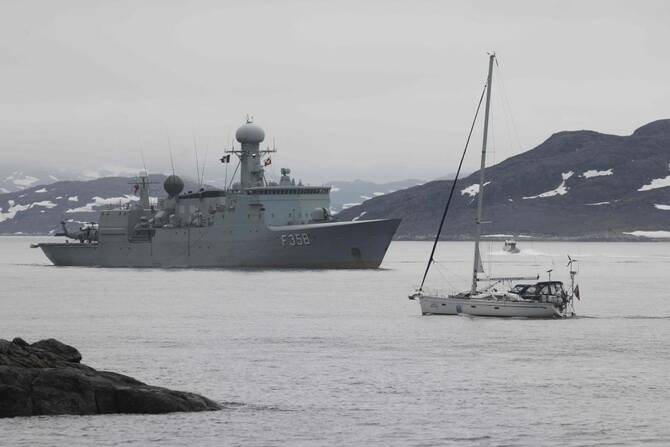
Denmark announced it would increase its military presence in Greenland, with NATO allies joining them, just as the Danish and Greenlandic foreign ministers met with White House representatives on Wednesday in Washington to discuss US President Donald Trump’s intentions to take over the island in order to tap its mineral resources and protect the security of the Arctic region amid rising Russian and Chinese interest.
On Thursday, Danish Defense Minister Troels Lund Poulsen said the intention was “to establish a more permanent military presence with a larger Danish contribution,” according to Danish broadcaster DR. He said soldiers from several NATO countries will be in Greenland on a rotation system.
Danish Foreign Minister Lars Løkke Rasmussen, flanked by his Greenlandic counterpart Vivian Motzfeldt, said Wednesday that a “fundamental disagreement” over Greenland remains with Trump after they held highly anticipated talks at the White House with Vice President JD Vance and Secretary of State Marco Rubio.
Rasmussen added that it remains “clear that the president has this wish of conquering over Greenland.”
“We really need it,” Trump told media in the Oval Office after the meeting. “If we don’t go in, Russia is going to go in and China is going to go in. And there’s not a thing Denmark can do about it, but we can do everything about it.”
Trump said he had not yet been briefed about the contents of the White House meeting when he made his remarks.
In Greenland’s capital, Nuuk, local residents told The Associated Press they were glad the first meeting between Greenlandic, Danish and American officials had taken place but suggested it left more questions than answers.
Several people said they viewed Denmark’s decision to send more troops, and promises of support from other NATO allies, as protection against possible US military action. But European military officials have not suggested the goal is to deter a US move against the island.
Maya Martinsen, 21, agreed and said it was “comforting to know that the Nordic countries are sending reinforcements” because Greenland is a part of Denmark and NATO.
The dispute, she said, is not about “national security” but rather about “the oils and minerals that we have that are untouched.”
More troops, more talks
On Wednesday, Poulsen had announced a stepped-up military presence in the Arctic “in close cooperation with our allies,” calling it a necessity in a security environment in which “no one can predict what will happen tomorrow.”
“This means that from today and in the coming time there will be an increased military presence in and around Greenland of aircraft, ships and soldiers, including from other NATO allies,” Poulsen said.
Asked whether the European troop movements were coordinated with NATO or what role the US-led military alliance might play in the exercises, NATO referred all questions to the Danish authorities.
However, NATO is looking at how members can collectively bolster the alliance’s presence in the Arctic, according to a NATO official who was not authorized to comment publicly and spoke on condition of anonymity.
Rasmussen, the Danish foreign minister, announced the creation of a working group with the Americans to discuss ways to work through differences.
“The group, in our view, should focus on how to address the American security concerns, while at the same time respecting the red lines of the Kingdom of Denmark,” he said.
Commenting on the outcome of the Washington meeting on Thursday, Poulsen said the working group was “better than no working group” and “a step in the right direction.” He added nevertheless that the dialogue with the US did not mean “the danger has passed.”
Line McGee, a 38-year old from Copenhagen, told AP that she was glad to see some diplomatic progress. “I don’t think the threat has gone away,” she said. “But I feel slightly better than I did yesterday.”
Speaking to FOX News Channel’s Special Report on Wednesday after the White House talks, Rasmussen rejected both a military takeover and the potential purchase of the island by the US Asked whether he thinks the US will invade, he replied: “No, at least I do not hope so, because, I mean, that would be the end of NATO.”
Rasmussen said Greenlanders were unlikely to vote for US rule even if financial incentives were offered “because I think there’s no way that US will pay for a Scandinavian welfare system in Greenland, honestly speaking.”
“You haven’t introduced a Scandinavian welfare system in your own country,” he added.
Trump, in his Oval Office meeting with reporters, said: “We’ll see how it all works out. I think something will work out.”


![]()

European troops arrive in Greenland as talks with US highlight ‘disagreement’ over island’s future
Short Url
https://arab.news/yj2qn
European troops arrive in Greenland as talks with US highlight ‘disagreement’ over island’s future
- Germany will deploy a reconnaissance team of 13 personnel to Greenland on Thursday
- Denmark announced it would increase its military presence in Greenland, with NATO allies joining them


Latest updates


© 2026 SAUDI RESEARCH & PUBLISHING COMPANY, All Rights Reserved And subject to Terms of Use Agreement.