

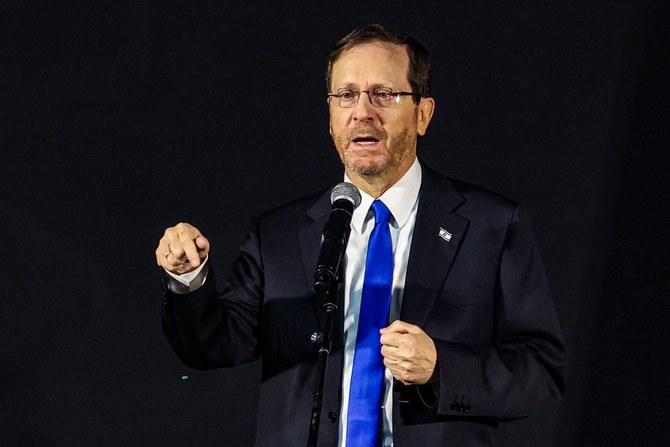
Israel president hit with criminal complaint in Switzerland: prosecutors

The Federal Prosecutor’s Office confirmed that it had received a criminal complaint against the Israeli president (AFP)
Short Url
Updated 19 January 2024
Follow

Israel president hit with criminal complaint in Switzerland: prosecutors

  • Addressing issue of immunity, statement suggested could be lifted “in certain circumstances”
  • WEF confirmed to Arab News Swiss authorities did not contact them regarding complaint

Geneva: Israeli President Isaac Herzog has been targeted with a criminal complaint during a visit to Switzerland, Swiss prosecutors said Friday, amid allegations of crimes against humanity over the war in Gaza.
The Federal Prosecutor’s Office (BA) confirmed that it had received a criminal complaint against the Israeli president, who was at the World Economic Forum (WEF)’s annual meeting in Davos on Thursday to discuss the Gaza war.
“The criminal complaints will now be examined in accordance with the usual procedure,” BA said in a statement, adding that it was in contact with the foreign ministry “to examine the question of the immunity of the person concerned.”
It did not say what the specific complaints were, or who had filed them.

WEF confirmed to Arab News that Swiss authorities did not contact them regarding the complaint against the Israeli president.

But a statement allegedly issued by the people behind the complaint, entitled “Legal Action Against Crimes Against Humanity” and obtained by AFP, said several unnamed individuals had filed charges with federal prosecutors and with cantonal authorities in Basel, Bern and Zurich.
The statement said the plaintiffs were seeking a criminal prosecution in parallel to a case brought before the UN’s International Court of Justice by South Africa, which accuses Israel of genocide in its offensive in Gaza.
Addressing the issue of immunity, the statement suggested that it could be lifted “in certain circumstances,” including in cases of alleged crimes against humanity, adding that “these conditions are met in this case.”
South Africa launched the emergency case at the ICJ in The Hague this month, arguing that Israel had breached the 1948 UN Genocide Convention.
South Africa demanded that the judges order Israel to halt its offensive in the Palestinian territory. Israel has denounced the case as “distorted.”
Fighting has ravaged the Gaza Strip since Hamas’s attacks on Israel on October 7 that resulted in the deaths of about 1,140 people, mostly civilians, according to an AFP tally based on official figures.
Israel responded with a relentless offensive that has killed at least 24,762 Palestinians, around 70 percent of them women, children and adolescents, according to Gaza’s Hamas-run health ministry.
Herzog told the Davos forum that Israel had launched its campaign in “self-defense” and again condemned the South Africa case as “outrageous.”
“They (South Africa) basically support the atrocities and barbarism that we have seen on October 7,” he said, adding that Israel was concerned about the destruction in Gaza.
“We care. It is painful for us that our neighbors are suffering so much,” he said.
“But how else can we defend ourselves if our enemies decided to entrench themselves in an infrastructure of terror of unbelievable size and scope?” he said.


Rubio says new governance bodies for Gaza will be in place soon

Updated 20 December 2025
Follow

Rubio says new governance bodies for Gaza will be in place soon

  • Rubio said progress had been made recently in identifying Palestinians to join the technocratic group and that Washington aimed to get the governance bodies in place “very soon,” without offering a specific timeline.

WASHINGTON: US Secretary of State Marco Rubio said that a ​new governance structure for Gaza — made up of an international board and a group of Palestinian technocrats — would be in place soon, followed by the deployment of foreign troops, as the US hopes to cement a fragile ceasefire in Israel’s war in the Palestinian enclave. 
Rubio, speaking at a year-end news conference, said the status quo was not sustainable in Gaza, where Israel has continued to strike Hamas targets while the group has reasserted its control since the October peace agreement ‌brokered by the US.
“That’s why we have a sense of ‌urgency about ​bringing ‌phase one to its full completion, which is the establishment of the Board of Peace, and the establishment of the Palestinian technocratic authority or organization that’s going to be on the ground, and then the stabilization force comes closely thereafter,” Rubio said.
Rubio said progress had been made recently in identifying Palestinians to join the technocratic group and that Washington aimed to get the governance bodies in place “very soon,” without offering a specific timeline. Rubio was speaking after the US Central Command hosted a conference in Doha this week with partner nations to plan ‌the International Stabilization Force for Gaza. 
Two US officials said last week that international troops could be deployed in the strip as early as next month, following the UN Security Council’s November vote to authorize the force.
It remains unclear how Hamas will be disarmed, and countries considering contributing troops to the ISF are wary that Hamas will engage their soldiers in combat.
Rubio did not specify who would be responsible for disarming Hamas and conceded that countries contributing troops want to know the ISF’s specific mandate and how it will be funded. 
“I think ⁠we owe them a few more answers before we can ask anybody to commit firmly, but I feel very confident that we have a number of nation states acceptable to all sides in this who are willing to step forward and be a part of that stabilization force,” Rubio said, noting that Pakistan was among the countries that had expressed interest.
Establishing security and governance was key to securing donor funding for reconstruction in Gaza, Rubio added.
“Who’s going to pledge billions of dollars to build things that are going to get blown up again because a war starts?” Rubio said, discussing the possibility of a donor conference to raise reconstruction funds. 
“They want to know ‌who’s in charge, and they want to know that there’s security so and that there’ll be long term stability.”