

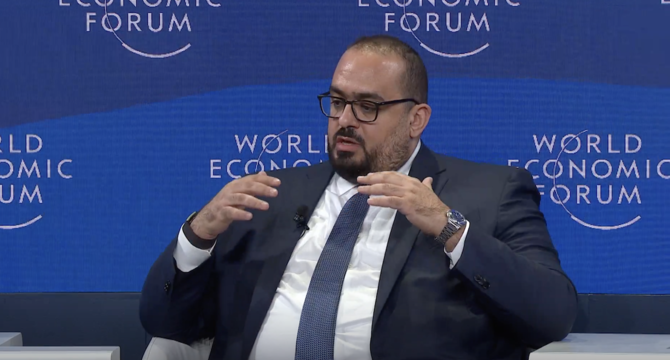
Saudi Arabia using ‘idle assets’ to drive future, economy minister tells Davos

Saudi Minister of Economy and Planning Faisal Alibrahim said at the World Economic Forum in Davos. (WEF)
Short Url
Updated 17 January 2024
Follow

Saudi Arabia using ‘idle assets’ to drive future, economy minister tells Davos

  • Kingdom’s playbook ‘all about bold movement,’ Faisal Alibrahim says
  • Long-term view critical for tackling issues like climate change, he says

RIYADH: Saudi Arabia is seeking better ways to exploit its resources and assets, Minister of Economy and Planning Faisal Alibrahim said at the World Economic Forum in Davos on Wednesday.

“We’ve looked at the vast, valuable yet idle assets and have started thinking about how we can mobilize them for the betterment and in contribution to our national objectives,” he told a panel discussion titled Investors of First Resort: Government Inc.

The event was moderated by WEF Managing Director Saadia Zahidi and featured several high-level speakers, including Singapore’s President Tharman Shanmugaratnam. It looked at how government investment is transforming the global economic landscape.

Alibrahim said governments recognized the need to mobilize their assets and capabilities more effectively, especially in response to recent global crises, and saw the need for greater collaboration with the private sector as vital to achieving national objectives.

A long-term view was critical for tackling issues like climate change and technological innovation, he said.

The minister also spoke about Vision 2030 — Saudi Arabia’s ambitious plan for economic diversification, global engagement and enhanced quality of life — and stressed the importance of investing in human capital, including education, healthcare and international partnerships, such as the Kingdom’s successful collaboration with Singapore on strengthening public sector capabilities.

“Saudi Arabia has a playbook that everyone is looking into, and this playbook is all about bold movement, learning by doing and global collaboration,” Alibrahim said.

He pointed to the Public Investment Fund as a prime example of using idle assets for national development, noting its dual focus on generating returns and stimulating development.

“We wanted to accelerate our diversification quickly. We went in and created the environment in several sectors,” he said.

“We prioritized 13 sectors that created the conditions for profitability. PIF has deployed the largest fresh capital in 2023, over $35 billion.”

He concluded by highlighting the need for international cooperation in areas like green energy and the importance of joint efforts in leading future technological advancements.


Saudi stock market opens its doors to foreign investors

Updated 06 January 2026
Follow

Saudi stock market opens its doors to foreign investors

RIYADH: Foreigners will be able to invest directly in Saudi Arabia’s stock market from Feb. 1, the Kingdom’s Capital Market Authority has announced.

The CMA’s board has approved a regulatory change which will mean the capital market, across all its segments, will be accessible to investors from around the world for direct participation.

According to a statement, the approved amendments aim to expand and diversify the base of those permitted to invest in the Main Market, thereby supporting investment inflows and enhancing market liquidity.

International investors' ownership in the capital market exceeded SR590 billion ($157.32 billion) by the end of the third quarter of 2025, while international investments in the main market reached approximately SR519 billion during the same period — an annual rise of 4 percent.

“The approved amendments eliminated the concept of the Qualified Foreign Investor in the Main Market, thereby allowing all categories of foreign investors to access the market without the need to meet qualification requirements,” said the CMA, adding: “It also eliminated the regulatory framework governing swap agreements, which were used as an option to enable non-resident foreign investors to obtain economic benefits only from listed securities, and the allowance of direct investment in shares listed on the Main Market.”

In July, the CMA approved measures to simplify the procedures for opening and operating investment accounts for certain categories of investors. These included natural foreign investors residing in one of the Gulf Cooperation Council countries, as well as those who had previously resided in the Kingdom or in any GCC country. 

This step represented an interim phase leading up to the decision announced today, with the aim of increasing confidence among participants in the Main Market and supporting the local economy.

Saudi Arabia, which ‌is more than halfway ‍through an economic plan ‍to reduce its dependence on oil, ‍has been trying to attract foreign investors, including by establishing exchange-traded funds with Asian partners in Japan and Hong Kong.