

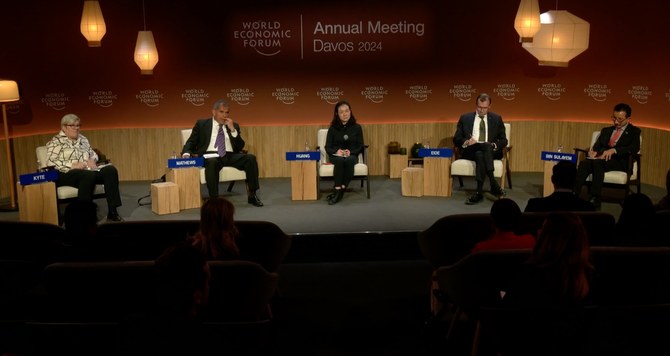

RIYADH: Collaborative trade initiatives can help accelerate the adoption of clean technologies to effectively fight climate change, experts told a panel at the World Economic Forum in Davos on Wednesday.
They viewed trade conflicts over subsidies, investment, and carbon pricing as counterproductive and responsible for hampering global efforts to mitigate the effects of climate change.
The annual meeting in Switzerland saw ministers, specialists, and private sector players discuss practices countries can adopt to overcome the current trade tensions to ensure global environmental growth.
During one of the many panels at the forum, Rachel Kate, an Oxford University professor, said the world is witnessing a shift in rhetoric from an emphasis on public money from the Global North being sent to the Global South in the form of climate aid to a discussion on how trade and investment could prove to be the necessary vehicles of growth.
For this to happen, international financial institutions must be reformed to support emerging markets and developing economies in reaching their climate goals, she affirmed.
Speaking alongside Kyte, Norway’s Minister of Foreign Affairs Espen Barth Eide noted that while the nation “very much” believes in the goal of “better and greener trade,” issues surrounding a lack of a global carbon pricing and transport production cost necessitate mechanisms like the EU’s Carbon Border Adjustment Mechanism, creating trade tensions.
The CBAM, a carbon tariff on carbon-intensive products, such as cement and some electricity, imported by the bloc, was legislated as part of the European Green Deal. It takes effect in 2026 while reporting started in 2023.
Globally, it will mean a significant ramp-up of emissions reporting and associated paperwork. Verified product carbon footprints are expected to be a requirement for CBAM certificates.
Therefore, offering a verified low-carbon product will likely create a strong competitive advantage for companies supplying to the EU.
The lack of a global carbon price has led to some nations being able to produce products using fossil fuels at a lower cost and ultimately shipping globally to countries that have adopted carbon pricing.
The consequence is producing a large amount of transport emissions, making the global efforts counterproductive.
The minister stated: “If we actually had the system of a global carbon price, we would not need to introduce, for instance, CBAM, which is perfectly necessary for those regions that are trying to step up and actually price emissions, but you can then import through the backdoor, the same type of emissions that you have avoided at home.“
He added: “But, of course, it also has some strength rate conflict because parts of the developing world are wondering if this is really climate policy, or is this actually a way to keep us out? And all of this coincides with the geopolitical trends.”
For this to be avoided, according to Eide, a layer of international transparency is needed to procure a global free trade system of mutual value that is equally compatible with the transnational goals to accelerate the transition away from fossil fuels.
Sultan Ahmed bin Sulayem, the group chairman and CEO of Dubai Ports World, a company that is a member of the first movers coalition and a global end-to-end logistics provider, noted that the challenge lies not only in a lack of mutual agreement but also in an added strain of geopolitical tensions that have prevented the green revolution from occurring.
Custom delays, protectionism, and regulations that prevent trade, including nontariff barriers, must be addressed by the global community, “the world has to work together to really remove that today,” Sulayem affirmed.
The executive cited China’s solar panels as an example, saying: “One of the largest producers of solar panels is China, but with this kind of geopolitical issues, it will impact the ability of people to get the best and the most efficient from China.”
The solution lies in a symbiotic relationship between logistics providers, such as DP World, global trade regulations, and emerging economies that are most vulnerable to the effects of climate change.
In order to create a green world that is simultaneously equitable, we need a trading system that will “take us all there,” which means that unilateralism is going to have a limited impact and a new era of collaboration and cooperation is going to be fundamental at a time when geopolitical tensions are on the rise, the Oxford professor affirmed.


