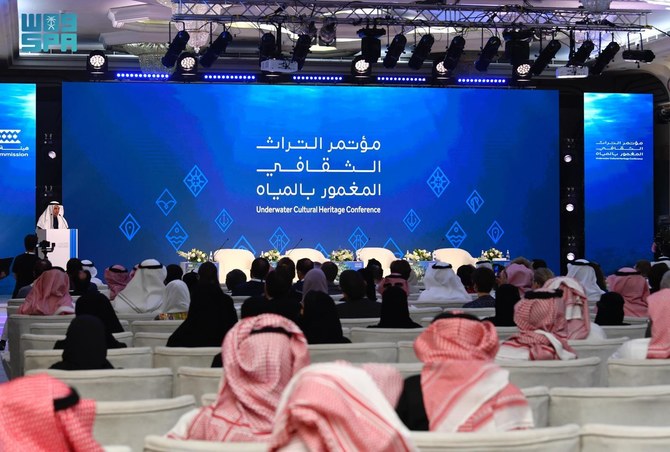

JEDDAH: Saudi heritage chiefs have revealed plans to establish a specialized center to coordinate the surveying and protection of key underwater cultural sites in the Red Sea and Arabian Gulf.
The announcement was made during an international scientific conference hosted in Jeddah on Monday by the Saudi Heritage Commission to discuss undersea archaeology projects.

Commission CEO, Jasser Al-Harbash, joined experts and interested parties from 14 countries taking part in the forum.
He noted that the preservation of underwater cultural heritage, helped to highlight the history of peoples and nations and he lauded the work of research teams that had participated in recent archaeological studies of the Red Sea and Arabian Gulf.
Abdullah Al-Zahrani, general manager of the Heritage Commission, pointed out the opportunities that the initiatives presented to showcase Saudi history on the global stage.
He told Arab News that through ongoing archaeological missions and collaborations with international universities, the commission aimed to raise awareness of the Kingdom’s historical significance.
“Presenting our rich history to the world is a great opportunity. Saudi Arabia, with its deep historical roots, boasts archaeological sites dating back over 10,000 years.
“The Heritage Commission is currently overseeing 70 archaeological missions across the Kingdom, spanning from ancient history to the present day,” Al-Zahrani said.
He noted collaboration on exploring more than 8,000 critical sites, adding that the Red Sea coastal area covered in excess of 100,000 km.
Through ongoing investigations with international partners, he said more than eight sites had now been documented.
“Our current focus extends from the south to the north of the Red Sea, revealing sunken ships with cargoes from Mediterranean cities, offering valuable insights into history.
“Additionally, a project was launched last year to study islands near the Arabian Gulf, and we aim to further explore underwater archaeological sites in the Gulf,” he added.
Faisal Alsaaq, a Saudi specialist in the hydrographic survey of underwater imaging at King Abdulaziz University, told Arab News about the cutting-edge technologies used in underwater archaeology.
He highlighted state-of-the-art instruments, including remotely operated vehicles that could travel to great depths, and hydrographic equipment with multibeam, side scan, and magnetometer functionalities used for precise underwater surveys.

The conference explored global perspectives on underwater cultural heritage, with delegates discussing modern techniques in surveying and excavating submerged sites, and the importance of capacity building and sustainable management practices.
In recent years, so-called citizen science has encouraged the involvement of members of the public in archaeology.
Chris Underwood, president of the International Committee on the Underwater Cultural Heritage, pointed out the move toward citizen science and community engagement for increased public awareness. He said: “What we are trying to do is build capacity in the general public to support what we do.
“In terms of community archaeology, it is often described as being by the people for the people. I take it one step further; it is actually the community engaging archaeologists to conduct the archaeology they want on specific sites in their location that they deem important, not necessarily nationally or regionally significant but of community importance,” he added.
The forum was attended by representatives from countries including the US, Spain, the UK, Argentina, Italy, Denmark, Slovenia, Mexico, South Korea, Egypt, Algeria, Lebanon, Bulgaria, and Australia.