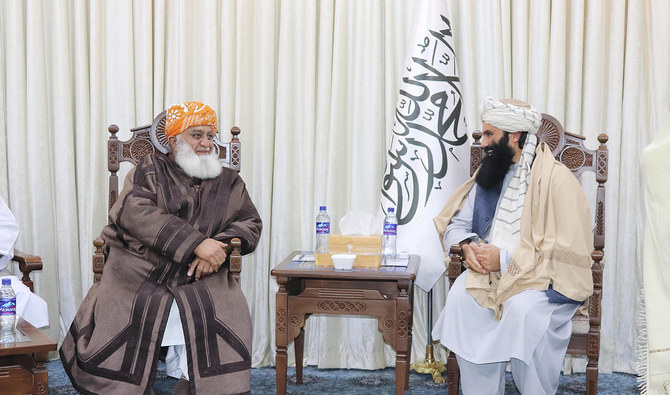
PESHAWAR: The chief of a prominent Pakistani religious party, Maulana Fazl-ur-Rehman, said this week that his six-day visit to Kabul has “paved” the way to de-escalate tensions with Afghanistan.
Rehman, the head of the Jamiat Ulama-e-Pakistan Fazl (JUI-F) party, arrived in Kabul last Sunday with a private delegation to hold talks with Taliban officials. His visit came at a time when ties between the two states are at their lowest ebb due to the rising number of militant attacks in Pakistan. Islamabad has blamed the surge in militant violence on factions it says are hiding in the neighboring country.
Pakistan also announced the deportation of large numbers of “illegal immigrants,” mostly Afghan nationals, in November, suspecting many of them to be jeopardizing the country’s security. The move further strained ties between the two countries.
“After the establishment of the Islamic Emirate (of Afghanistan), there was some tension between the two countries,” Rehman told Radio and Television Afghanistan on Saturday, a day before the JUI-F delegation departed for Islamabad.
“The main objective of my visit is to de-escalate tensions between the two countries and this visit has paved the road for this purpose.”
Rehman confirmed he met the Afghan Taliban’s supreme leader, Haibatullah Akhundzada, with whom he held a detailed discussion.
“The meeting with Mullah Haibatullah has been very positive,” he said, without elaborating on what was discussed between the two.
Rehman said the objectives of his visit to Kabul had been achieved, urging both countries to forget the bitter past and enhance bilateral trade activities.
Without taking any specific country’s name, Rehman said some states wanted to create rifts between Pakistan and Afghanistan.
“After my visit, a new era of mutual trust will begin,” he hoped.
Rehman said Afghan refugees who had been forcibly repatriated from Pakistan had reservations about how they were expelled.
“I and my party have viewed Afghan refugees as guests of Pakistan and we as a nation respect them,” he said. “But since my party is not in the government, I have played a role in dealing with the refugees’ issue.”
Pakistan’s foreign office distanced itself from Rehman’s visit this week, saying that he was not an emissary of the government and had traveled as a private individual.
Jalil Jan, a spokesperson of the JUI-F, said Rehman would brief Pakistani officials regarding his meetings with Afghan officials. Jan said he was optimistic Rehman’s Kabul trip would yield tangible results and improve Pakistan-Afghanistan ties after the JUI-F chief briefs officials in Islamabad.
“I hope a new era of mutual trust will begin,” Jan told Arab News. “You will see positive changes in bilateral political, diplomatic, and trade relations as the JUI-F’s visit has prepared the pitch to remove misunderstandings [between the two countries].”
Senior Afghan journalist Mansoor Nekmal doubted Rehman’s visit would resolve Pakistan’s main security concerns regarding banned militant outfits, particularly the Tehreek-e-Taliban Pakistan (TTP).
The TTP has carried out some of the deadliest attacks against Pakistani security forces and civilians over the past decade-and-a-half. Islamabad has asked Kabul to take action or hand over TTP militants it says are hiding in “terrorist” sanctuaries in Afghanistan. Kabul denies it is providing shelter to militants, and has repeatedly assured Islamabad it would not let militants launch attacks on Pakistan.
He said Rehman’s visit was largely seen in Afghanistan as a visit by a Pakistani diplomat, adding that the Pakistani cleric had though conveyed Islamabad’s message to Kabul.
“I think the TTP issue is a very, very complicated one in nature and it will need hectic and persistent efforts to tackle it,” Nekmal told Arab News. “Both Kabul and Islamabad need to employ a give-and-take formula to get rid of daily tensions and resolve frequent border closures, trade and diplomatic issues.”


![]()

Pakistani religious cleric says Kabul visit has paved way for de-escalating tensions with Afghanistan
Short Url
https://arab.news/cnkda
Pakistani religious cleric says Kabul visit has paved way for de-escalating tensions with Afghanistan
- Maulana Fazl-ur-Rehman met senior Afghan officials during six-day Kabul trip to reduce tensions between Pakistan and Afghanistan
- Pakistan’s foreign office earlier this week distanced itself from Rehman’s visit, saying he had traveled to Afghanistan in an individual capacity
Latest updates


Recommended


© 2026 SAUDI RESEARCH & PUBLISHING COMPANY, All Rights Reserved And subject to Terms of Use Agreement.