Future Minerals Forum sheds light on inclusive approach for responsible mineral supply chain 

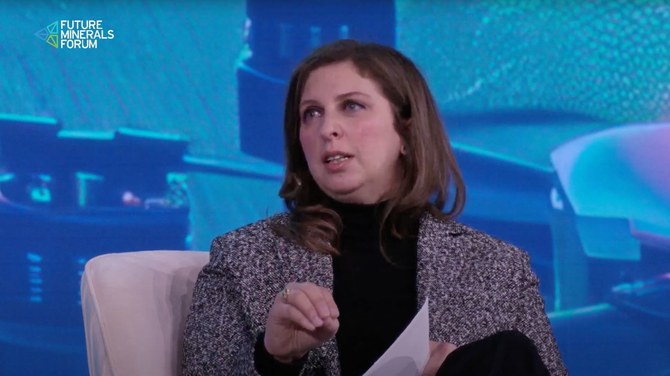
Emily Olson, chief sustainability and corporate affairs officer at Vale Base Metals, speaking at the Future Minerals Forum. Screenshot
Short Url
Updated 11 January 2024
Follow

Future Minerals Forum sheds light on inclusive approach for responsible mineral supply chain 

RIYADH: Key industry leaders discussed sustainable mining and the role of essential elements in the global green transition at the Future Minerals Forum on Thursday. 

The start of the second day witnessed insightful discussions during a panel session titled “An inclusive multi-stakeholder approach: accelerating responsible mineral supply.” 

Emily Olson, chief sustainability and corporate affairs officer at Vale Base Metals, emphasized the importance of people in her company’s operations, saying: “We’ve always had to take community-centered view on where we operate, our regions being Brazil, Canada and Indonesia.” 

She highlighted the evolving nature of the industry and the necessity for a multi-layered engagement to address changing dynamics in business and work. 

Olson also expressed her passion for ensuring financial tools are available for sustainable practices.  

She highlighted Vale’s proactive approach and discussed the ongoing efforts to advance their sustainability practices. 

Helena Nonka, director of strategy and sustainability at Anglo American, drew attention to the critical role of mining in supporting the green transition.  

However, she stressed that a move that is fair to all countries is equally imperative, considering the nearly 1 billion people living at or below the poverty line. 

Nonka said: “There is a big focus on the role of mining in supporting green transition, but we all know that green transition will not happen unless it is also a just transition.” 

She pointed out a staggering fact that to feed the global population over the next 30 years, the world will require as much fertilizer as was used in the last 100 years, underscoring the resource demands for sustainable development. 

Khalil Ibrahim Ibn Salamah, Saudi vice minister for industry at the Ministry of Industry and Mineral Resources, also highlighted the importance of human-centric considerations in building a sustainable supply chain.  

He noted: “Mining now is taking off as one of the most important, I think, the third pillar in our industry diversification, so this is already determined and once we set our goals we just go and march in.” 

The official emphasized the strategic geographical advantage of Saudi Arabia, highlighting the resilience created by well-connected ports in the east and west, mitigating potential interruptions. 

He outlined the Kingdom’s commitment to clean energy for mineral extraction and purification, expressing plans to make green power available according to regional demand. 

Salamah stressed the significance of understanding the human aspect in supply chains, emphasizing that a connection between miners, users, and middle companies is crucial for creating a truly sustainable and resilient supply chain. 

The official pointed out that the creation of the mining council is encouraging open dialogue with everyone speaking his or her mind. 

He noted that the substantial growth in the capital market is a significant facilitator ensuring the fulfillment and surpassing of the sector’s plans.

The discussions at the Future Minerals Forum underscored the industry’s commitment to responsible and sustainable mineral supply chains, emphasizing the collaborative efforts needed for a greener future. 


Global trade isn’t deglobalizing — it’s reshuffling, Harvard economist says 

Updated 5 sec ago
Follow

Global trade isn’t deglobalizing — it’s reshuffling, Harvard economist says 

ALULA: Global trade is not retreating into deglobalization despite geopolitical shocks, but is instead undergoing a structural reshuffling led by US-China tensions, according to Harvard University economist Pol Antras. 

Presenting research at the AlUla Emerging Market Economies Conference, Antras said there is no evidence that countries are systematically turning inward. Instead, trade flows are being redirected across markets, creating winners and losers depending on export structure and exposure to Chinese competition. 

This comes as debate intensifies over whether supply-chain disruptions, industrial policy and rising trade barriers signal the end of globalization after decades of expansion. 

Speaking to Arab News on the sidelines of the event, Antras said: “I think the right way to view it is more a reorganization, where things are moving from some countries to others rather than a general trend where countries are becoming more inward looking, in a sense of producers selling more of their stuff domestically than internationally, or consumers buying more domestic products than foreign products.”  

He said a change of that scale has not yet happened, which is important to recognize when navigating the reshuffling — a shift his research shows is driven by Chinese producers redirecting sales away from the US toward other economies. 

He added that countries are affected differently, but highlighted that the Kingdom’s position is relatively positive, stating: “In the case of Saudi Arabia, for instance, its export structure, what it exports, is very different than what China exports, so in that sense it’s better positioned so suffer less negative consequences of recent events.” 

He went on to say that economies likely to be more negatively impacted than the Kingdom would be those with more producers in sectors exposed to Chinese competition. He added that while many countries may feel inclined to follow the United States’ footsteps by implementing their own tariffs, he would advise against such a move.  

Instead, he pointed to supporting producers facing the shock as a better way to protect and prepare economies, describing it as a key step toward building resilience — a view Professor Antras underscored as fundamental. 

Elaborating on the Kingdom’s position amid rising tensions and structural reorganization, he said Saudi Arabia holds a relative advantage in its economic framework. 

“Saudi Arabia should not be too worried about facing increased competitive pressures in selling its exports to other markets, by its nature. On the other hand, there is a benefit of the current situation, which is when Chinese producers find it hard to sell in US market, they naturally pivot to other markets.” 

He said that pivot could benefit importing economies, including Saudi Arabia, by lowering Chinese export prices. The shift could increase the Kingdom’s import volumes from China while easing cost pressures for domestic producers.