Saudi and Qatari culture ministers welcome direct flights between AlUla and Doha

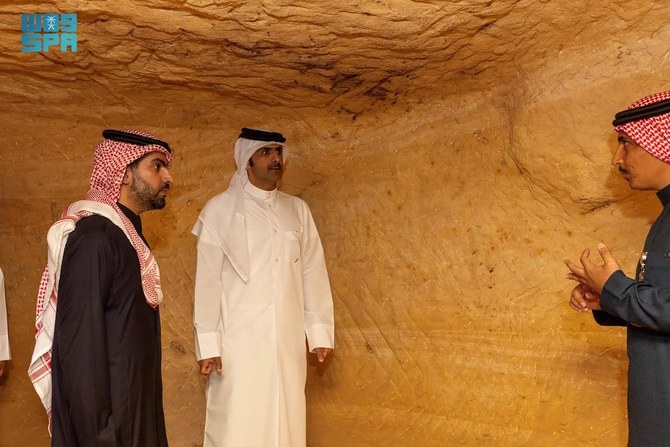
Saudi Culture Minister Prince Badr bin Abdullah bin Farhan and his Qatari counterpart Abdulrahman bin Hamad Al-Thani. (SPA)
Short Url
Updated 11 January 2024
Follow

Saudi and Qatari culture ministers welcome direct flights between AlUla and Doha

  • Flights between AlUla and Doha were announced in early October

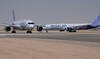
RIYADH: Saudi Culture Minister Prince Badr bin Abdullah bin Farhan and his Qatari counterpart, Abdulrahman bin Hamad Al-Thani, on Wednesday officially inaugurated the direct route between Doha and AlUla that was recently introduced by Qatar Airways.

“The launch of direct flights to AlUla from Doha confirms our countries’ approach of working together to strengthen ties through advanced transportation networks,” Prince Badr said.

“As part of our work, we are keeping up with the expected increase in flights to AlUla Governorate as a global tourist destination, and the number of international flights will help AlUla progress to various other stages in collaboration with our brothers in the region.”

Sheikh Abdulrahman said the new route is a significant step toward confirming the role of the Qatari-Saudi Coordination Council’s Culture, Tourism, and Entertainment Committee in enhancing and strengthening cultural ties, adding that cultural heritage is an important factor in shaping public awareness, the Saudi Press Agency reported.

The flights between AlUla and Doha were announced in early October and began toward the end of that month. The Royal Commission for AlUla seeks to transform the historic area into a major logistics hub in northwestern Saudi Arabia. Part of this vision includes the expansion of AlUla International Airport’s capacity from 400,000 to 6 million passengers annually.

Since its designation as an international airport in March 2021, it has undergone significant development and now covers an area of about 2.4 million square meters, and is capable of accommodating 15 aircraft at a time.


Saudi foreign ministry welcomes second phase of Gaza peace plan, formation of transitional committee

Updated 16 January 2026
Follow

Saudi foreign ministry welcomes second phase of Gaza peace plan, formation of transitional committee

  • Ministry also thanked US President Donald Trump for his leadership and efforts to end the war in Gaza

RIYADH: The Saudi Ministry of Foreign Affairs on Friday welcomed the announcement of the second phase of a comprehensive peace plan for Gaza, the Saudi Press Agency reported.

The ministry said it also welcomed the formation of the Palestinian National Committee for the Administration of the Gaza Strip as a temporary transitional body, established under UN Security Council Resolution 2803, which met in Cairo on Friday.

In a statement, the ministry also thanked US President Donald Trump, who declared the formation of the Gaza “board of peace,” for his leadership and efforts to end the war in Gaza.

It highlighted his commitment to the withdrawal of Israeli forces, the prevention of any annexation of parts of the West Bank, and efforts to advance sustainable peace in the region.

The ministry commended the role of mediators Qatar, Egypt and Turkiye, stressing the importance of international and regional cooperation in supporting the peace process.

It underlined the need to support the work of the temporary Palestinian National Committee in managing the daily affairs of Gaza’s residents, while preserving the institutional and geographical link between the West Bank and the Gaza Strip, ensuring Gaza’s unity and rejecting any attempts to divide it.

The statement also called for consolidating the ceasefire, halting violations, ensuring the unhindered delivery of humanitarian aid, and accelerating early recovery and reconstruction efforts across Gaza.

It said these steps were essential to enabling the Palestinian National Authority to resume its responsibilities in the Gaza Strip, leading to an end to the Israeli occupation of Palestinian territory in Gaza and the West Bank and the establishment of an independent Palestinian state in line with UN resolutions, the Arab Peace Initiative and the two-state solution.