

Houthis launch ‘largest’ Red Sea attack against US Navy

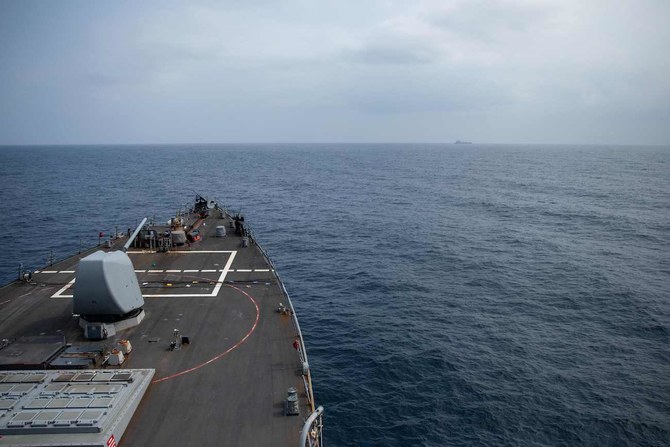
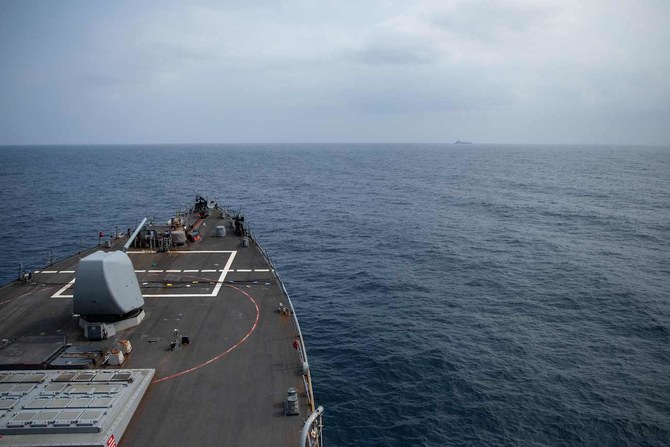
In this image, the Arleigh Burke-class guided-missile destroyer USS Laboon can be seen in the Red Sea. (File/AFP)
Short Url
Updated 10 January 2024
Follow

Houthis launch ‘largest’ Red Sea attack against US Navy

  • Sarea said: “The operation was launched in retaliation to the deceitful assault by American enemy troops on our naval forces”

AL-MUKALLA: Yemen’s Houthi militia said on Wednesday that it carried out a retaliation strike on the US Navy in the Red Sea with multiple missiles and drones.

In a statement, military spokesperson Yahya Sarea revealed that “large” numbers of the weapons were fired at a US Navy ship patrolling the waters in response to a naval attack by the Americans on Dec. 31 that left 10 of the group’s men dead.

He noted that the Houthi actions were also in protest at what it described as the US’ backing of Israel’s bombing of the Gaza Strip.

Sarea said: “The operation was launched in retaliation to the deceitful assault by American enemy troops on our naval forces.”

The Iran-backed Houthis recently issued new threats against the US Navy following its destruction of three boats carrying the killed Houthi personnel and attempting to seize a ship in the Red Sea.

The Houthi announcement came hours after the US Central Command (CENTCOM) said on Wednesday that American and British navy ships shot down 21 Houthi drones, anti-ship cruise missiles, and an anti-ship ballistic missile fired from areas under their control in Yemen on Tuesday night. It was the largest Houthi Red Sea attack to date.

In a post on X, CENTCOM said: “This is the 26th Houthi attack on commercial shipping lanes in the Red Sea since Nov. 19. There were no injuries or damage reported.”

The post also reaffirmed a warning by the US, the UK, and other nations to punish the Houthis for compromising Red Sea security.

As well as drone and missile attacks, the Houthis have seized a commercial ship as part of their attempts to pressure Israel into allowing humanitarian aid to reach Gaza.

The UN’s Yemen envoy, Hans Grundberg, was currently in consultation with the warring factions in Yemen to formulate a peace plan to end the conflict.

In the Omani capital Muscat, Grundberg met Mohammed Abdul Sallam, chief negotiator of the Houthis, and officials from Oman to discuss how to get international support for his efforts to forge a roadmap that would address issues such as implementing a nationwide truce, resuming the political process in Yemen, and paying public employees.

On Sunday, Rashad Al-Alimi, president of Yemen’s internationally recognized Presidential Leadership Council, discussed with Grundberg progress to date.

Al-Alimi renewed the council’s pledge to support UN-led peace efforts during a meeting in Riyadh on Wednesday with Catherine Corm-Kammoun, France’s ambassador to Yemen.

During his talks with the French envoy, Al-Alimi highlighted his government’s efforts to mitigate the economic impact of Houthi attacks on international shipping in the Red Sea as well as on oil installations in Yemen.

Grundberg recently said he had received commitments from both the Yemeni government and the Houthis to support a ceasefire and other measures to alleviate Yemenis’ suffering. These included paying state employees in Houthi-controlled areas and resuming oil exports from government-controlled areas.

Meanwhile, the government-run Criminal Court in Yemen’s temporary capital of Aden on Wednesday served death sentences on three members of a raided Houthi cell accused of murdering government soldiers by blowing up their military vehicle in Dhale province.


Lebanon PM says IMF wants rescue plan changes as crisis deepens

Updated 4 sec ago
Follow

Lebanon PM says IMF wants rescue plan changes as crisis deepens

  • “We want to engage with the IMF. We want to improve. This is a draft law,” Salam said
  • “They wanted the hierarchy of claims to be clearer. The talks are all positive”

DAVOS, Switzerland: The International Monetary Fund has demanded amendments to a draft rescue law aimed at hauling Lebanon out of its worst financial crisis on record and giving depositors access to savings frozen for six years, Prime Minister Nawaf Salam said.
The “financial gap” law is part of a series of reform measures required by the IMF in order to access its funding and aims to allocate the losses from Lebanon’s 2019 crash between the state, the central bank, commercial banks and depositors.
Salam told Reuters the IMF wants clearer provisions in the hierarchy of claims, which is a core element of the draft legislation designed to determine how losses are allocated.
“We want to engage with the IMF. We want to improve. This is a draft law,” Salam said in an interview at the World Economic Forum annual meeting in ⁠the Swiss mountain resort of Davos.
“They wanted the hierarchy of claims to be clearer. The talks are all positive,” Salam added.
In 2022, the government put losses from the financial crisis at about $70 billion, a figure that analysts and economists forecast is now likely to be higher.
Salam stressed that Lebanon is still pushing for a long-delayed IMF program, but warned the clock is ticking as the country has already been placed on a financial ‘grey list’ and risks falling onto the ‘blacklist’ if reforms stall further.
“We want an IMF program and we want to continue our discussions until we get there,” he said, adding: “International pressure is real ... The longer we delay, the more people’s money will evaporate.”
The draft law, which was passed by Salam’s government in December, is under parliamentary review. It aims to give depositors a guaranteed path to recovering their funds, restart bank lending, and end a financial crisis that has left nearly a million accounts frozen and confidence in the system shattered.
The roadmap would repay depositors up to $100,000 over four years, starting with smaller accounts, while launching forensic audits to determine losses and responsibility.
Lebanon’s Finance Minister Yassine Jaber, who is driving the reform push with Salam, told Reuters it was ⁠essential to salvage a hollowed-out banking system, and to stop the country from sliding deeper into its cash-only, paralyzed economy.
The aim, Jaber said, is to give depositors clarity after years of uncertainty and to end a system that has crippled Lebanon’s international standing.
He framed the law as part of a broader reckoning: the first time a Lebanese government has confronted a combined collapse of the banking sector, the central bank and the state treasury.
Financial reforms have been repeatedly derailed by political and private vested interests over the last six years and Jaber said the responsibility now lies with lawmakers.
Failure to act, he said, would leave Lebanon trapped in “a deep, dark tunnel” with no way back to a functioning system.
“Lebanon has become a cash economy, and the real question is whether we want to stay on the grey list, or sleepwalk into a blacklist,” Jaber added.