

Yemeni journalist assaulted by Houthis receives hospital care in Jordan

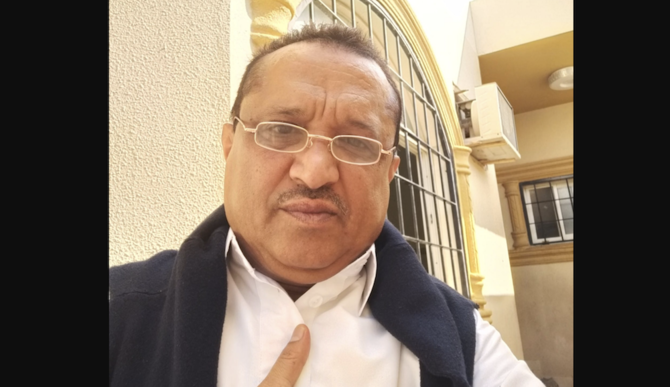
Majili Al-Samadi, head of Yemen Voice radio, shared this photograph on Facebook before heading to a hospital in Amman to seek treatment for wounds sustained in a Houthi attack outside his house in Sanaa on January 1. (Supplied)
Short Url
Updated 06 January 2024
Follow

Yemeni journalist assaulted by Houthis receives hospital care in Jordan

  • Majili Al-Samadi was beaten on Jan. 1, shortly after he criticized a judge at a Houthi-run court for dismissing an appeal against a ban on his radio broadcasts
  • Yemeni human rights advocates and government officials urge Houthis to release kidnapped judge Abdul Wahab Qatran and stop persecuting dissenting voices

AL-MUKALLA: A Yemeni journalist attacked by Iran-backed Houthis in Sanaa last week has flown to Jordan for medical treatment. It comes as local and international campaigners condemned the militant group for persecuting dissenting voices in Yemen.

Majili Al-Samadi, the head of Voice of Yemen Radio, posted a photo taken on a Yemenia flight from Houthi-controlled Sanaa to Amman and a message in which he said goodbye to his followers, followed by another about his hospital care in Jordan.

“Tomorrow, I’ll have my third therapy session for suctioning clotted blood beneath my skin, which was caused by an assault on me by an armed group linked with the Houthis,” he wrote on his Facebook page.

On Jan. 1, less than a day after Al-Samadi criticized a judge at a Houthi-run court for denying his appeal against a ban on his radio broadcasts, an armed group with suspected connections to the Houthis assaulted him, for the second time in six months, and broke the windows of his car outside his home in Sanaa.

He said the attack caused his hands to swell and become red as a result of blood clots and that he was having difficulty moving his hands and legs.


Al-Samadi said the attack caused his hands to swell and become red as a result of blood clots and that he was having difficulty moving his hands and legs.

In early 2022, the Houthis shut down Voice of Yemen Radio and five other radio stations for refusing to broadcast the group’s propaganda. The first attack on Al-Samadi was in August, after he continued to protest against the broadcast ban, and supported public demands for the Houthis to pay government employees’ wages.

Meanwhile, Yemeni human rights advocates and government officials urged the Houthis to release outspoken judge Abdul Wahab Qatran and halt their escalating persecution of dissenting voices.

The Houthis abducted the judge from his home last week after besieging it for hours, wrecking the property and detaining other his members of his family. Hours earlier, he had expressed support for Al-Samadi and criticized the Houthis for silencing opponents through intimidation.

The Houthis have not commented on the kidnapping but the judge’s sons said the group falsely accused him of possessing and consuming alcohol.

Yemen’s information minister, Muammar Al-Eryani, strongly condemned the Houthis for attacking Al-Samadi, Qatran and others who oppose their rule, and accused the group of attempting to exploit the conflict in Gaza as a means to silence their critics and deflect public outrage over their failure to pay public-sector workers.

“These assaults and threats indicate the Houthi militia’s state of panic, as well as its attempts to use regional events to silence critics of its actions, continuous robbery of the state’s public funds, and refusal to pay employee wages,” the minister wrote in a message posted on social media platform X.


Bahrain arrests four for spying for Iran’s IRGC as Gulf attacks intensify

Updated 25 min 46 sec ago
Follow

Bahrain arrests four for spying for Iran’s IRGC as Gulf attacks intensify

  • Investigators said the suspects were found to have sent pictures and coordinates of vital locations in Bahrain to the IRGC via encrypted software

MANAMA: Bahrain has detained four citizens suspected of spying for Iran’s Islamic Revolutionary Guard Corps (IRGC), as Tehran’s retaliatory strikes on Gulf states show no signs of letting up.

Bahrain’s General Directorate of Criminal Investigation and Forensic Science identified the four detainees as Murtadha Hussain Awal, 25; Ahmed Isa Al Haiki, 34; Sarah Abdulnabi Marhoon, 36; and Elias Salman Mirza, 22. A fifth suspect, Ali Mohammed Hassan Al Shaikh, 25, remains at large abroad.

Investigators said Murtadha Hussain and his cohorts, acting on IRGC instructions, used high-resolution equipment to photograph and record coordinates of vital locations in Bahrain, transmitting the data to the IRGC via encrypted software.

The arrests come as Iran escalates attacks across the Gulf. Bahrain’s Interior Ministry issued an advisory urging residents in Hidd, Arad, Qalali and Samaheej to stay indoors and seal windows against smoke from fires sparked by Iranian strikes. Fuel tanks at a facility in Muharraq Governorate, northeast of Manama, were among the targets. Oman’s Port of Salalah also battled blazes at fuel storage tanks following separate Iranian drone strikes.

Elsewhere in the region, two Iranian drones struck near Dubai International Airport, wounding four people, though flights continued uninterrupted. A fire broke out at a luxury apartment tower in Dubai Creek Harbour after another drone hit — extinguished by Thursday morning.

Iran also targeted commercial ships and struck what officials described as the world’s busiest international airport on Wednesday, as US and Israeli strikes continued to pound Tehran.

A war now 12 days old — and costly

The conflict began on February 28, when US and Israeli forces launched coordinated strikes on Iran. Tehran has since retaliated by targeting Gulf states, US and Israeli assets, and critical energy infrastructure.

Iran has declared a blockade on energy shipments through the Strait of Hormuz, a vital chokepoint for global oil and gas flows, sending commodity prices surging and rattling international markets.

The Pentagon told Congress this week that the first week of war cost the United States $11.3 billion — including $5 billion in munitions in the conflict’s opening weekend alone.

The UN Security Council on Wednesday voted to approve a resolution demanding a halt to Iran’s attacks on its Gulf neighbors. Bahrain’s UN Ambassador Jamal Alrowaiei welcomed the move.

“The international community is resolute in rejecting these Iranian attacks against sovereign countries that are threatening the stability of the peoples, especially in a region of strategic importance to global economy, energy security and global trade,” he said.

Despite the resolution, there were no immediate signs the conflict was easing.

(With AP)