

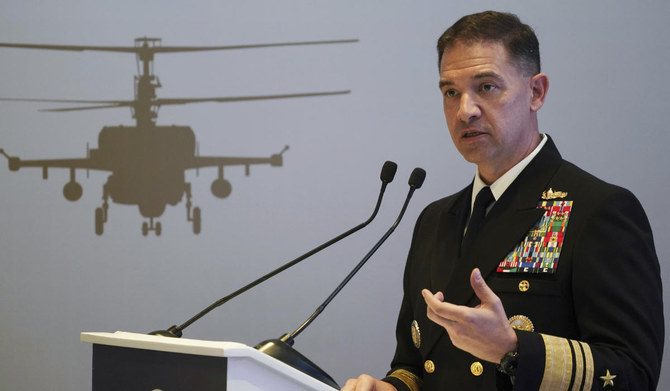

CHRISTIANSTED, US Virgin Islands: Yemen’s Houthi rebels show no signs of ending their “reckless” attacks on commercial ships in the Red Sea, the top commander of US naval forces in the Middle East said Saturday, even as more nations join the international maritime mission to protect vessels in the vital waterway and trade traffic begins to pick up.
Since Operation Prosperity Guardian was announced just over 10 days ago, 1,200 merchant ships have traveled through the Red Sea region, and none has been hit by drone or missile strikes, Vice Adm. Brad Cooper said in an Associated Press interview. He said additional countries are expected to sign on. Denmark was the latest, announcing Friday it plans to send a frigate to the mission that Defense Secretary Lloyd Austin announced during a visit to Bahrain, where the Navy’s 5th Fleet is based, saying that “this is an international challenge that demands collective action.”
The Iran-backed Houthis say their attacks are aimed at Israel-linked ships in an effort to stop the Israeli offensive in Gaza.
The narrow Bab el-Mandeb Strait connects the Gulf of Aden to the Red Sea and then the Suez Canal. The crucial trade route links markets in Asia and Europe. The seriousness of the attacks, several of which have damaged vessels, led multiple shipping companies to order their vessels to hold in place and not enter the strait until the security situation improved. Some major shippers were sending their ships around Africa and the Cape of Good Hope, adding time and costs to the journeys.
Currently there are five warships from the United States, France, and the United Kingdom patrolling the waters of the southern Red Sea and the western Gulf of Aden, said Cooper, who heads the 5th Fleet. Since the operation started, the ships have shot down a total of 17 drones and four anti-ship ballistic missiles, he said.
Just two days ago, the USS Mason, a Navy destroyer, downed a drone and anti-ship ballistic missile that were fired by the Houthis, according to US Central Command. The US said the 22nd attack on international shipping by the Houthis since Oct. 19 caused no damage to any of the 18 ships in the area or any reported injuries.
“I expect in the coming weeks we’re going to get additional countries,” Cooper said, noting Denmark’s recent announcement.
The US has said that more than 20 nations are participating, but a number of those nations have not acknowledged it publicly.
On Saturday, Austin discussed the ongoing illegal Houthi attacks in a call with Netherlands’ defense minister, Kajsa Ollongren, according to the Pentagon. Both condemned the attacks as unacceptable and “profoundly destabilizing” to international order and global commerce, with Austin stressing that they constitute “a significant international problem that demands collective action.”
Cooper said the coalition is in direct communication with commercial ships to provide guidance on “maneuvering and the best practices to avoid being attacked,” and working closely with the shipping industry to coordinate security.
An international task force had been set up in April 2022 to improve maritime security in the region. But Cooper said Operation Prosperity Guardian has more ships and a persistent presence to assist vessels.
Since the operation started, the Houthis have stepped up their use of anti-ship ballistic missiles, Cooper said. “We are cleareyed that the Houthi reckless attacks will likely continue,” he said.
The Houthis seized Yemen’s capital, Sanaa, in 2014, launching a grinding war against a Saudi-led coalition that sought to restore the government. The militants have sporadically targeted ships in the region, but the attacks increased since the start of the Israel-Hamas war.
The Houthi threatened to attack any vessel they believe is either going to or coming from Israel. That has escalated to apparently any vessel, with container ships and oil tankers flagged to countries such as Norway and Liberia being attacked or drawing missile fire.
The shipping company Maersk had announced earlier that it had decided to re-route its ships that have been paused for days outside the strait and Red Sea, and send them around Africa instead. Maersk announced Dec. 25 that it was going to resume sending ships through the strait, citing the operation. Cooper said another shipping company had also resumed using the route.
“Commerce is definitely flowing,” Cooper said.


