NAQURA, Lebanon: Some displaced residents of southern Lebanon returned Monday to their towns for a key Muslim holiday to pray and mourn loved ones killed in months of cross-border violence between Israel and Hezbollah.
“Today is Eid Al-Adha, but it’s completely different this year,” said teacher Rabab Yazbek, 44, at a cemetery in the coastal town of Naqura, from which many residents have fled.
Every family has lost someone, “whether a relative, friend or neighbor,” Yazbek said, adding that two people she had taught had been killed.
Israel and Hezbollah, a powerful Lebanese movement allied with Hamas, have traded near-daily cross-border fire since the Palestinian militant group’s October 7 attack on Israel which triggered war in the Gaza Strip.
The violence has killed at least 473 people in Lebanon, most of them fighters but also including 92 civilians, according to an AFP tally.
Israeli authorities say at least 15 soldiers and 11 civilians have been killed in the country’s north.
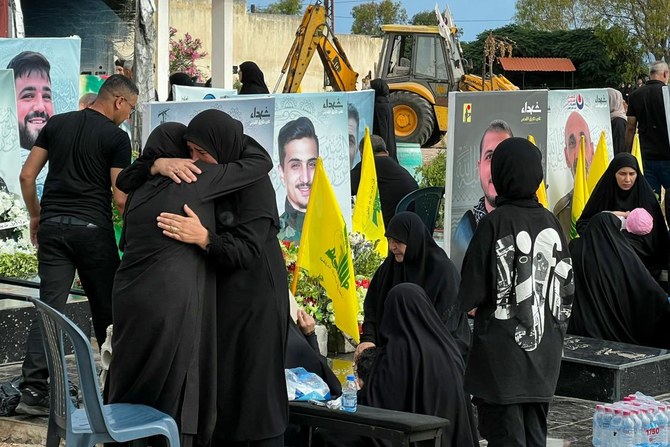
At the cemetery, women in black chadors consoled each other at the shiny new graves adorned with flowers and large pictures of the dead, including Hezbollah fighters.
The Naqura municipality said it had coordinated with the Lebanese army so that residents could safely visit the cemetery and mosque for two hours for Eid Al-Adha, which for many Shiite Muslims in Lebanon began on Monday.
Residents reportedly returned to a number of south Lebanon border villages on Monday morning as part of similar initiatives.
Yellow Hezbollah flags and green ones belonging to the group’s ally the Amal movement flew at the recently established cemetery near the sea, located just a stone’s throw from the United Nations peacekeepers’ headquarters.
Lebanese soldiers accompanied the residents as they entered the town.
The army coordinates with the UN peacekeepers, who in turn communicate with the Israeli side as part of efforts to maintain calm.
In Naqura, a damaged sign reading “thank you for your visit” lay along the highway.
Amid the concrete rubble and twisted metal of one building, the shattered glass of a family photo lay scattered on the ground.
Nearby, potted plants hung from the veranda rails of another devastated structure, with a pink child’s toy car among the debris.
Rawand Yazbek, 50, was inspecting her clothing shop, whose glass store front had been destroyed, though the rest remained largely intact.
“A thousand thanks to God,” she said, grateful that not all was lost.
“As you can see... our stores are full of goods,” she said, pointing to shelves and racks of colorful clothes.
Hezbollah stepped up attacks against northern Israel last week after an Israeli strike killed a senior commander from the movement.
The Iran-backed group has not claimed any attacks since Saturday afternoon.
Lebanese official media reported Israeli bombardment in the country’s south over the weekend, as well as a deadly strike on Monday. Hezbollah said later that one of its fighters had been killed.
Like other residents who support the Hezbollah and Amal movements, Naqura municipality head Abbas Awada called attacks on the town “cowardly.”
Last week, a strike there blamed on Israel killed an employee of the area’s public water company.
More than 95,000 people in Lebanon have been displaced by the hostilities, according to the UN’s International Organization for Migration.
Tens of thousands have also been displaced on the Israeli side of the frontier.
Hezbollah lawmaker Hassan Ezzedine, among a large crowd that attended prayers at the Naqura mosque, said the turnout was a message that “this land is ours, we will not leave it.”
“We support this resistance (Hezbollah) because it’s what protects us, it’s what defends us,” he said.


![]()

Displaced Lebanese return to southern border to mourn, pray over Eid
Short Url
https://arab.news/9426c
Displaced Lebanese return to southern border to mourn, pray over Eid
- Israel and Hezbollah have traded near-daily cross-border fire since Hamas’ Oct. 7 attack


Latest updates


© 2026 SAUDI RESEARCH & PUBLISHING COMPANY, All Rights Reserved And subject to Terms of Use Agreement.