SEOUL: North Korean leader Kim Jong Un said Pyongyang would not hesitate to launch a nuclear attack if an enemy provokes it with nuclear weapons, state media reported on Thursday.
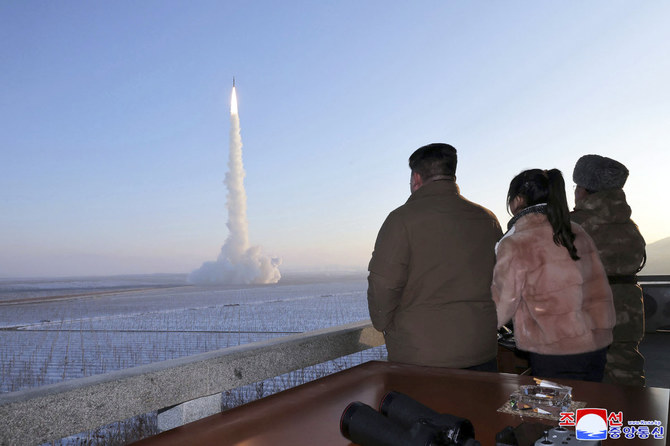
Kim made the remark as he met with soldiers working for the military’s missile bureau and congratulated them over Pyongyang’s recent launching drill of an intercontinental ballistic missile (ICBM), KCNA news agency said.
He said the test demonstrated the loyalty and strong stand of the armed forces and was “a clear explanation of the offensive counteraction mode and the evolution of the nuclear strategy and doctrine of the DPRK not to hesitate even a nuclear attack when the enemy provoke it with nukes,” KCNA reported.
DPRK is the abbreviation for the North’s official name, the Democratic People’s Republic of Korea.
North Korea said this week it had tested its newest ICBM on Monday to gauge the war readiness of its nuclear forces against mounting US hostility.
The top diplomats of the United States, South Korea and Japan on Wednesday issued a joint statement condemning North Korea’s recent ballistic missile launches and urged Pyongyang to engage in “substantive dialogue without preconditions.”
Kim said Monday’s launch showed the military’s high mobility and rapid attack capability, and called for efforts to further strengthen its combat efficiency, KCNA reported.
In a separate statement, Kim’s sister, Kim Yo Jong, condemned the United Nations Security Council (UNSC) for holding a meeting over the ICBM launch, saying it was an exercise of the country’s right to self-defense.
“The UNSC should place heavy responsibility on the irresponsible behavior and act of the US and the ROK, which have aggravated the tension on the Korean peninsula through all sorts of military provocations all year round,” she said.
ROK stands for South Korea’s official name, the Republic of Korea.
The United States, South Korea and Japan staged a joint air drill involving a US strategic bomber near the Korean peninsula on Wednesday, the latest US strategic asset to be deployed as part of Washington’s pledge with Seoul to boost defense readiness.

North Korea’s Kim warns of ‘nuclear attack’ if provoked with nukes
Short Url
https://arab.news/bgups
North Korea’s Kim warns of ‘nuclear attack’ if provoked with nukes
- North Korea said this week it had tested its newest ICBM on Monday to gauge the war readiness of its nuclear forces against mounting US hostility
El Paso flights resume after US anti-drone system prompts sudden shutdown
- Aviation officials lifts restrictions after sudden overnight halt
- FAA, US Army in dispute over laser anti-drone system
WASHINGTON: A secret military laser-based anti-drone system prompted the Trump administration to ban air traffic for more than seven hours in and out of the Texas border city of El Paso after US aviation officials raised drastic concerns about the safety of commercial air traffic.
The sudden closure of the nation’s 71st busiest airport by the Federal Aviation Administration stranded air travelers and disrupted medical evacuation flights overnight. The FAA initially said the closure would last 10 days for “special security reasons,” in what would have been an unprecedented action involving a single airport. Government and airline officials, speaking on condition of anonymity, said the FAA closed the airspace due to concerns that an Army laser-based counter-drone system could pose risks to air traffic. The two agencies had planned to discuss the issue at a February 20 meeting but the Army opted to proceed without FAA approval, sources said, which prompted the FAA to halt flights.
The Army’s laser was a direct-energy weapon called LOCUST and is manufactured by AeroVironment, a Virginia-based drone and counter-drone defense firm, two people briefed on the matter said. The company and the Pentagon did not immediately respond to requests for comment.
The FAA lifted its restrictions after the Army agreed to more safety tests before using the system, which is housed at Fort Bliss, next to El Paso International Airport.
The White House was surprised by the El Paso airspace closure, according to two sources speaking on condition of anonymity, touching off a scramble among law enforcement agencies to figure out what happened.
The FAA lifted the restrictions shortly after the situation was discussed in the office of White House chief of staff Susie Wiles, the sources said. US Transportation Secretary Sean Duffy, who oversees the FAA, said the closure had been prompted by a drone incursion by a Mexican drug cartel. However, a drone sighting near an airport would typically lead to a brief pause on traffic, not an extended closure, and the Pentagon says there are more than 1,000 such incidents each month along the US-Mexico border.
FAA Administrator Bryan Bedford met senators on Wednesday and told them there could have been better coordination about the move but did not answer detailed questions about why the agency initially planned a 10-day halt to flights, lawmakers said. Senate Commerce Committee chair Ted Cruz, a Texas Republican, and Senator Ben Ray Lujan, a New Mexico Democrat, both called for a classified briefing to get more answers. “The details of what exactly occurred over El Paso are unclear,” Cruz said.
The move had stranded numerous aircraft from Southwest Airlines, United Airlines and American Airlines at the airport, which handles about 4 million passengers annually.
El Paso Mayor Renard Johnson said the FAA did not reach out to the airport, the police chief or other local officials before shutting down the airspace.
“I want to be very, very clear that this should have never happened,” he said at a news conference.
The US official in charge of airport security, Transportation Security Administration Acting Administrator Ha Nguyen McNeill, also told Congress that she had not been notified.
“That’s a problem,” said Republican Representative Tony Gonzales of Texas, who said there are daily drone incursions along the US-Mexico border.
Airlines caught off guard
Airlines were also caught off-guard by the early Wednesday announcement. Southwest Airlines said the effects should be minimal for its 23 daily departures scheduled.
“FAA has not exactly acquitted itself credibly, objectively, or professionally,” said Bob Mann, an airline industry consultant. “The question should be, do we get an explanation?”
Trump has repeatedly threatened to deploy US military force against Mexican drug cartels, which have used drones to carry out surveillance and attacks on civilian and government infrastructure, according to US and Mexican security sources.
Mexican President Claudia Sheinbaum said at her daily news conference that her administration would try to find out what exactly happened but had no information about drone traffic along the border.
Tensions between the US and regional leaders have ramped up since the Trump administration mounted a large-scale military buildup in the southern Caribbean, attacked Venezuela and seized its president, Nicolas Maduro, in a military operation. The FAA curbed flights throughout the Caribbean after the attack, forcing the cancelation of hundreds of flights.
The sudden closure of the nation’s 71st busiest airport by the Federal Aviation Administration stranded air travelers and disrupted medical evacuation flights overnight. The FAA initially said the closure would last 10 days for “special security reasons,” in what would have been an unprecedented action involving a single airport. Government and airline officials, speaking on condition of anonymity, said the FAA closed the airspace due to concerns that an Army laser-based counter-drone system could pose risks to air traffic. The two agencies had planned to discuss the issue at a February 20 meeting but the Army opted to proceed without FAA approval, sources said, which prompted the FAA to halt flights.
The Army’s laser was a direct-energy weapon called LOCUST and is manufactured by AeroVironment, a Virginia-based drone and counter-drone defense firm, two people briefed on the matter said. The company and the Pentagon did not immediately respond to requests for comment.
The FAA lifted its restrictions after the Army agreed to more safety tests before using the system, which is housed at Fort Bliss, next to El Paso International Airport.
The White House was surprised by the El Paso airspace closure, according to two sources speaking on condition of anonymity, touching off a scramble among law enforcement agencies to figure out what happened.
The FAA lifted the restrictions shortly after the situation was discussed in the office of White House chief of staff Susie Wiles, the sources said. US Transportation Secretary Sean Duffy, who oversees the FAA, said the closure had been prompted by a drone incursion by a Mexican drug cartel. However, a drone sighting near an airport would typically lead to a brief pause on traffic, not an extended closure, and the Pentagon says there are more than 1,000 such incidents each month along the US-Mexico border.
FAA Administrator Bryan Bedford met senators on Wednesday and told them there could have been better coordination about the move but did not answer detailed questions about why the agency initially planned a 10-day halt to flights, lawmakers said. Senate Commerce Committee chair Ted Cruz, a Texas Republican, and Senator Ben Ray Lujan, a New Mexico Democrat, both called for a classified briefing to get more answers. “The details of what exactly occurred over El Paso are unclear,” Cruz said.
The move had stranded numerous aircraft from Southwest Airlines, United Airlines and American Airlines at the airport, which handles about 4 million passengers annually.
El Paso Mayor Renard Johnson said the FAA did not reach out to the airport, the police chief or other local officials before shutting down the airspace.
“I want to be very, very clear that this should have never happened,” he said at a news conference.
The US official in charge of airport security, Transportation Security Administration Acting Administrator Ha Nguyen McNeill, also told Congress that she had not been notified.
“That’s a problem,” said Republican Representative Tony Gonzales of Texas, who said there are daily drone incursions along the US-Mexico border.
Airlines caught off guard
Airlines were also caught off-guard by the early Wednesday announcement. Southwest Airlines said the effects should be minimal for its 23 daily departures scheduled.
“FAA has not exactly acquitted itself credibly, objectively, or professionally,” said Bob Mann, an airline industry consultant. “The question should be, do we get an explanation?”
Trump has repeatedly threatened to deploy US military force against Mexican drug cartels, which have used drones to carry out surveillance and attacks on civilian and government infrastructure, according to US and Mexican security sources.
Mexican President Claudia Sheinbaum said at her daily news conference that her administration would try to find out what exactly happened but had no information about drone traffic along the border.
Tensions between the US and regional leaders have ramped up since the Trump administration mounted a large-scale military buildup in the southern Caribbean, attacked Venezuela and seized its president, Nicolas Maduro, in a military operation. The FAA curbed flights throughout the Caribbean after the attack, forcing the cancelation of hundreds of flights.
© 2026 SAUDI RESEARCH & PUBLISHING COMPANY, All Rights Reserved And subject to Terms of Use Agreement.