Pakistani inmates in Karachi sell art, transform lives in prison rehabilitation program

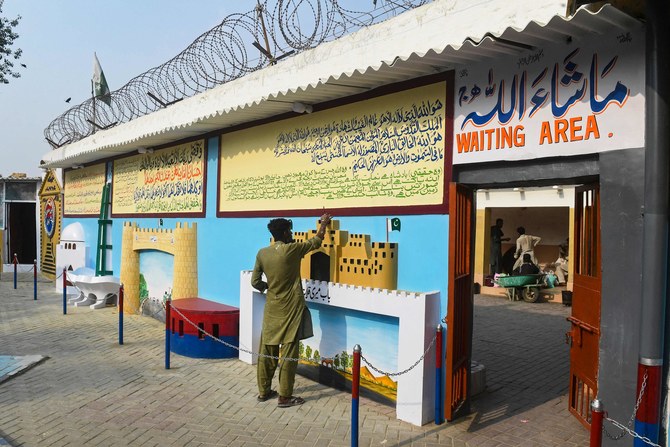
In this photograph taken on December 16, 2023, a prisoner works on a wall mural at the Central Jail in Karachi. (AFP)
Short Url
Updated 22 December 2023
Follow

Pakistani inmates in Karachi sell art, transform lives in prison rehabilitation program

  • Prisoners charged with serious offenses say they have learned about the colors of life after being thrown in jail
  • The rehabilitation program also provides opportunities to inmates to learn languages like Arabic, English or Chinese

KARACHI: Karachi’s colonial-era prison is adorned with murals of rural Pakistani life, painted by convicted murderers and kidnappers locked away from the world but learning their craft inside its walls.
A rehabilitation art and music program has seen some inmates sell their work for several thousand dollars at exhibitions supported by the local arts council, according to prison chiefs.
“Before I was jailed, it was another life with no responsibility and immaturity,” Mohammad Ijaz told AFP from the prison studio.
“But I have found the true meaning of life since being jailed. They have taught us that life is full of colors and the colors themselves speak.”
Ijaz, who declines to give details about his conviction under a penal code covering kidnapping and abduction, says he is about halfway through a 25-year sentence.
Despite being locked up, he has earned huge sums from his art depicting horses — funding his mother’s pilgrimage to Makkah and his sister’s wedding.
“In the beginning, my family didn’t believe me that I had become an artist,” said the 42-year-old, who now teaches other prisoners. “When they saw us in the exhibition, they were happy.”
The art program was launched at Karachi Central Jail in 2007, and aims to reform inmates serving long sentences or those on death row.
Prisoners can also learn languages such as Arabic, English or Chinese, as well as hand embroidery and beadwork.
“Engaging them in constructive pursuits kind of polishes them,” senior prison official Ammad Chandio told AFP. “It helps them reflect upon their past, what crime, what sin or what violation of law they had committed.”
“Any art that is being produced inside the correctional facility, it is actually the property of the inmates, and any proceeds that come from the sale of these products, the property of those inmates.”
Prisons across Pakistan are often dangerously overcrowded with limited access to water, sanitation and food, but central jails in major cities generally receive better funding.
“Efforts to rehabilitate prisoners should be at the fore, the purpose of penal punishments is to help them become better citizens,” said Sarah Belal, executive director of Justice Project Pakistan.
Mehtab Zakir is serving a murder sentence handed down five years ago but his family still depends on him for financial support.
“I know I haven’t wasted time here, at least we have learnt something,” said the 34-year-old. “I feel happy when I finish a painting and it gives me confidence that at least I can do something.”


US says trade with Pakistan could top $8 billion in 2025

Updated 7 sec ago
Follow

US says trade with Pakistan could top $8 billion in 2025

  • US chargé d’affaires links rising trade to deeper economic engagement with Pakistan
  • Visit comes amid broader effort by Islamabad and Washington to improve bilateral ties 

ISLAMABAD: Trade between the United States and Pakistan is projected to exceed $8 billion in 2025, the US Embassy said on Tuesday, as Washington signaled confidence in Pakistan’s export base and economic potential during a high-profile visit to the industrial city of Sialkot.

The projection was highlighted by US Chargé d’Affaires Natalie A. Baker during meetings with Pakistani exporters and business leaders, underlining the importance Washington places on trade, investment and supply-chain cooperation as the two countries seek to stabilize and expand their economic relationship.

“Highlighting the growth in trade between the United States and Pakistan, which was projected to reach over $8 billion in 2025, Baker said, ‘Expanding trade reflects a strong foundation that highlights the positive impact of US economic engagement in Pakistan and globally. The United States and Pakistan are pursuing a fair and balanced trade relationship that creates prosperity for both our nations’,” the US embassy said in a statement.

The envoy said the United States had been Pakistan’s largest export market and a leading investor, presenting significant opportunities for expanded trade and shared prosperity. 

“The United States remains deeply invested in Pakistan and its people,” Baker said, “building on a partnership that dates back to Pakistan’s independence and continues to grow through trade, innovation, education, and cultural exchange.”

The visit comes amid a broader effort by Islamabad and Washington to improve bilateral ties under US President Donald Trump’s second term, after years of uneven engagement. Since mid-2025, the two sides have stepped up diplomatic contacts, including meetings between Prime Minister Shehbaz Sharif, Pakistan’s military leadership and US officials, alongside discussions on trade, minerals, security cooperation and regional stability.

Pakistan has also sought to re-energize economic diplomacy with Washington as it works to boost exports, attract foreign investment and stabilize its economy under an IMF-backed reform program. 

In July 2025, the two countries agreed to a bilateral trade deal that included reciprocal tariff reductions and frameworks for US investment in Pakistan’s energy and mineral sectors, a step Islamabad has hailed as opening new avenues for economic collaboration.

During her visit, Baker toured leading exporters including Forward Sports, First American Corporation (FAC) and CA Sports, companies that are deeply embedded in global supply chains. The embassy said nearly 70 percent of FAC’s exports go to the United States, illustrating sustained US consumer demand for Pakistani-made goods.

Baker also visited Sialkot International Airport and met with the leadership of AirSial, highlighting private-sector-led infrastructure and logistics as key to Pakistan’s export growth.