Amnesty International condemns arrest of Baloch protesters, asks Pakistan to drop charges against them

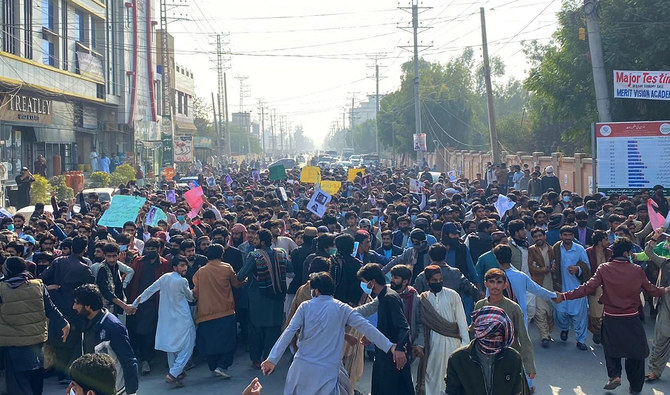
People march against the “extrajudicial killings,” accusing the counterterrorism authorities of Balochistan province, in Dera Ghazi Khan on December 18, 2023. (Photo courtesy: X/@Shamooo52)
Short Url
Updated 19 December 2023
Follow

Amnesty International condemns arrest of Baloch protesters, asks Pakistan to drop charges against them

  • The rights group says the protesters were arrested in DG Khan on Dec. 17 while marching to Islamabad
  • The Baloch march began after a 24-year-old man died in CTD’s custody following his arrest in Turbat

ISLAMABAD: A global human rights advocacy group on Monday raised concern over the arrest of protesters from Balochistan marching toward Islamabad to highlight the issue of extrajudicial killings in their province, asking the Pakistani authorities to drop all charges against them.
The march began after people in the country’s southeastern town of Turbat accused officials of the provincial Counter-Terrorism Department (CTD) of killing 24-year-old Balach Baloch in November after arresting him on charges of possessing five kilograms of explosive material.
Baloch’s family and members of the civil society held a sit-in in Turbat for about two weeks to protest what they called his “custodial death” and demanded action against the CTD officials. The protesters, including women and children, set out on a 766-kilometer-long march to the provincial capital of Quetta earlier this month before deciding to move on to Islamabad.
According to Amnesty International, at least 20 of these people were arrested on December 17 while they were moving from Dera Ghazi Khan district in the Punjab province.
“The protesters have been released,” the international rights organization said. “However, 3 separate cases against the organizers and participants have been filed.”
“Amnesty International demands that the Pakistani authorities immediately and unconditionally drop all charges against all those charged solely for exercising their right to freedom of expression,” it added.
It also demanded an impartial investigation of all extrajudicial killings and enforced disappearances in Pakistan, particularly in Balochistan, in line with international standards.
The global rights organization also urged Pakistani authorities to compensate families of victims of extrajudicial killings and those forcibly disappeared.
Pakistan has frequently faced allegations of extrajudicial killings and enforced disappearances in the province of Balochistan, though its governments have always denied these allegations.
The province shares a porous border with Iran and Afghanistan and has been the scene of a low-level insurgency by Baloch nationalists for nearly two decades.


Pakistan vows to play active role against climate change on International Day of Clean Energy 

Updated 4 sec ago
Follow

Pakistan vows to play active role against climate change on International Day of Clean Energy 

  • Governments, civil societies every year mark Jan. 26 as International Day of Clean Energy, calling for inclusive transition to clean power
  • Pakistan ranks among nations most vulnerable to climate change, suffering from erratic weather patterns such as floods, heatwaves, storms

ISLAMABAD: Pakistan will play an active role in global efforts against climate change, President Asif Ali Zardari vowed on Monday as the world marks International Day of Clean Energy today. 

The International Day of Clean Energy is marked every year on Jan. 26 during which governments and civil societies around the world call for awareness on climate change impacts and demand action for a just and inclusive transition to clean energy for the benefit of the people.

Burdened by an energy crisis that has resulted in costly fuel imports over the past couple of years, Pakistan has sought to shift to clean energy to place less burden on its fragile economy. The South Asian country has emerged as one of the world’s fastest growing solar markets, with 12 gigawatts (GWs) of off-grid and over 6GWs of net-metered solar capacity by the end of 2025. In the last fiscal year, renewables accounted for a historic 53 percent of total electricity generation, according to the prime minister’s coordinator on climate change, Romina Khurshid Alam. 

“Pakistan will play an active role in global efforts against climate change,” Zardari was quoted in a statement released by his office. “Investment in safe technologies is essential for the protection of the planet.”
Zardari stressed that clean energy is essential for inclusive development, noting that Pakistan has made the transition toward it a “national priority.”

He said clean energy occupies a central place in the government’s policy framework, adding that Pakistan has set a target of electric vehicles comprising 30 percent of all passenger vehicles and heavy-duty truck sales by 2030. 

The Pakistani president cited air pollution as a major challenge to public health in the country, noting its social and economic costs for the government and the people. 

“Pakistan is committed to building a reliable and sustainable energy system,” he said. 

Pakistan ranks among nations most vulnerable to climate change and has seen erratic changes in its weather patterns that have led to frequent heatwaves, untimely rains, storms, cyclones, floods and droughts in recent years. 

In 2022, monsoon floods killed over 1,700 people, displaced another 33 million and caused over $30 billion losses. Over 1,000 people were killed in floods last year as well due to torrential monsoon rains and floods triggered by climate change impacts and excess water released by Indian dams.