

Protest erupts in southwestern Pakistani town over ‘extrajudicial killings’ by authorities

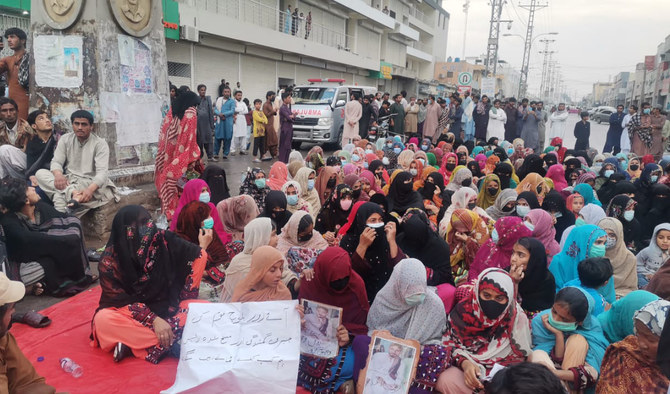
People in Pakistan’s southwestern town of Turbat protest after accusing the provincial counterterrorism authorities of Balochistan of “extrajudicial killings” on Saturday, November 25, 2023. (Photo courtesy: Asad Baloch)
Short Url
Updated 25 November 2023
Follow

Protest erupts in southwestern Pakistani town over ‘extrajudicial killings’ by authorities

  • CTD recently reported the killing of a young Baloch resident of Turbat, accusing him of involvement in militant activities
  • His family members are protesting with his body, saying he was a shopkeeper who was not involved in unlawful activities

QUETTA: Residents of Turbat, a remote Pakistani town in southwestern Balochistan, have been protesting for three days with the body of a young man, killed in a recent Counterterrorism Department (CTD) operation, accusing law enforcement agencies of extrajudicial killings of citizens.
According to a CTD statement issued on Nov. 24, Balach Baloch confessed he had carried out a number of militant attacks following his arrest with five kilograms of explosive material on Nov. 20.
The statement, a copy of which is in possession of Arab News, said the CTD authorities raided a spot on Pasni Road where there was heavy exchange of fire in which Baloch lost his life.
The family of the deceased, however, has denied the claim, saying he was not involved in unlawful activities but was a peaceful Pakistani citizen who was picked up by the CTD on Oct. 29 and produced before a local court for a 10-day physical remand on Nov. 21.
“Balach was 24 years old and ran a small shop in Turbat,” Saba Baloch, his cousin, told Arab News over the phone. “The CTD has leveled fake allegations against him.”
“We have been protesting for three days at the Fida Square in Turbat with Balach’s corpse,” she added. “Today, we camped outside the Turbat court and presented a list of six demands, including the registration of an FIR [First Information Report] against the CTD personnel involved in the fake encounter and their suspension from service.”
Baloch’s killing triggered outrage on social media where his sister’s mourning video went viral after the incident. Civil society activists and political parties have also joined the protest, seeking justice in the matter for him and three other Baloch men who also lost their lives in the same encounter.
The Human Rights Commission of Pakistan (HRCP) condemned the “extrajudicial killings” in response to the development, stating they could not be justified under any circumstances.
“The extrajudicial killings are continued to be reported from Balochistan, particularly in Kech [where Turbat is located] and its surrounding areas,” it said in a statement on X. “Extrajudicial executions are not justified in any circumstances whatsoever, given that the state has a legal obligation to protect the right to life and the right to due process.”
“The impunity accorded to perpetrators must cease and those responsible be held to account,” it added.


The local court in Turbat ordered the registration of FIR against the CTD team involved in the operation.
The deputy commissioner of Kech, Hussain Jan Baloch, said the authorities in the area were negotiating with the protesters, hoping that they would peacefully disperse tonight and bury the body.
“They have presented their charter of demands and one of their prime demands was to lodge an FIR against the CTD personnel which has been accepted by the court,” he told Arab News. “We are optimistic that we will be able to convince them to bury Balach’s body.”
Waseem Safar, a member of the Baloch Solidarity Committee in Turbat, however, pledged to continue the protest and not bury the corpse until justice was served.
Pakistan’s resource-rich Balochistan province has witnessed low-scale insurgency in recent decades by separatist groups that accuse Islamabad of exploiting the province’s natural resources.
The government denies the allegation, saying it is striving to improve the quality of life of people in the region by launching mega development projects.


Sindh assembly passes resolution rejecting move to separate Karachi

Updated 21 February 2026
Follow

Sindh assembly passes resolution rejecting move to separate Karachi

  • Chief Minister Shah cites constitutional safeguards against altering provincial boundaries
  • Calls to separate Karachi intensified amid governance concerns after a mall fire last month

ISLAMABAD: The provincial assembly of Pakistan’s southern Sindh province on Saturday passed a resolution rejecting any move to separate Karachi, declaring its territorial integrity “non-negotiable” amid political calls to carve the city out as a separate administrative unit.

The resolution comes after fresh demands by the Muttahida Qaumi Movement (MQM) and other voices to grant Karachi provincial or federal status following governance challenges highlighted by the deadly Gul Plaza fire earlier this year that killed 80 people.

Karachi, Pakistan’s largest and most densely populated city, is the country’s main commercial hub and contributes a significant share to the national economy.

Chief Minister Syed Murad Ali Shah tabled the resolution in the assembly, condemning what he described as “divisive statements” about breaking up Sindh or detaching Karachi.

“The province that played a foundational role in the creation of Pakistan cannot allow the fragmentation of its own historic homeland,” Shah told lawmakers, adding that any attempt to divide Sindh or separate Karachi was contrary to the constitution and democratic norms.

Citing Article 239 of Pakistan’s 1973 Constitution, which requires the consent of not less than two-thirds of a provincial assembly to alter provincial boundaries, Shah said any such move could not proceed without the assembly’s approval.

“If any such move is attempted, it is this Assembly — by a two-thirds majority — that will decide,” he said.

The resolution reaffirmed that Karachi would “forever remain” an integral part of Sindh and directed the provincial government to forward the motion to the president, prime minister and parliamentary leadership for record.

Shah said the resolution was not aimed at anyone but referred to the shifting stance of MQM in the debate while warning that opposing the resolution would amount to supporting the division of Sindh.

The party has been a major political force in Karachi with a significant vote bank in the city and has frequently criticized Shah’s provincial administration over its governance of Pakistan’s largest metropolis.

Taha Ahmed Khan, a senior MQM leader, acknowledged that his party had “presented its demand openly on television channels with clear and logical arguments” to separate Karachi from Sindh.

“It is a purely constitutional debate,” he told Arab News by phone. “We are aware that the Pakistan Peoples Party, which rules the province, holds a two-thirds majority and that a new province cannot be created at this stage. But that does not mean new provinces can never be formed.”

Calls to alter Karachi’s status have periodically surfaced amid longstanding complaints over governance, infrastructure and administrative control in the megacity, though no formal proposal to redraw provincial boundaries has been introduced at the federal level.