

Protests over custodial death in southwestern Pakistan renew debate on extrajudicial killings

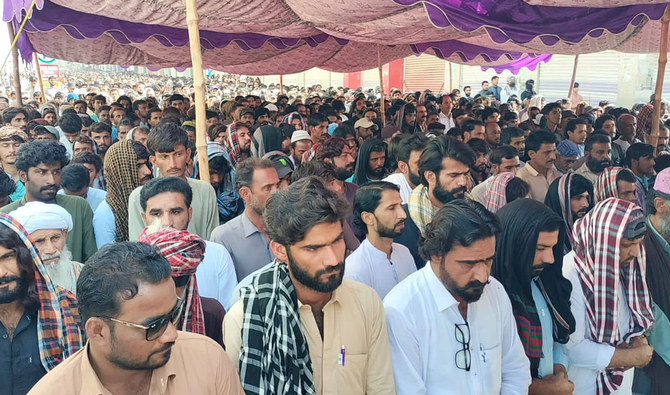
People gather to protest the alleged extrajudicial killing of a 24-year-old ethnic Baloch man in Turbat city, Kech District of Pakistan's Balochistan province, on November 30, 2023. (Photo courtesy: Assad Baloch)
Short Url
Updated 30 November 2023
Follow

Protests over custodial death in southwestern Pakistan renew debate on extrajudicial killings

  • Family says Balach Baloch killed in “fake encounter,” counterterrorism officials say Baloch had confessed to being involved in militancy
  • Protests and shutter down strikes observed across Makran division over killing as government sets up ‘fact-finding’ commission

QUETTA: A protest in southwestern Pakistan over the alleged extrajudicial killing of a 24-year-old ethnic Baloch man entered its seventh day on Thursday, in an ongoing saga that has renewed debate over extrajudicial detentions and deaths and police impunity in Balochistan province where such incidents are not uncommon.

Last week, the Counter Terrorism Department (CTD) Balochistan issued a statement, seen by Arab News, saying Balach Baloch had confessed in custody to being a militant and carrying out a number of attacks. He was arrested on Nov. 20, as per the statement, in possession of five kilograms of explosive materials. Baloch was later killed in a raid on a militant hideout in the city of Turbat, the CTD said.

His family, which finally buried him on Wednesday but vowed to continue protests, has refuted CTD claims, saying Baloch was not involved in any unlawful activities but was picked up by the CTD on Oct. 29 and killed in a “fake encounter.”

Political leaders, human rights activists and families of victims have for decades spoken against killings by the police and other security agencies in staged encounters, a practice where officials claim the victim was killed in a gunfight though they were executed. Authorities deny involvement in such incidents. 

“Things are in progress,” a senior official in a “fact-finding” committee set up to probe the case told Arab News, declining to be named as he was not authorized to speak to the media about the inquiry. 

The body has five members and has been tasked to submit a report within 15 days.

“The families of the deceased blame others, but the Chief Minister Balochistan has constituted an inquiry commission to ascertain the circumstances,” Interior Minister Sarfraz Bugti told reporters on Wednesday. “There are actions that need to be taken under the law, we can’t speak on assumptions.”

A spokesperson for the government of Balochistan and the deputy commissioner’s office did not respond to Arab News queries.

“SIT-IN WILL TURN INTO MOVEMENT“

Baloch’s killing has triggered outrage in cities across the Makran division, with a complete shutter down strike observed in Turbat and other towns on Wednesday while roads leading from the area to Pakistan’s main business hub, Karachi, were blocked by protesters.

Following a demand by Baloch’s family, a local court in Turbat had ordered the registration of a First Information Report (FIR), or police complaint, against the CTD team involved in the operation in which the 24-year-old was allegedly killed.

“Now we are protesting because despite court orders, why are the authorities not registering an FIR against the people who killed my brother,” Balach’s elder sister Najma Baloch told Arab News.
On the government’s inquiry tribunal, she said: 

“Neither do I know anything about the inquiry committee nor has anyone from the committee contacted us.”

“Now hundreds of people have joined the protest and are demanding registration of FIR against the CTD team,” she added, saying her family’s “clear demand” was that Baloch’s murderers be punished.

Waseem Safar, a local member of the Baloch Yakjehti Council (BYC) that is organizing the protests, said the protest would continue in Turbat and be expanded across the province if the police case was not filed.

“Now the sit-in will turn into a movement until authorities register an FIR against the personnel involved in Balach’s murder,” he said. “We will expand the protest across Balochistan against this extrajudicial killing.”

Senior analyst Dr. Amir Rana, who is the director of the Pakistan Institute of Peace Studies, said extrajudicial detentions and killings would continue as long as the pattern of releasing suspects involved in such crimes continued.

“If the authorities register an FIR against the CTD team involved in the recent Turbat killing, the state and its institutions, including the courts, will release them,” Rana told Arab News, adding that those involved needed to be brought to justice as per the law to set a precedent for the future. 


Islamabad says surge in aircraft orders after India standoff could end IMF reliance

Updated 06 January 2026
Follow

Islamabad says surge in aircraft orders after India standoff could end IMF reliance

  • Pakistani jets came into the limelight after Islamabad claimed to have shot down six Indian aircraft during a standoff in May last year
  • Many countries have since stepped up engagement with Pakistan, while others have proposed learning from PAF’s multi-domain capabilities

ISLAMABAD: Defense Minister Khawaja Asif on Tuesday said Pakistan has witnessed a surge in aircraft orders after a four-day military standoff with India last year and, if materialized, they could end the country’s reliance on the International Monetary Fund (IMF).

The statement came hours after a high-level Bangladeshi defense delegation met Pakistan’s Air Chief Marshal Zaheer Ahmed Baber Sidhu to discuss a potential sale of JF-17 Thunder aircraft, a multi-role fighter jointly developed by China and Pakistan that has become the backbone of the Pakistan Air Force (PAF) over the past decade.

Fighter jets used by Pakistan came into the limelight after Islamabad claimed to have shot down six Indian aircraft, including French-made Rafale jets, during the military conflict with India in May last year. India acknowledged losses in the aerial combat but did not specify a number.

Many countries have since stepped up defense engagement with Pakistan, while delegations from multiple other nations have proposed learning from Pakistan Air Force’s multi-domain air warfare capabilities that successfully advanced Chinese military technology performs against Western hardware.

“Right now, the number of orders we are receiving after reaching this point is significant because our aircraft have been tested,” Defense Minister Asif told a Pakistan’s Geo News channel.

“We are receiving those orders, and it is possible that after six months we may not even need the IMF.”

Pakistan markets the Chinese co-developed JF-17 as a lower-cost multi-role fighter and has positioned itself as a supplier able to offer aircraft, training and maintenance outside Western supply chains.

“I am saying this to you with full confidence,” Asif continued. “If, after six months, all these orders materialize, we will not need the IMF.”

Pakistan has repeatedly turned to the IMF for financial assistance to stabilize its economy. These loans come with strict conditions including fiscal reforms, subsidy cuts and measures to increase revenue that Pakistan must implement to secure disbursements.

In Sept. 2024, the IMF approved a $7 billion bailout for Pakistan under its Extended Fund Facility (EFF) program and a separate $1.4 billion loan under its climate resilience fund in May 2025, aimed at strengthening the country’s economic and climate resilience.

Pakistan has long been striving to expand defense exports by leveraging its decades of counter-insurgency experience and a domestic industry that produces aircraft, armored vehicles, munitions and other equipment.

The South Asian country reached a deal worth over $4 billion to sell military equipment to the Libyan National Army, Reuters report last month, citing Pakistani officials. The deal, one of Pakistan’s largest-ever weapons sales, included the sale of 16 JF-17 fighter jets and 12 Super Mushak trainer aircraft for basic pilot training.