

US senator questions Zuckerberg over alleged Meta censorship of pro-Palestinian content

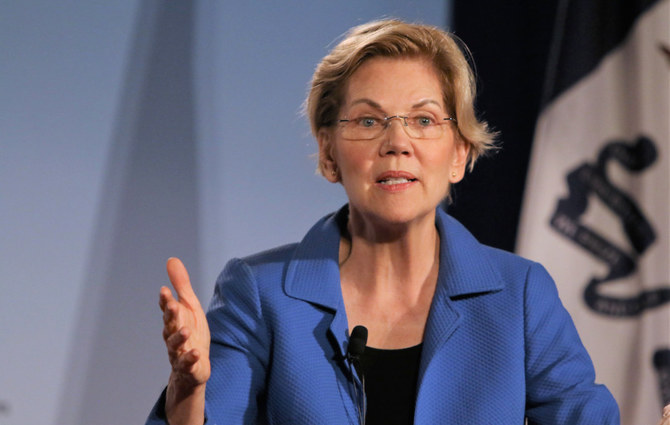
Senator Elizabeth Warren. (Shutterstock photo)
Short Url
Updated 15 December 2023
Follow

US senator questions Zuckerberg over alleged Meta censorship of pro-Palestinian content

  • Letter from Elizabeth Warren seeks details of content moderation methods employed by Meta platforms
  • Since Oct. 7, Meta’s Instagram has faced accusations of censoring, shadow banning, or account suspension of posts on Palestine conflict

LONDON: US Senator Elizabeth Warren has sought clarification from Mark Zuckerberg on allegations that Meta is censoring pro-Palestine content across its platforms.

In a letter co-signed by more than 90 human rights and civil rights organizations, Warren referred to media reports and concerns about Meta’s handling of Palestine-related material in October.

She wrote that that “amid the horrific Hamas terrorist attacks in Israel … it is more important than ever that social media platforms do not censor truthful and legitimate content.”

Warren also highlighted the need for social media platforms at times when online communities play a pivotal role in sharing information about regional developments.

The letter underscored concerns over Meta’s actions, including censorship, removal, and mistranslation of content.

Citing an October report from the Wall Street Journal, the letter revealed that Meta had implemented a “temporary risk response measure,” resulting in an increased frequency of flagging posts related to Palestine.

Unlike Meta’s usual practice of suppressing content when there is an 80 percent certainty that it is inflammatory, the threshold was lowered to 25 percent in the weeks following the Oct. 7 Hamas attacks.

Many users experienced Instagram restrictions or deleted posts about Palestine without clear explanation, and some faced complete account suspensions, which Meta attributed to glitches in its systems.

Warren’s letter sought details on Meta’s content moderation methods, and requested examples over the past five years where the company altered the content moderation threshold for a specific country, along with the corresponding count of posts removed.

The senator expressed concern, saying that “reports of Meta’s suppression of Palestinian voices raise serious questions about Meta’s content moderation practices and anti-discrimination protections.”

She added: “Social media users deserve to know when and why their accounts and posts are restricted, particularly on the largest platforms where vital information-sharing occurs.”

Since the Oct. 7 attack, Meta’s Instagram has faced multiple accusations of censorship, shadow banning, or account suspension due to users posting pro-Palestinian content.


TikTok finalizes a deal to form a new American entity

Updated 59 min 29 sec ago
Follow

TikTok finalizes a deal to form a new American entity

  • The social video platform company signed agreements with major investors including Oracle, Silver Lake and MGX to form the joint venture
  • The company said in a statement that the new version will operate under “defined safeguards” with an emphasis on data protections and software assurances for US users

TikTok has finalized a deal to create a new American entity, avoiding the looming threat of a ban in the United States that has been in discussion for years on the platform now used by more than 200 million Americans.
The social video platform company signed agreements with major investors including Oracle, Silver Lake and the Emirati investment firm MGX to form the new TikTok US joint venture. The new version will operate under “defined safeguards that protect national security through comprehensive data protections, algorithm security, content moderation and software assurances for US users,” the company said in a statement Thursday. American TikTok users can continue using the same app.
President Donald Trump praised the deal in a Truth Social post, thanking Chinese leader Xi Jinping specifically “for working with us and, ultimately, approving the Deal.” Trump add that he hopes “that long into the future I will be remembered by those who use and love TikTok.”
The Chinese government has not yet publicly commented on TikTok’s announcement. Earlier on Thursday and ahead of the statement, Liu Pengyu, spokesperson Chinese embassy in Washington, said “China’s position on TikTok has been consistent and clear.”
Adam Presser, who previously worked as TikTok’s head of operations and trust and safety, will lead the new venture as its CEO. He will work alongside a seven-member, majority-American board of directors that includes TikTok’s CEO Shou Chew.
The deal ends years of uncertainty about the fate of the popular video-sharing platform in the United States. After wide bipartisan majorities in Congress passed — and President Joe Biden signed — a law that would ban TikTok in the US if it did not find a new owner in the place of China’s ByteDance, the platform was set to go dark on the law’s January 2025 deadline. For a several hours, it did. But on his first day in office, President Donald Trump signed an executive order to keep it running while his administration sought an agreement for the sale of the company.
Apart from an emphasis on data protection, with US user data being stored locally in a system run by Oracle, the joint venture will also focus on TikTok’s algorithm. The content recommendation formula, which feeds users specific videos tailored to their preferences and interests, will be retrained, tested and updated on US user data, the company said in its announcement.
The algorithm has been a central issue in the security debate over TikTok. China previously maintained the algorithm must remain under Chinese control by law. But the US regulation passed with bipartisan support said any divestment of TikTok must mean the platform cuts ties — specifically the algorithm — with ByteDance. Under the terms of this deal, ByteDance would license the algorithm to the US entity for retraining.
The law prohibits “any cooperation with respect to the operation of a content recommendation algorithm” between ByteDance and a new potential American ownership group, so it is unclear how ByteDance’s continued involvement in this arrangement will play out.
“Who controls TikTok in the US has a lot of sway over what Americans see on the app,” said Anupam Chander, a professor of law and technology at Georgetown University.
Oracle, Silver Lake and MGX are the three managing investors, each holding a 15 percent share. Other investors include the investment firm of Michael Dell, the billionaire founder of Dell Technologies. ByteDance retains 19.9 percent of the joint venture.
