

Pakistan rejects Indian Supreme Court decision to uphold revocation of Kashmir’s special status

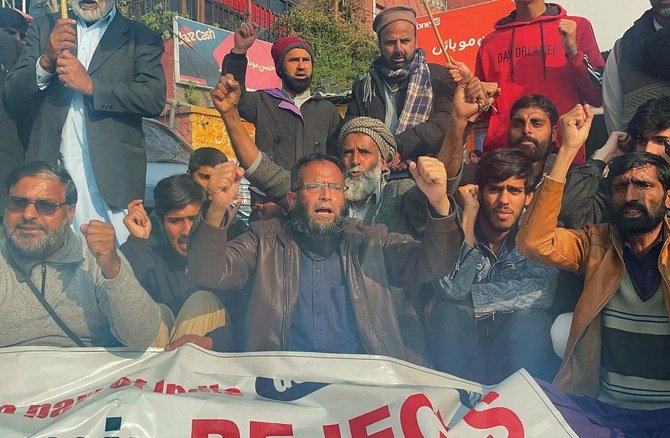
Activists protest against the decision of the Indian Supreme Court to uphold the revocation of the special status of Kashmir, Muzaffarabad, Pakistan, Dec. 11, 2023. (AFP)
Short Url
Updated 11 December 2023
Follow

Pakistan rejects Indian Supreme Court decision to uphold revocation of Kashmir’s special status

  • Authorities vow to petition heads of the UN and Organization of Islamic Cooperation, and the EU Parliament, on the issue
  • India and Pakistan each rule parts of Kashmir but claim it in full; India in 2019 revoked the special status of the part it controls and split it into two federal territories

ISLAMABAD: Authorities in Pakistan rejected a unanimous ruling by the Indian Supreme Court on Monday to uphold the 2019 decision by the government of Prime Minister Narendra Modi to revoke the special status of Indian-controlled Kashmir, describing the judges’ decision as a “travesty of justice.”

In response to more than a dozen petitions challenging the government’s actions, five judges sitting on the court’s constitutional bench said the region’s special status had been a “temporary provision” and removing it was constitutionally valid.

Indian-controlled Kashmir, the only Muslim-majority region in the country, has been at the heart of more than 75 years of hostility with neighboring Pakistan since the partition of India in 1947, when British colonial rule ended. India and Pakistan each rule parts of Kashmir but claim it in full.

The UN Security Council adopted several resolutions in 1948 and the 1950s relating to the dispute, including one calling for a referendum to determine the future of the region.

“Pakistan categorically rejects the judgment announced by the Supreme Court of India,” Pakistani Foreign Minister Jalil Abbas Jilani said, noting that the area it relates to is an internationally recognized disputed territory that has remained on the agenda of the Security Council for more than seven decades.

“India has no right to make unilateral decisions on the status of this disputed territory against the will of the Kashmiri people and Pakistan … India cannot abdicate its international obligations on the pretext of domestic legislation and judicial verdict.”

The judicial endorsement of the “unilateral and illegal” actions by Indian authorities in August 2019 to revoke Kashmir’s special status is a “travesty of justice based on distorted historical and legal arguments,” he added.

Pakistani authorities will convene a meeting of all stakeholders and political leaders to decide how best to respond to the development, said Jilani.

“We will write to the United Nations secretary-general, the OIC (Organization of Islamic Cooperation) secretary-general, and the European Union Parliament to appraise them of the futility of this decision,” he added.

“We are in the process of interacting with all the stakeholders and we will consider all options after consulting with the relevant stakeholders.”

The dispute over Kashmir sparked two of three wars between India and Pakistan in the years after independence, the first in 1947-48 and the second in 1965. The third, in 1971, was largely related to Bangladesh’s attempts to gain independence from Pakistan.


Top US defense official hails ‘model ally’ in South Korea talks

Updated 5 sec ago
Follow

Top US defense official hails ‘model ally’ in South Korea talks

SِEOUL: The Pentagon’s number three official hailed South Korea as a “model ally” as he met with local counterparts in Seoul on Monday, days after Washington’s new defense strategy called for reduced support for partners overseas.
Under Secretary of Defense for Policy Elbridge Colby arrived in South Korea on Monday and is seen as a key proponent of President Donald Trump’s “America First” foreign policy.
That policy — detailed in Washington’s 2026 National Defense Strategy (NDS) released last week — calls for the United States to prioritize deterring China and for long-standing US allies to take “primary responsibility” for their own defense.
Arriving in Seoul on his first overseas trip as the Pentagon’s number three official, Colby in a post on X called South Korea a “model ally.”
And he praised President Lee Jae Myung’s pledge to spend 3.5 percent of the country’s GDP on the military.
That decision, he told a forum, “reflects a clear-eyed and sage understanding of how to address the security environment that we all face and how to put our storied and historic alliance on sound footing for the long haul,” according to South Korea’s Yonhap News Agency.
“Such adaptation, such clear-eyed realism about the situation that we face and the need for greater balance in the sharing of burdens, will ensure that deterrence remains credible, sustainable and resilient in this changing world,” he added, according to the agency.
Colby also met Monday with South Korea’s defense and foreign ministers, who touted Seoul’s development of nuclear-powered attack submarines as proof the country was taking more responsibility for its defense.
Details remain murky on where the nuclear submarines will be built, however.
South Korea’s leader said last month it would be “extremely difficult” for them to be built outside the country.
But Trump has insisted they will be built in the United States.
Longstanding treaty allies, ties between the United States and South Korea were forged in the bloodshed of the Korean War.
Washington still stations 28,500 troops in South Korea as a deterrent against the nuclear-armed North.