

India’s top court upholds abrogation of Kashmir’s special status

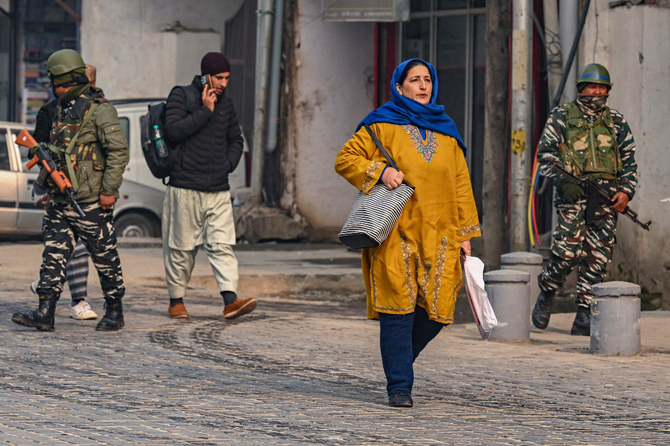
People walk along a street as Indian paramilitary personnel patrol in Srinagar on Dec. 11, 2023, ahead of Supreme Court's verdict on Article 370. (AFP)
Short Url
Updated 11 December 2023
Follow

India’s top court upholds abrogation of Kashmir’s special status

  • Five-judge bench also ordered statehood to be restored, polls to be held by next September
  • For many people in Kashmir, the Supreme Court ruling came as a disappointment

NEW DELHI: India’s top court upheld on Monday a 2019 government decision that stripped Kashmir of its special autonomous status in a unanimous ruling that sets the stage for local polls to be held by September next year.

The semi-autonomy of Jammu and Kashmir was granted by India’s constitution until Aug. 5, 2019, when the Indian government unilaterally revoked the relevant provisions under Article 370 and scrapped the region’s flag, legislature, protections on land ownership, and fundamental rights.  

The Indian Supreme Court began in August hearings of petitions that were filed over the past four years to challenge the government’s contentious move.  

“We don’t find that the president’s exercise to abrogate Article 370 was malafide,” Chief Justice DY Chandrachud said while reading out the judgment.  

“Article 370 is a temporary provision. J&K’s Constitution was subordinate to the Constitution of India. Article 370 was introduced to serve a transitional purpose, to serve as an interim process … and the president can abrogate Article 370.”  

Indian-controlled Jammu and Kashmir is part of the larger Kashmiri territory, which has been the subject of international dispute since the 1947 partition of the Indian subcontinent into Hindu-majority India and Muslim-majority Pakistan. 

Both countries claim Kashmir in full, and rule in part. 

Indian-controlled Kashmir has for decades witnessed outbreaks of separatist insurgency to resist control from the government in New Delhi. 

With the constitutional change, Jammu and Kashmir was split into two federally governed union territories in a move that was followed by a total communications blackout, severe restrictions on freedom of movement, and detention of local leaders — some of whom remain in jail. 

Administrative measures introduced after the abrogation of the special status and statehood have allowed non-locals to settle and vote in the region, raising fears of attempts to engineer demographic change. 

The five-judge bench of the Supreme Court also ordered the government to hold elections in the region by Sept. 30, 2024 and to restore its statehood “at the earliest.” 

The Supreme Court decision was welcomed by Prime Minister Narendra Modi, who described it as “historic.”  

“The verdict today is not just a legal judgment; it is a beacon of hope, a promise of a brighter future and a testament to our collective resolve to build a stronger, more united India,” Modi said.  

But for the people of Kashmir, Monday’s verdict came as a disappointment.  

“I am very much disappointed. Today’s verdict is totally against our emotions and gives pain to the majority of the people of Jammu and Kashmir,” Aijaz Ahmad, a business professional based in Srinagar, told Arab News.  

Yashwant Sinha group, comprising civil society members who have monitored the situation in Kashmir over the last six years, has reported anger, hatred, a sense of political betrayal and alienation among residents of the valley.  

“People of the valley with whom I have been talking for weeks are not at all surprised and as a petitioner, I am not surprised either,” said Air Vice Marshal Kapil Kak, a retired officer of the Indian Air Force and one of the petitioners who appealed to India’s apex court.  

Kak, who is also a member of Yashwant Sinha group, told Arab News the Supreme Court ruling will “take it further away” from resolving the problem of Jammu and Kashmir and exacerbate the concerns and deep alienation felt by youths of the valley.  

Kashmiris were “dejected, humiliated, discredited and disenfranchised” by the Supreme Court ruling, said Nasir Khuehami, president of Kashmir Students Union.  

Subhash Chander Gupta, a senior advocate based in Jammu, believes the verdict was a “politically bad judgment” that will create a trust deficit in the region while also further deepening the “distrust between the Kashmiri people and the rest of India.”  

The apex court’s decision was “nothing less than a death sentence not only for Jammu and Kashmir but for the idea of India,” said Mehbooba Mufti, former chief minister of Jammu and Kashmir. 

“This is the defeat of the imagination of India, the Gandhian India with which Muslims of Jammu and Kashmir, rejecting Pakistan, joined hands with the Hindus, Buddhists, Sikhs and Christians … Today marks the defeat of that idea of India," she said.   

Kashmir “continues to be a bleeding humanitarian and political issue” that is “begging redressal,” said Mirwaiz Umar Farooq, a top cleric and pro-freedom leader.  

“Those people who at the time of the partition of the subcontinent, facilitated the accession of J&K and reposed their faith in the promises and assurances given to them by the Indian leadership must feel deeply betrayed.”


Agonizing wait as Switzerland works to identify New Year’s fire victims

Updated 02 January 2026
Follow

Agonizing wait as Switzerland works to identify New Year’s fire victims

  • Authorities begin moving bodies from burned-out bar in luxury ski resor Crans-Montana
  • At least 40 people were killed in one of Switzerland's worst tragedies

CRANS-MONTANA, Switzerland: Families endured an agonizing wait for news of their loved ones Friday as Swiss investigators rushed to identify victims of a ski resort fire at a New Year’s celebration that killed at least 40 people.
Authorities began moving bodies from the burned-out bar in the luxury ski resort town Crans-Montana late Friday morning, with the first silver-colored hearse rolling into the funeral center in nearby Sion shortly after 11:00 am (1000 GMT), AFP journalists saw.
Around 115 people were also injured in the fire, many of them critical condition.
As the scope of the tragedy — one of Switzerland’s worst — began to sink in, Crans-Montana appeared enveloped in a stunned silence.

Mathias Reynard, president of the Council of State of Valais Canton, with Italy's Foreign Minister Antonio Tajani outside "Le Constellation" bar in Crans-Montana where a fire and explosion on New Year's Eve killed more than 40 people. (Reuters)

“The atmosphere is heavy,” Dejan Bajic, a 56-year-old tourist from Geneva who has been coming to the resort since 1974, told AFP.
“It’s like a small village; everyone knows someone who knows someone who’s been affected,” he said.
It is not yet clear what set off the blaze at Le Constellation, a bar popular with young tourists, at around 1:30 am (0030 GMT) Thursday.
Bystanders described scenes of panic and chaos as people tried to break the windows to escape and others, covered in burns, poured into the street.

‘Screaming in pain’

Edmond Cocquyt, a Belgian tourist, told AFP he had seen “bodies lying here, ... covered with a white sheet,” and “young people, totally burned, who were still alive... Screaming in pain.”
The exact death toll was still being established.
And it could rise, with canton president Mathias Reynard telling the regional newspaper Wallizer Bote that at least 80 of the 115 injured were in critical condition.
Swiss authorities warned it could take days to identify everyone who perished, an agonizing wait for family and friends.
Condolences poured in from around the world, including from Pope Leo XIV, who offered “compassion and solidarity” to victims’ families.
Online, desperate appeals abound to find the missing.
“We’ve tried to reach our friends. We took loads of photos and posted them on Instagram, Facebook, all possible social networks to try to find them,” said Eleonore, 17. “But there’s nothing. No response.”

‘The apocalypse’

The exact number of people who were at the bar when it went up in flames remains unclear.
Le Constellation had a capacity of 300 people, plus another 40 people on its terrace, according to the Crans-Montana website.
Swiss President Guy Parmelin, who took office on Thursday, called the fire “a calamity of unprecedented, terrifying proportions” and announced that flags would be flown at half-mast for five days.
“We thought it was just a small fire — but when we got there, it was war,” Mathys, from the neighboring village of Chermignon-d’en-Bas, told AFP. “That’s the only word I can use to describe it: the apocalypse.”

Authorities have declined to speculate on what caused the tragedy, saying only that it was not an attack.
Several witness accounts, broadcast by various media, pointed to sparklers mounted on champagne bottles and held aloft by restaurant staff as part of a regular “show” for patrons.

‘Dramatic’

Pictures and videos shared on social media also showed sparklers on champagne bottles held into the air, as an orange glow began spreading across the ceiling.
One video showed the flames advancing quickly as revellers initially continued to dance.
One young man playfully attempted to extinguish the flames with a large white cloth, but the scene became panic-stricken as people scrambled and screamed in the dark against a backdrop of smoke and flames.
The canton’s chief prosecutor, Beatrice Pilloud, said investigators would examine whether the bar met safety standards.
Red and white caution tape, flowers and candles adorned the street outside, while police shielded the site with white screens.
Italian Foreign Minister Antonio Tajani, who said 13 Italians had been injured in the fire, and six remained missing, was among those to lay flowers at the site.
The French foreign ministry said nine French citizens figured among the injured, and eight others remained unaccounted for.
After emergency units at local hospitals filled, many of the injured were transported across Switzerland and beyond.
Patients are being treated in Italy, France and Germany, and Polish Prime Minister Donald Tusk said his country was ready to provide “specialized medical care to 14 injured.”
Multiple sources told AFP the bar owners were French nationals: a couple originally from Corsica who, according to a relative, are safe, but have been unreachable since the tragedy.