

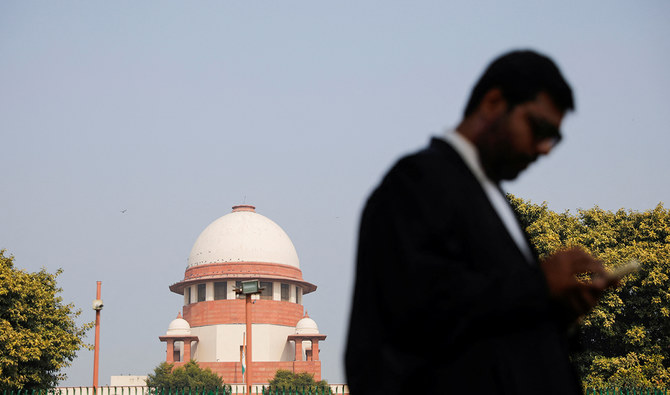

NEW DELHI: India’s Supreme Court upheld on Monday a 2019 decision by Prime Minister Narendra Modi’s government to revoke special status for Kashmir and split the region into two federally administered territories.
The disputed Himalayan region is claimed in full, though ruled in part by both India and Pakistan since their independence from Britain in 1947, with the nuclear-armed neighbors having fought two of their three wars over it.
Here are some facts about Kashmir and the constitutional change.
WHAT HAPPENED AT PARTITION?
After partition of the subcontinent in 1947, Kashmir was expected to go to Pakistan, as other Muslim-majority regions did. Its Hindu ruler wanted to stay independent, but faced with an invasion by Muslim tribesmen from Pakistan, he acceded to India in October 1947 in return for help against the invaders.
WHAT WAS THE CONSTITUTIONAL POSITION?
Article 370 of the Indian constitution, which provided autonomy for Jammu and Kashmir, was drafted in 1947 by Sheikh Abdullah, then the state’s prime minister, and accepted by India’s first prime minister Jawaharlal Nehru.
Classified only as a temporary provision, it was included in the Indian constitution in October 1949.
HOW DID THE PICTURE CHANGE IN 1954?
A further provision added to the constitution in 1954 as part of Article 370, article 35A empowered state lawmakers to ensure special rights and privileges for permanent residents of the state.
But it was scrapped with the repeal of Article 370, allowing non-Kashmiris to buy property in the region and ending local control over state government jobs and admission to colleges.
WHEN DID THE NEIGHBOURS GO TO WAR OVER THE REGION?
The dispute over the former princely state sparked the first two of three wars between India and Pakistan after independence in 1947. They fought a second in 1965, and a third, largely over what become Bangladesh, in 1971.
HOW IS THE REGION DIVIDED UP?
For decades, the armies of India and Pakistan have faced off over the the Line of Control (LoC), a UN-monitored cease-fire line agreed in 1972, that divides the areas each administers.
The foes fought a 1999 battle along the LoC that some analysts described as an undeclared war. Their forces exchanged regular gunfire over the LoC until a truce in late 2003, which has largely held since.
WHY WAS THERE AN INSURGENCY?
Resentment by many Muslims in Indian Kashmir over what they saw as heavy-handed rule by New Delhi sparked an insurgency by separatists in 1989, with some backing Pakistan, while others sought independence for Kashmir.
India responded by pouring in troops, and accused Pakistan of backing the separatists, in particular by arming and training fighters in its part of Kashmir and sending them into Indian Kashmir. Pakistan denies that, saying it only offers political support to the Kashmiri people.
HOW HAS THE PICTURE IN INDIAN KASHMIR CHANGED SINCE 2019?
Since 2019, India has announced more investments for the region in areas such as industries, health care, education and tourism. It recently listed Kashmir’s new-found lithium reserves for private mining.
Tourism has grown since 2019 and separatist violence has fallen, the government says, with a G20 meet on tourism held in Srinagar this year during India’s presidency of the bloc.
WHAT AREAS DOES PAKISTAN HOLD?
These consist of the smaller Azad, or “Free,” Kashmir and the Northern Areas that formed part of the state before independence. Pakistan backs a UN-mandated referendum to settle the dispute over the region, expecting that the majority of Kashmiris would opt to join Pakistan.
WHAT IS THE REGION’S GEOGRAPHIC APPEAL?
The Himalayan region has two capitals, Jammu in winter, and Srinagar in summer.
Parts of Kashmir are strikingly beautiful, with forest-clad mountains, rivers running through lush valleys and lakes ringed by willow trees.
Indian Kashmir sprawls over 42,241 sq km (16,300 sq miles). Before the region was split, its size of 222,236 sq km (86,000 sq miles) was slightly bigger than the US state of Utah and almost as big as Britain.
The western Himalayan region is bounded by Pakistan to the west, Afghanistan to the northwest, China to the northeast, and India to the south.
HOW LARGE IS THE POPULATION?
There are more than 12 million people in Indian Kashmir and Ladakh and more than four million in Azad Kashmir. About 70 percent are Muslims and the rest Hindus, Sikhs and Buddhists in Indian Kashmir.
WHAT ARE KEY FEATURES OF THE ECONOMY?
It is about 80 percent based on agriculture, with crops such as rice, maize, apples and saffron. The area is also known for handicrafts such as carpets, woodcarving, woollens and silk.


