

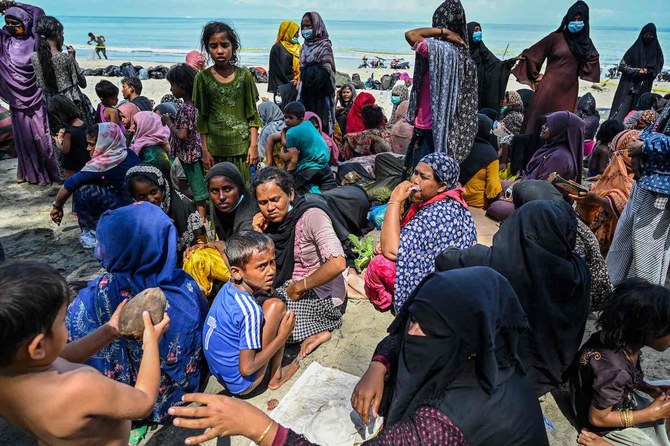

JAKARTA: Indonesia will continue to handle the influx of Rohingya refugees humanely, the National Refugee Task Force said on Sunday, after the latest batch of people from the minority group arrived in the westernmost province of Aceh amid a pushback from local residents.
Two boats carrying more than 300 Rohingya refugees docked at different beaches in Aceh Besar and Pidie districts in the early hours of Sunday. Most are women and children who left their refugee camps in Bangladesh last month and had been adrift for weeks in the Andaman Sea.
More than 1,200 Rohingya refugees have arrived in Aceh since mid-November and were met with some opposition from local authorities and residents, who threatened to push them back to sea.
The safety of the Rohingya is a priority for the government, Indonesia’s National Refugee Task Force said.
“We will continue to handle the Rohingya refugees humanely, even when many local residents are rejecting them,” Eros Shidqy Putra, a member of the task force, told Arab News.
“Our main priority is their safety. For Aceh residents, we are also trying to raise awareness about the refugee situation.”
The mostly Muslim Rohingya have faced decades of suffering in Myanmar and are described as the “world’s most persecuted minority” by the UN.
In 2017, more than 730,000 Rohingya fled to neighboring Bangladesh following a brutal crackdown by the Myanmar military that the UN said amounted to genocide. For the last six years, the refugees lived in squalid and overcrowded camps in Cox’s Bazar where humanitarian aid has dwindled, facing rising insecurity and uncertainty.
Over 3,500 Rohingya attempted deadly sea crossings in 2022, more than 340 of whom died or went missing, highlighting the “growing sense of desperation” among them in both Myanmar and Bangladesh, the UN said earlier this year.
The Indonesian government suspected human trafficking behind the recent escalation in boat arrivals, President Joko Widodo said on Friday, as he promised to work with international organizations to address the issue.
Indonesia is not a signatory to the 1951 UN Convention on Refugees, but has a history of taking in refugees on humanitarian grounds when they arrive on the country’s shores.
This year’s arrivals prompted a backlash on social media and some pushback from people in Aceh, but the rejection of Rohingya refugees has been around since 2018, according to Geutanyoe, an Aceh-based humanitarian organization which has worked with Rohingya refugees for over a decade.
Geutanyoe director Al-Fadhel said the opposition in Aceh has mostly been protests against the official handling of refugees in the province, which does not have permanently designated shelters to host them.
“In Aceh, the handling of refugees has always been on an emergency basis,” Fadhel told Arab News in a phone interview. “So the rejection has mostly been a form of protest on the silence of the local government, and the absence of a good mechanism to handle the arrival of refugees in Aceh.”
There was no opposition during programs organized by Geutanyoe, which saw participation of the local community and the Rohingya, he said, adding that the handling of the refugee situation in Aceh must prioritize protection for both local residents and the Rohingya.
“The refugee situation is a humanitarian issue that we must address, to which we must give our assistance. But there are also legal aspects that we must uphold, because in their arrivals there must be people who are involved in smuggling, and this needs to be sorted.”


