Gangs, extortion in Bangladesh camps driving Rohingya sea exodus

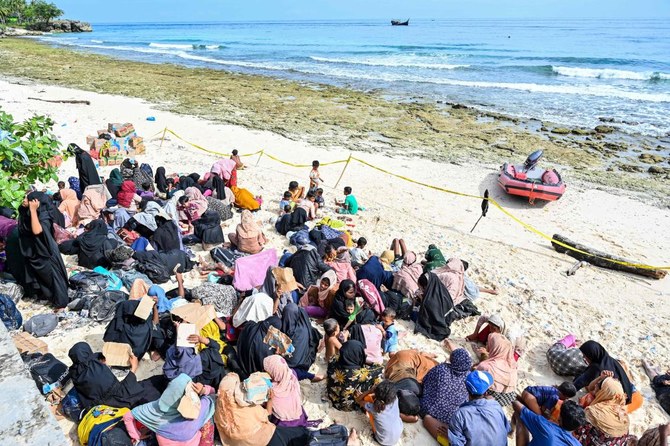
Newly-arrived Rohingya refugees rest on a beach in Sabang island, Aceh province on Nov. 22, 2023 as they escape violence and brutality in Bangladesh camps. (AFP)
Short Url
Updated 29 November 2023
Follow

Gangs, extortion in Bangladesh camps driving Rohingya sea exodus

  • Rohingya escape escalating brutality in the camps in and around Cox’s Bazar
  • Bangladesh defense ministry identifies at least 11 armed groups operating in the camps

LHOKSEUMAWE, Indonesia: Holding his son’s hand in a temporary shelter in Indonesia, Rohingya Mohamed Ridoi says he made the dangerous 12-day sea journey from massive refugee camps in Bangladesh to escape the pervasive threats of kidnapping, extortion and murder.
The 27-year-old said he was starting a “peaceful life” in a temporary shelter in Indonesia’s western Aceh Province, where more than 1,000 Rohingya people have arrived this month, the largest such influx since 2015.
He and others said they fled escalating brutality in the camps in and around Cox’s Bazar, which hold more than one million people and where gangs regularly abduct and torture residents for ransom.
“One of the groups kidnapped me and demanded 500,000 Bangladeshi taka ($4,551) to buy their guns,” Ridoi, who left with his wife, two children and his brother, said.
“They told me that if I couldn’t give them the money, they would kill me.”
He said he eventually paid 300,000 taka for his release last month and, within weeks, he was on a boat to Indonesia, arriving on November 21.
“We are not safe in Bangladesh. That is why I decided to go to Indonesia to save me and my family’s life,” he said.
Having first fled state-backed persecution in Myanmar — including a 2017 crackdown that is subject to a UN genocide probe — the refugees now find themselves pushed to undertake weeks-long journeys of more than 1,800 kilometers on packed, rickety boats.
Indonesia is not a signatory to the UN Refugee Convention and says it is not compelled to take in refugees from Myanmar, but neighboring countries have shut their doors, meaning they have almost no other options.
More than half a dozen boats have arrived in Aceh since November 14, and monitors say more are on their way, despite some locals turning arriving boats back to sea and stepping up patrols on the coast.
Human Rights Watch reported this year that criminal gangs and alleged affiliates of Islamist armed groups were causing fear at night in the Bangladesh refugee camps, which now number more than two dozen.
The Bangladesh defense ministry has identified at least 11 armed groups operating in the camps, but rights groups say Dhaka is not doing enough to protect refugees from the violence.
These gangs, vying for control and involved in activities like drug smuggling and human trafficking, have specifically targeted Rohingya community leaders and activists.
Aisha, 19, arrived in Aceh on the same boat as Ridoi with two children and her husband.
“They asked for money every night, threatening to abduct my husband. I couldn’t sleep at night because of them,” she said via an interpreter.
Bangladesh police say about 60 Rohingya people have been killed in violence in the camps this year.
Phil Robertson, deputy Asia director of HRW, said it appeared the Bangladeshi government “doesn’t care” about the refugees’ fate.
“The bottom line is the Bangladesh government just wants all the Rohingya to go back to Myanmar as soon as possible — even if (it) means subjecting the refugees to conditions of absolute misery in the camps so that they leave.”
Aisha, the young mother, said fear of the criminals pushed her family to pay 200,000 taka ($1,819) to illegal middlemen for her family’s boat journey to Indonesia, despite the risks.
Aisha said she preferred to “die at sea than in the camp.”
“I looked for a safe place for my children, hoping they could study and get an education,” she said.
Chris Lewa, director of Rohingya rights organization the Arakan Project, said food shortages were also worsening camp conditions and entire families were now leaving, instead of just groups of young men as seen previously.
“Now, the profile is different, now we have many families. Before there was not many,” she said.
“Nowadays we see small children, there are many families making their way. They just want to be away from Bangladesh.”
Aisha and her children now share a windowless room in a shelter in the Aceh city of Lhokseumawe with more than a hundred other women and minors, sleeping on mats on the floor without a fan in the tropical heat.
Aisha said that it was still much better than living in fear in the Bangladesh camp.
Ridoi also hoped that his decision to bring his family to Indonesia would bring a better life for his sons.
“I am not qualified to be a doctor or engineer, but I am doing my best to make them one,” he said.
“My children are everything to me.”


War powers resolution fails in Senate as 2 Republicans bow to Trump pressure

Updated 15 January 2026
Follow

War powers resolution fails in Senate as 2 Republicans bow to Trump pressure

WASHINGTON: Senate Republicans voted to dismiss a war powers resolution Wednesday that would have limited President Donald Trump’s ability to conduct further attacks on Venezuela after two GOP senators reversed course on supporting the legislation.
Trump put intense pressure on five Republican senators who joined with Democrats to advance the resolution last week and ultimately prevailed in heading off passage of the legislation. Two of the Republicans — Sens. Josh Hawley of Missouri and Todd Young of Indiana — flipped under the pressure.
Vice President JD Vance had to break the 50-50 deadlock in the Senate on a Republican motion to dismiss the bill.
The outcome of the high-profile vote demonstrated how Trump still has command over much of the Republican conference, yet the razor-thin vote tally also showed the growing concern on Capitol Hill over the president’s aggressive foreign policy ambitions.
Democrats forced the debate after US troops captured Venezuelan leader Nicolás Maduro in a surprise nighttime raid earlier this month
“Here we have one of the most successful attacks ever and they find a way to be against it. It’s pretty amazing. And it’s a shame,” Trump said at a speech in Michigan Tuesday. He also hurled insults at several of the Republicans who advanced the legislation, calling Sen. Rand Paul of Kentucky a “stone cold loser” and Sens. Lisa Murkowski of Alaska and Susan Collins of Maine “disasters.” Those three Republicans stuck to their support for the legislation.
Trump’s latest comments followed earlier phone calls with the senators, which they described as terse. The president’s fury underscored how the war powers vote had taken on new political significance as Trump also threatens military action to accomplish his goal of possessing Greenland.
The legislation, even if it had cleared the Senate, had virtually no chance of becoming law because it would eventually need to be signed by Trump himself. But it represented both a test of GOP loyalty to the president and a marker for how much leeway the Republican-controlled Senate is willing to give Trump to use the military abroad. Republican angst over his recent foreign policy moves — especially threats of using military force to seize Greenland from a NATO ally — is still running high in Congress.
Two Republicans reconsider
Hawley, who helped advance the war powers resolution last week, said Trump’s message during a phone call was that the legislation “really ties my hands.” The senator said he had a follow-up phone call with Secretary of State Marco Rubio Monday and was told “point blank, we’re not going to do ground troops.”
The senator added that he also received assurances that the Trump administration will follow constitutional requirements if it becomes necessary to deploy troops again to the South American country.
“We’re getting along very well with Venezuela,” Trump told reporters at a ceremony for the signing of an unrelated bill Wednesday.
As senators went to the floor for the vote Wednesday evening, Young also told reporters he was no longer in support. He said that he had extensive conversations with Rubio and received assurances that the secretary of state will appear at a public hearing before the Senate Foreign Relations Committee.
Young also shared a letter from Rubio that stated the president will “seek congressional authorization in advance (circumstances permitting)” if he engaged in “major military operations” in Venezuela.
The senators also said his efforts were also instrumental in pushing the administration to release Wednesday a 22-page Justice Department memo laying out the legal justification for the snatch-and-grab operation against Maduro.
That memo, which was heavily redacted, indicates that the administration, for now, has no plans to ramp up military operations in Venezuela.
“We were assured that there is no contingency plan to engage in any substantial and sustained operation that would amount to a constitutional war,” according to the memo signed by Assistant Attorney General Elliot Gaiser.
Trump’s shifting rationale for military intervention
Trump has used a series of legal arguments for his campaign against Maduro.
As he built up a naval force in the Caribbean and destroyed vessels that were allegedly carrying drugs from Venezuela, the Trump administration tapped wartime powers under the global war on terror by designating drug cartels as terrorist organizations.
The administration has claimed the capture of Maduro himself was actually a law enforcement operation, essentially to extradite the Venezuelan president to stand trial for charges in the US that were filed in 2020.
Paul criticized the administration for first describing its military build-up in Caribbean as a counternarcotics operation but now floating Venezuela’s vast oil reserves as a reason for maintaining pressure.
“The bait and switch has already happened,” he said.
Trump’s foreign policy worries Congress
Lawmakers, including a significant number of Republicans, have been alarmed by Trump’s recent foreign policy talk. In recent weeks, he has pledged that the US will “run” Venezuela for years to come, threatened military action to take possession of Greenland and told Iranians protesting their government that ” help is on its way.”
Senior Republicans have tried to massage the relationship between Trump and Denmark, a NATO ally that holds Greenland as a semi-autonomous territory. But Danish officials emerged from a meeting with Vance and Rubio Wednesday saying a “fundamental disagreement” over Greenland remains.
“What happened tonight is a roadmap to another endless war,” Senate Democratic leader Chuck Schumer said at a news conference following the vote.
More than half of US adults believe President Donald Trump has “gone too far” in using the US military to intervene in other countries, according to a new AP-NORC poll.
House Democrats have also filed a similar war powers resolution and can force a vote on it as soon as next week.
How Republican leaders dismissed the bill

Last week’s procedural vote on the war powers resolution was supposed to set up hours of debate and a vote on final passage. But Republican leaders began searching for a way to defuse the conflict between their members and Trump as well as move on quickly to other business.
Once Hawley and Young changed their support for the bill, Republicans were able to successfully challenge whether it was appropriate when the Trump administration has said US troops are not currently deployed in Venezuela.
“We’re not currently conducting military operations there,” said Senate Majority Leader John Thune in a floor speech. “But Democrats are taking up this bill because their anti-Trump hysteria knows no bounds.”
Democratic Sen. Tim Kaine, who has brought a series of war powers resolutions this year, accused Republicans of burying a debate about the merits of an ongoing campaign of attacks and threats against Venezuela.
“If this cause and if this legal basis were so righteous, the administration and its supporters would not be afraid to have this debate before the public and the United States Senate,” he said in a floor speech.