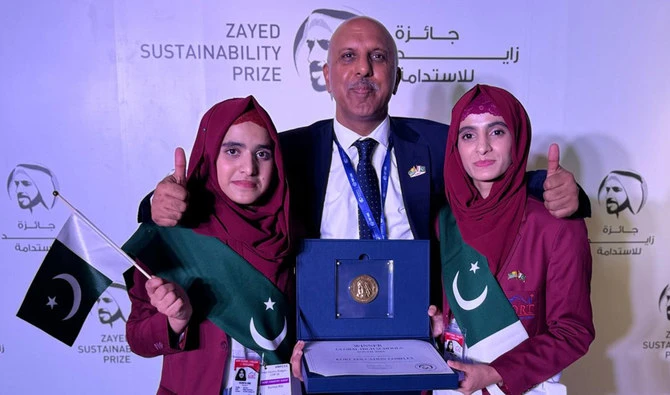
- The KORT Education Complex in Azad Kashmir won the prize at COP28 in Dubai for its organic farming, water conservation project
- With prize money, students and school management also plan to install sensor taps to create public awareness about water conservation
ISLAMABAD: A Pakistani orphan school, which won the prestigious Zayed Sustainability Prize of $100,000 at the COP28 climate conference in Dubai, has planned to utilize the funds for the promotion of organic farming and water conservation in the South Asian country, the management and students said on Saturday.
The KORT (Kashmir Orphan Relief Trust) Education Complex, one of the largest orphan schools in Mirpur, Azad Kashmir, was declared the best ‘Global School’ in South Asia for its innovative project on organic farming and water conservation at the UN climate conference. It was competing for the prize against two other finalists from Bangladesh and India.
Two young representatives of the school, Sumiya Bibi and Kinza Bibi, received the award from the United Arab Emirates (UAE) President Sheikh Mohamed bin Zayed Al-Nahyan at Dubai Expo City. The Zayed Sustainability Prize honors the legacy of UAE’s founding father Sheikh Zayed bin Sultan Al-Nahyan by rewarding small and medium enterprises, non-profit organizations and high schools addressing health, food, energy, water and climate-related challenges.
“We are thankful to the UAE government for recognizing our efforts to fight the climate change through education and awareness. We will be using the award money to promote organic farming and water conservation in our area in Kashmir,” Zaib-un-Nisa, the school principal, told Arab News over the phone.
“The KORT will be working on promotion of biogas and biofertilizers to maintain the ecosystem and spread awareness at a large scale.”
Pakistan ranks among one of the most vulnerable countries to the impacts of climate change, facing water scarcity as its annual water availability falls below 1,000 cubic meters per person.
Sumiya and Kinza, both second-year students, lead the project at their school where they have been growing different vegetables including cabbage, onions, potatoes and some fruits by using compost and water conservation techniques.
“We recycle the kitchen waste into compost for our organic farming at the school premises to fulfil the nutritional needs of students living in the hostel,” Sumiya said.
The KORT Education Complex is spread over 7.5 hectares in the heart of Mirpur city and houses some 550 students who were orphaned in 2005 deadly earthquake in the area. It was set up in 2016 by a philanthropist to provide education, boarding and lodging facilities to orphaned children.
Around 25 students are working on the “micro project” of organic farming and water conservation in the school which they aim to expand to other schools and colleges in the area through collaboration.
“Pakistan is badly affected by adverse impacts of climate change including smog, water scarcity and food security, and this led us to an idea of setting up a small garden in our school to work on organic farming and water conservation,” Sumiya said.
Kinza, who leads the water conservation part, said at least 36 percent of daily use water used to be wasted due to traditional running taps, but now they were conserving around 40 percent of it through sensor taps.
“The installation of sensor taps is costly, but [it is] worth spending on them as they help save the water,” she said, adding they would be utilizing the prize money to install sensor taps in some public areas to create awareness about water conservation.