



DUBAI: For more than two decades British designer Stella McCartney has been on a mission to produce her fashion line adhering to sustainable methods of production, to combat climate change and reduce the industry’s damaging effects on the planet.
McCartney helms the world’s first luxury house to never use animal leather, feathers, fur or skins. She also adopted extensive sustainability principles following the Livestock’s Long Shadow Report in 2006, which linked animal agriculture with climate harm.
Titled “Stella McCartney’s Sustainable Market: Innovating Tomorrow’s Solutions,” and running until the culmination of COP28 on Dec. 12, she is also hosting a space at the environmental conference in Dubai that presents highlights from her latest collection.

Titled “Stella McCartney’s Sustainable Market: Innovating Tomorrow’s Solutions,” she is also hosting a space at the environmental conference in Dubai that presents highlights from her latest collection. (Supplied)
In addition, McCartney’s showcasing new breakthrough discoveries in regenerative agriculture, bio- and plant-based alternatives to plastic, animal leather and fur, and traditional fibers. Among these is a grape-based alternative to animal leather discovered in partnership with Veuve Clicquot, and the debut of the world’s first garments crafted from Protein Evolution’s biologically recycled and infinitely recyclable polyester.
“I am the first to say coming to COP28 is not the easy route; you need to have purpose and passion not only to get a seat at the table, but just to get heard at all,” the designer told Arab News. “Especially when you’re a woman. However, if I do not represent the industry at COP28, who will?”
“Fashion is not an island; our industry impacts everyone, everywhere,” she continued. “There are no laws or legalization that control how people are working. Every second, a truckful of fast fashion is burnt or sent to landfill.”

McCartney’s showcasing new breakthrough discoveries in regenerative agriculture, bio- and plant-based alternatives to plastic, animal leather and fur, and traditional fibers. (Supplied)
The fashion industry, according to the UN Environment Programme, is responsible for around 8 percent of all global carbon emissions.
Adding to the challenge of reducing its global greenhouse gas footprint is also the concern that the industry will grow due to increased consumption patterns and population.
“If we want to leave a better world for the next generation, we need to have a voice here calling for change — encouraging both private and public leaders to join us by investing in and incentivizing innovation, creating less and doing more with what we already have, and being kinder to our fellow creatures, humans and Mother Earth. We have to stay positive, and proactive,” she told Arab News.
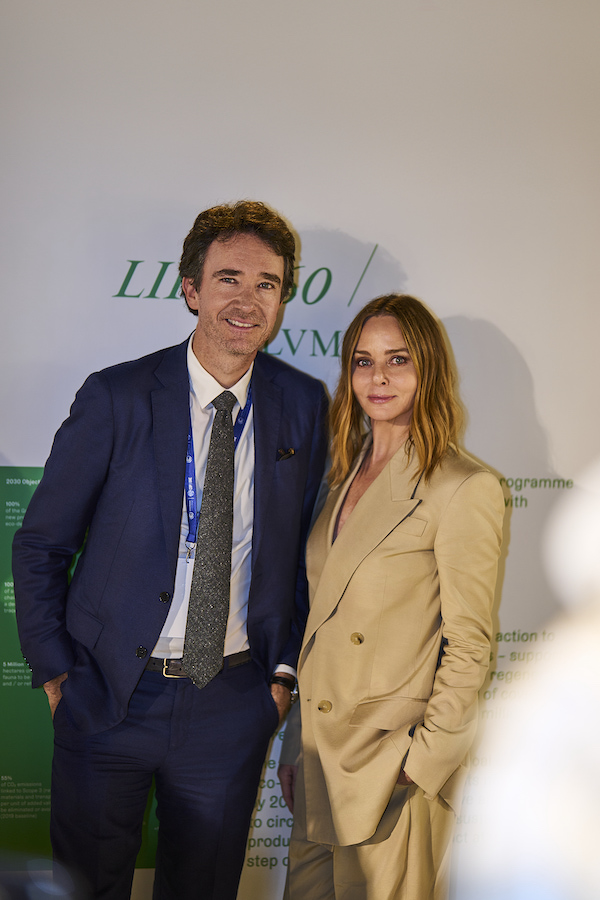
McCartney at COP28. (Supplied)
McCartney attended COP26 in Glasgow, Scotland, where she declared that the fashion industry was “getting away with murder” due to a lack of accountability and poor self-regulation.
How does McCartney believe change can take place?
“Governments and policymakers can start by putting tax breaks and benefits in place for more sustainable, circular and cruelty-free practices. We are penalized, not incentivized, to work with vegan alternatives to leather,” she explained. “We need government leaders who are brave enough to step up and say no to the powerful leather, fur and agricultural industries that are so afraid of our cruelty-free future,” she said.
“We need policy change, because fashion is one of the most harmful industries on the planet,” she declared. “I have never used leather or fur, but that is because I had the privilege of being raised by two vegetarians and animal rights activists. So, I self-police myself. Nobody else would do that. Governments need to step in and make it worthwhile for brands to do the same, or regulate them, because I can tell you after 22 years, it is not easy.”

The designer’s latest collaboration with Veuve Clicquot serves as an example of what can happen when people from different industries, but with similar sustainable perspectives, come together to champion the same cause. (Supplied)
McCartney has been advocating for governments to change the way they approach vegan alternatives, which is what she incorporates in her designs.
“Our cruelty-free innovations are often taxed 30 percent more than skins that come from animals. How disgusting is that?” she told Arab News.
“Animal agriculture (which is where leather comes from) is responsible for 80 percent of the Amazon’s deforested areas, which has a huge impact on biodiversity as well as the release and sequestering of greenhouse gases,” she added. “One billion animals die annually for leather, so one place the fashion industry could start is by stopping the use of leather.”
The designer’s latest collaboration with Veuve Clicquot serves as an example of what can happen when people from different industries, but with similar sustainable perspectives, come together to champion the same cause.
“We used the harvest by-product from Veuve Clicquot’s regeneratively grown, traceable grape harvest and innovated a new vegan alternative to leather that is on display here at my sustainable market,” she added. “Could you imagine 10 years ago saying that a champagne maison and a fashion house had come together to innovate a luxury material? Time is ticking towards 2030; this kind of outside-the-box thinking and collaboration is what we need more of not only at COP28, but everywhere,” she said.


