


RIYADH: Despite the daily efforts of the International Committee of the Red Cross to “step up, to scale up, to send more people on the ground in Gaza,” humanitarians “can only do so much,” according to Robert Mardini, the ICRC’s director general.
He made the comment in the course of an interview on Tuesday with Arab News in Riyadh, where he held a meeting with officials from the Saudi aid agency KSrelief.
“We cannot cope with this magnitude of needs and we want the parties in the conflict, the Israeli side and the Hamas side, to de-escalate and to create the conditions for humanitarians to be able to operate at the level that is required,” Mardini said.
He added that the current level and intensity of fighting in Gaza makes humanitarians’ ability to operate at the levels required “impossible.”
He said: “No meaningful humanitarian response is possible under the current circumstances. This is why we have to, in parallel to doing everything we can to step up the humanitarian response, double down on repeating and reiterating our calls to the parties in the conflict to respect their obligations under the rules of war, the Geneva Conventions.”
Mardini made it clear that as humanitarians, the ICRC will continue to push the limits of the possible to “make a difference for the people in Gaza.”
But while efforts will continue, Mardini said the ICRC can only do so much, “and the responsibility lies within the parties in the conflict.”
He added: “They have the obligations under the Geneva Conventions to protect civilians, to do everything they can to protect civilians, and to de-escalate the conflict; to ensure that there are regular humanitarian pauses to allow humanitarian supplies to get into the Gaza Strip; and to allow humanitarian workers to be able to deliver much-needed humanitarian support to the people in Gaza, and also to give respite to the civilian population, who are living in disastrous conditions, in constant fear of violent death.”
Mardini has no doubt about the immediate requirements: A de-escalation of the conflict, regular humanitarian pauses, and better conditions for civilians.
He said all people in Gaza today were traumatized by what is happening.

Palestinians wounded in the Israeli bombardment of the Gaza Strip arrive at a hospital in Rafah. (AP)
When asked about what needs to take place to alleviate the suffering of people in Gaza, he said that humanitarian goods were critical.
“Even before the conflict started on Oct. 7, on average 400 to 500 or 600 trucks a day were getting into the Gaza Strip at the time where it was more or less normal life,” Mardini said.
Now, after nearly two months of fighting, “people (are) being torn apart with thousands killed, tens of thousands severely injured,” and the needs of the region are much greater.
He added: “So, definitely, 200 trucks, which was the maximum reach during the seven-day truce, is only a small fragment, and it’s a drop in an ocean of needs. Trucks alone will not save the people of Gaza.
“What the people of Gaza need now is going back to a normal life, is more respite, is the de-escalation of the conflict. And it’s a political solution that is needed to avoid additional loss of life, and desperation and despair.”
Mardini stressed that although the ICRC is currently trying to receive reasonable security guarantees, “it’s very tough because today, really nowhere is safe in Gaza.”
He said: “Our own teams were in the line of fire. The teams of the Palestine Red Crescent Society were also caught in the line of fire. Many other humanitarians from UNWRA, MSF, also lost their lives in the line of duty.”
Mardini underlined the gravity of the humanitarian situation, adding that the ICRC has a full surgical team working in the European Hospital of Gaza with Palestinian doctors and nurses.
He said: “The testimonies they are giving us are terrifying and horrifying, you know. The sheer number of mass casualties is totally unprecedented.”

Robert Mardini, director-general of the International Committee of the Red Cross, being interviewed by Arab News Assistant Editor-in Chief Noor Nugali. (AN Photo/Abdulrhman Bin Alshuhub)
According to the Hamas-run government media office in Gaza, fighting has claimed more than 16,000 lives since the start of the war. While a humanitarian pause was reached on Nov. 24, it ended on Dec. 1, with Israeli forces resuming combat operations.
Mardini said: “The resumption of the fighting in the Gaza Strip is taking its toll on the civilian population, which has been through impossible hardship over the past almost two months.”
Mardini described the testimonies he has heard from ICRC colleagues on the ground in the Gaza Strip operating in a hospital and supporting the Palestine Red Crescent Society volunteers as “horrendous.”
He added: “People are living in difficult circumstances. The families have been separated. Thousands are getting into hospitals.”
He said that hospitals were so overcrowded with the sick, injured, and those seeking shelter that treatment had become difficult. He added that such overcrowding, complicated by shortages of water and medicine, may lead to the spread of disease.
“Doctors are facing impossible choices of who to save, who will make it, who won’t be able to make it, because of the very limited medical supplies, the lack of fuel,” he said.
He added that civilians were in areas, “the so-called safe zones,” adding that “(they) are not really safe, because there are no safe places in the Gaza Strip today.”
Commenting on his meeting with Dr. Abdullah Al-Rabeeah, KSrelief’s supervisor general, during which they discussed the situation in Gaza, he said: “The King Salman Center is a very solid partner of ICRC.
“We have discussed ways and means to step up the humanitarian response. I expressed also our gratitude at ICRC for the very strong support of the King Salman Center, which has recently contributed through funding for our humanitarian endeavors in the Gaza Strip, as it did several months ago to our work in Sudan.”
When asked about the application of the law of armed conflict, which was put in place to set the conduct of military operations and provide protection for the victims of conflict, Mardini asserted that “the law of armed conflict actually works.”
He said: “We have a demonstration of this every day. Every day, an ICRC surgeon is able to save a life.
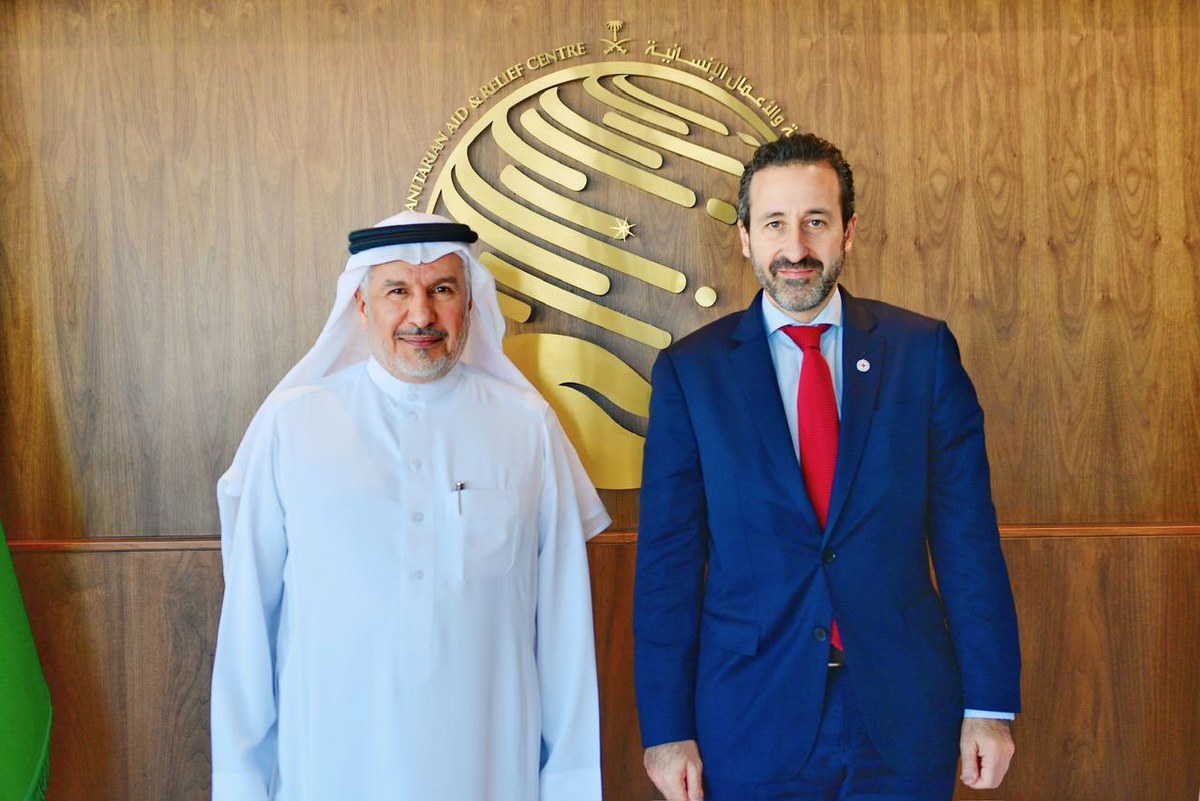
Commenting on his meeting with Dr. Abdullah Al-Rabeeah, KSrelief’s supervisor general, Mardini, right, said: “I expressed also our gratitude at ICRC for the very strong support of the King Salman Center, which has recently contributed through funding for our humanitarian endeavors in the Gaza Strip.” (Supplied)
“Every day, a Palestine Red Crescent volunteer is able to evacuate the severely injured from our hospital to the other. Every day. And we have seen this over the past seven days. The ICRC managed to facilitate the release of hostages in Gaza and Palestinian detainees in Israel to their families in Ramallah.
“These are the laws of war in action. These are the laws of war working.”
Elaborating on the point, he said that when the law of armed conflict works, it “prevents harm from happening in the first place … The laws of war are the ultimate safety net to uphold dignity in war. They should be supported; they should be respected by parties in the conflict.”
Discussing the role of the ICRC in aiding hostage situations, he described the agency as a “neutral intermediary.”
In its role as a neutral intermediary, the ICRC over several days transferred hostages held in Gaza to Israeli authorities and ultimately their families, and transfer Palestinian detainees to authorities in the West Bank, to be reunited with their families.
He said: “I have to hope that the two parties will continue to negotiate for further releases of hostages and Palestinian detainees. And we are certainly ready to renew these types of operations, of course, provided the conditions are acceptable for the safety of hostages and detainees, and our own staff.”
He added: “We need to keep hope alive. I think it’s important civilians, on both sides of this front line, still have hope. And they deserve better conditions than they have today.”


